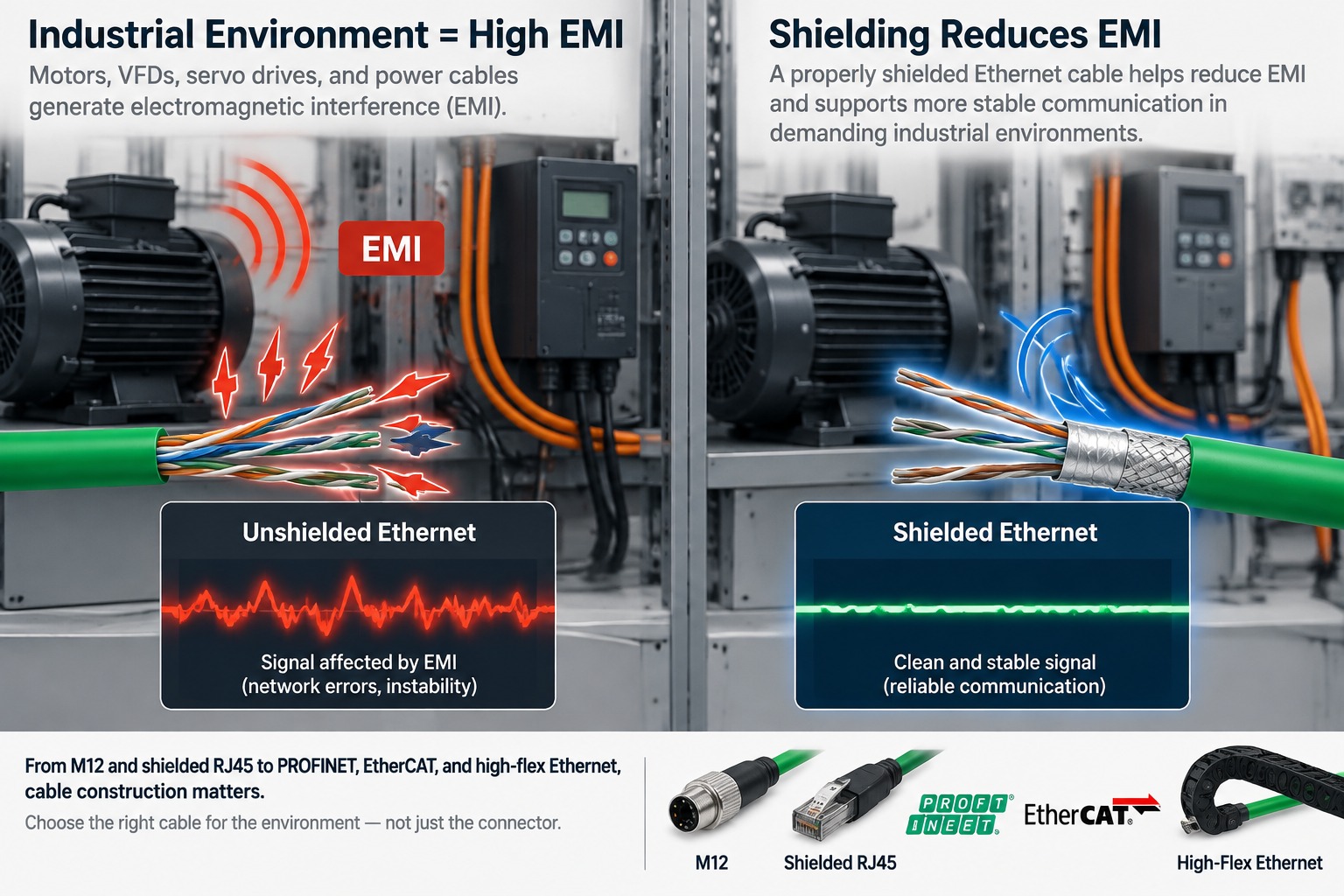
Industrial Ethernet networks are designed to provide fast and reliable communication between machines, controllers, sensors, cameras, and other industrial devices. But unlike a typical office network, industrial Ethernet often operates in environments with motors, inverters, power cables, relays, and other sources of electrical interference.
This is where cable shielding becomes important.
What Is Cable Shielding?
Cable shielding is a conductive layer placed around the signal conductors inside an Ethernet cable. Depending on the cable construction, the shield may use materials such as braided metal, foil, or a combination of both.
The purpose of the shield is to reduce the impact of electromagnetic interference (EMI) on the data transmission.
In a factory environment, Ethernet cables may run close to:
- Motors and motor drives
- Servo systems
- Variable frequency drives (VFDs)
- High-current power cables
- Switching power supplies
- Relays and contactors
- Welding equipment
- Other industrial machinery
These devices can generate electromagnetic noise that may interfere with nearby communication cables.
How Does EMI Affect Industrial Ethernet?
Ethernet transmits data using electrical signals. When unwanted electromagnetic noise couples into the cable, it can affect the quality of the transmitted signal.
Depending on the environment and installation, excessive interference may contribute to:
- Communication errors
- Packet retransmissions
- Intermittent network connections
- Increased latency
- Unstable machine communication
- Unexpected network downtime
These problems can be particularly difficult to diagnose because the network may appear to work normally under some conditions and become unstable when nearby equipment starts operating.
Shielding helps reduce the amount of external interference coupled into the signal conductors.
Why Is Shielding More Important in Industrial Applications?
A typical office network usually has a relatively controlled electromagnetic environment. Industrial networks are different.
Ethernet cables may need to share cable trays or pathways with power wiring and may be installed near equipment that generates significant electromagnetic noise.
For example, a machine may contain both:
Power side
Motor → Servo Drive → Power Cable
and
Communication side
PLC → Ethernet Switch → Industrial Device
If the communication cable is routed through a noisy environment, proper cable construction and installation become important factors in maintaining reliable communication.
This is why shielded Ethernet cables are commonly used in industrial applications.
Shielding Is Not the Same as Grounding
One important point is that having a shielded cable does not automatically mean the shielding system will work correctly.
The cable shield is part of a larger system that includes:
- Connectors
- Equipment interfaces
- Shield termination
- Grounding/bonding
- Cable routing
- Installation practices
A shield that is poorly terminated or incorrectly connected may not provide the expected protection.
For industrial Ethernet, the entire connection should therefore be considered as a system rather than looking at the cable alone.
Common Shielded Industrial Ethernet Cable Types
Different industrial applications use different connector and cable constructions.
M12 Ethernet Cables
M12 connectors are widely used in industrial automation because of their compact and robust design.
Depending on the application, M12 Ethernet connections can be used for systems such as PROFINET, EtherCAT, industrial Gigabit Ethernet, and other industrial communication networks.
Shielded RJ45 Ethernet Cables
Shielded RJ45 connections are also common in industrial control cabinets, switches, machine vision systems, and other Ethernet-based equipment.
They can be suitable when standard RJ45 interfaces are used but additional protection against electromagnetic interference is required.
High-Flex Ethernet Cables
Robotic equipment and automated machinery may require Ethernet cables that repeatedly move through a drag chain.
In these applications, the cable needs to be considered not only for electrical performance but also for mechanical requirements such as flexibility and repeated movement.
Shielding Is Only One Part of Reliable Industrial Ethernet
Choosing a shielded cable is important, but it is not the only factor that affects network reliability.
A reliable industrial Ethernet installation should also consider:
Cable routing: Keep communication cables away from strong sources of electromagnetic interference whenever possible.
Connector selection: The connector should be appropriate for the industrial environment and the required Ethernet interface.
Shield termination: The shield needs to be properly integrated with the connector and equipment grounding/bonding system.
Mechanical requirements: Applications involving vibration, flexing, or drag-chain movement require an appropriate cable construction.
Transmission requirements: Cable category, conductor construction, length, and network speed should match the application requirements.
Conclusion
Industrial Ethernet operates in environments that can be significantly noisier than typical office networks. Motors, drives, power cables, and other industrial equipment can introduce electromagnetic interference that may affect communication reliability.
Shielding helps reduce the impact of this interference, but effective protection depends on more than simply selecting a shielded cable. Cable construction, connectors, shield termination, grounding, routing, and mechanical requirements all need to work together.
For industrial Ethernet applications, selecting the right cable should therefore start with the actual installation environment—not just the connector type.
Need a custom industrial Ethernet cable?
Alvin's Cables supports custom cable configurations for industrial applications, including M12 Ethernet, shielded RJ45, high-flex Ethernet, machine vision, and other industrial connectivity requirements.
Share your connector type, cable length, network requirement, and application environment with our team, and we can help confirm the appropriate cable configuration.