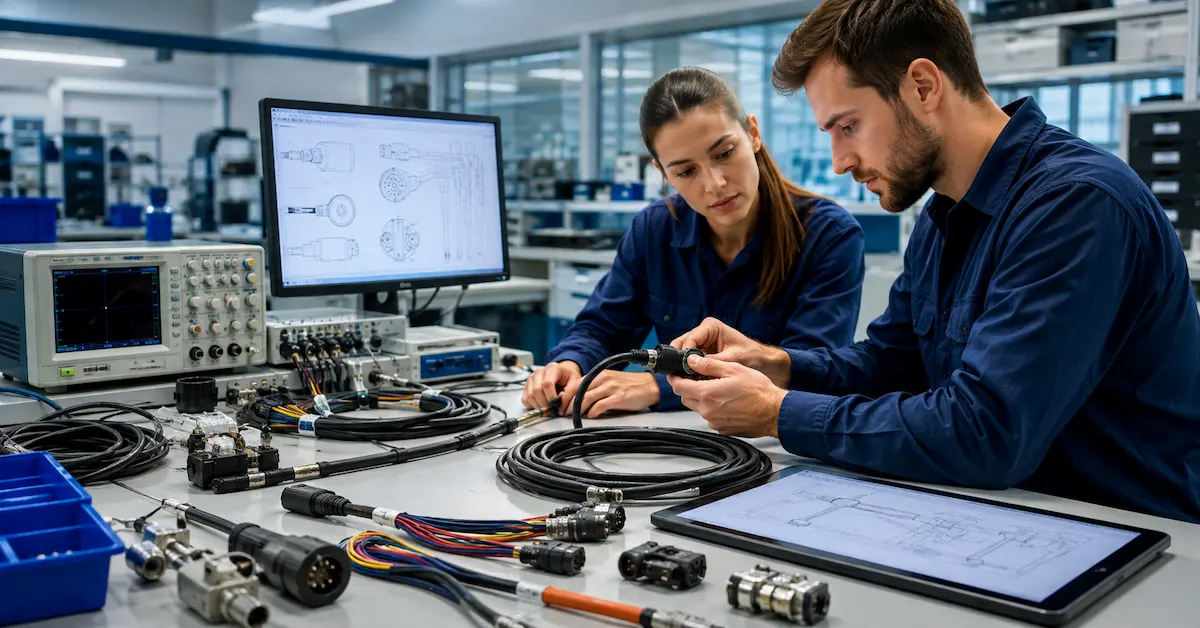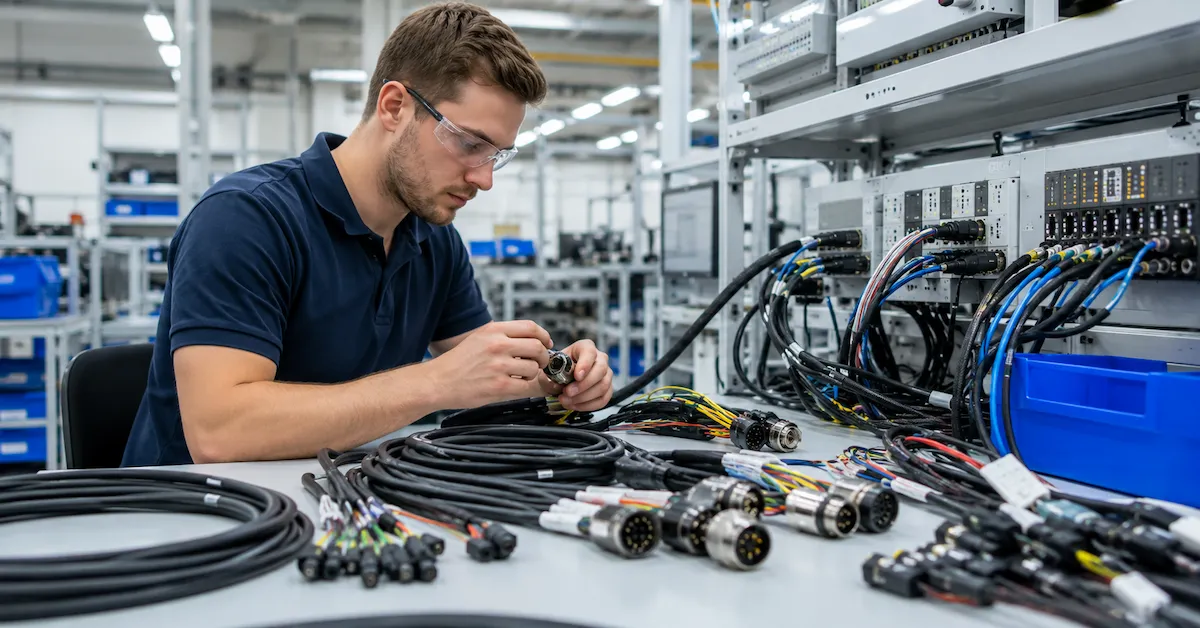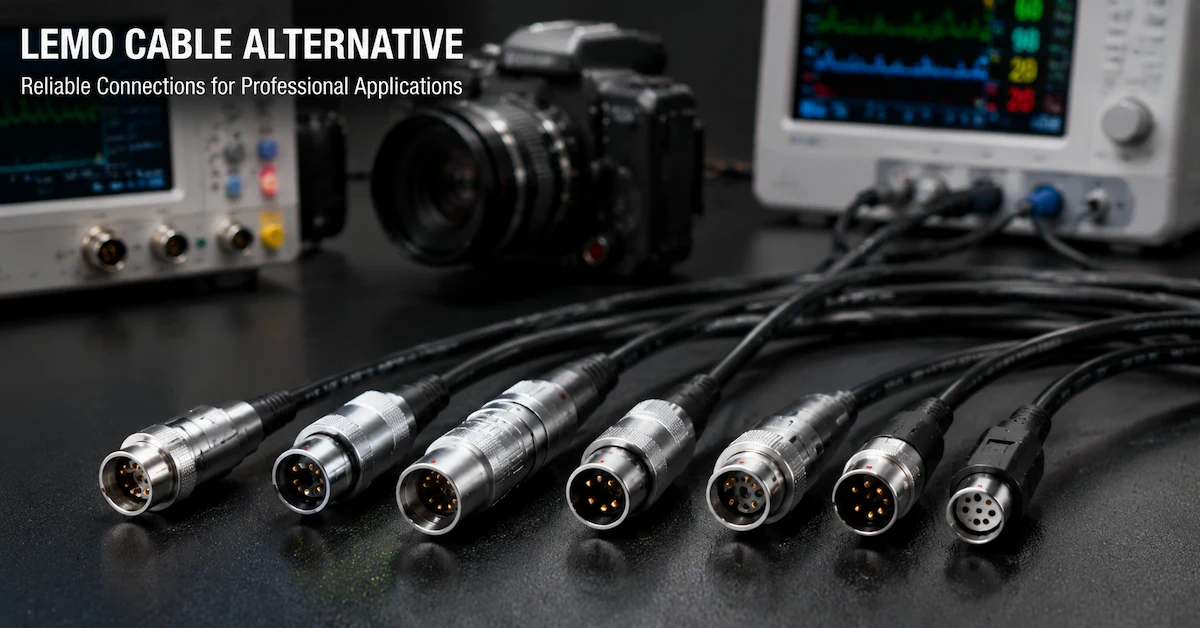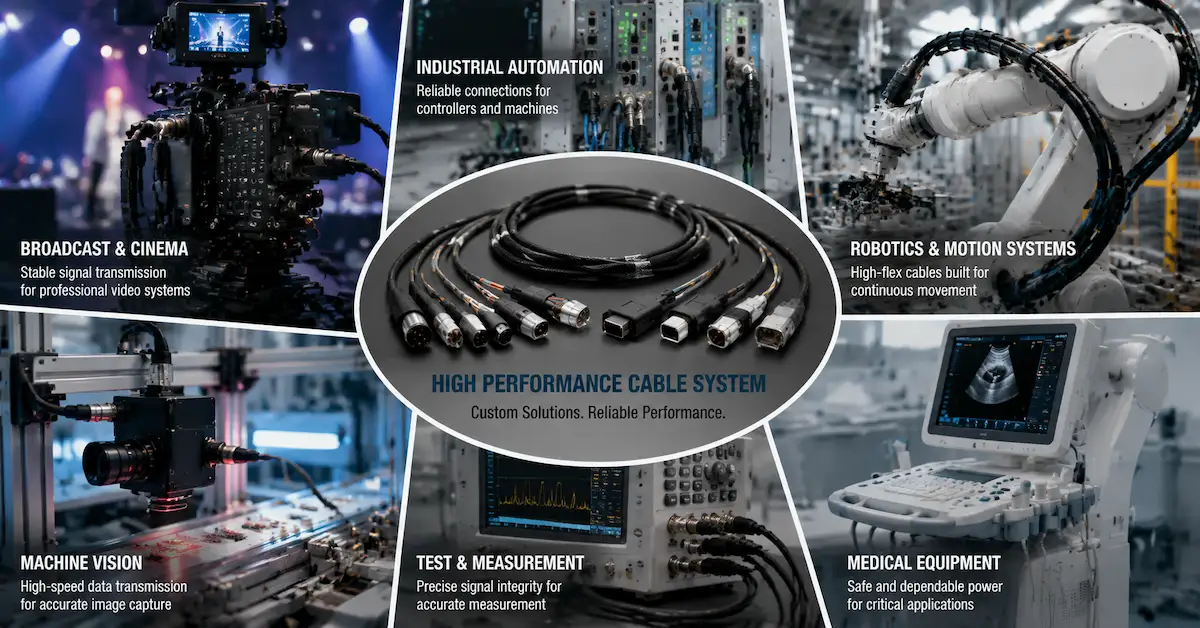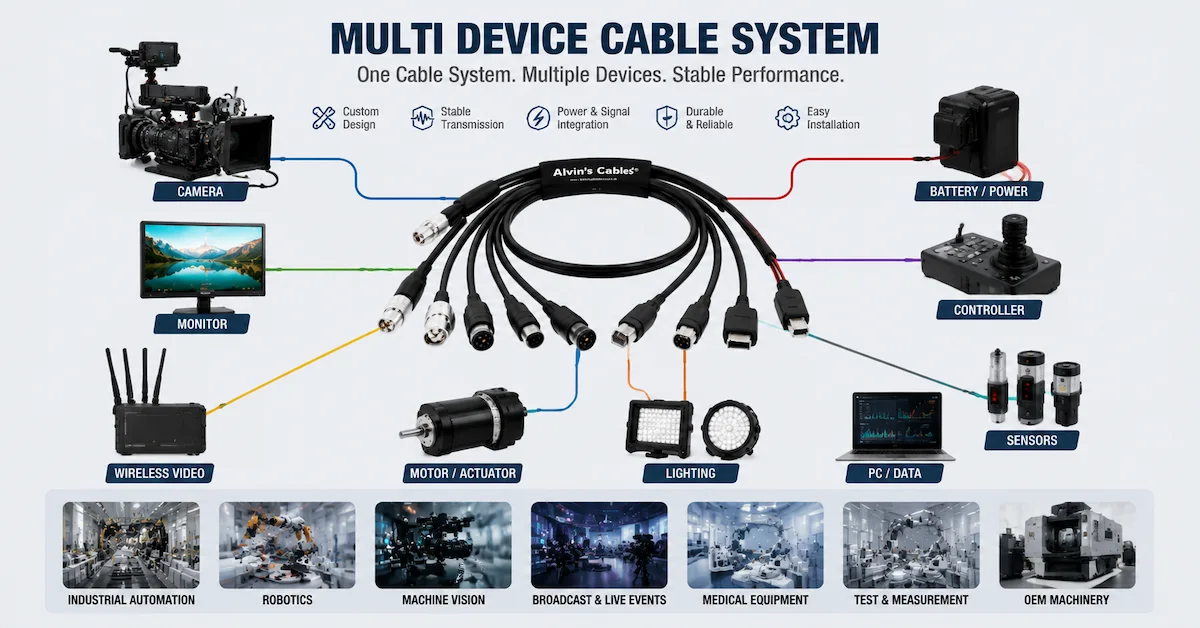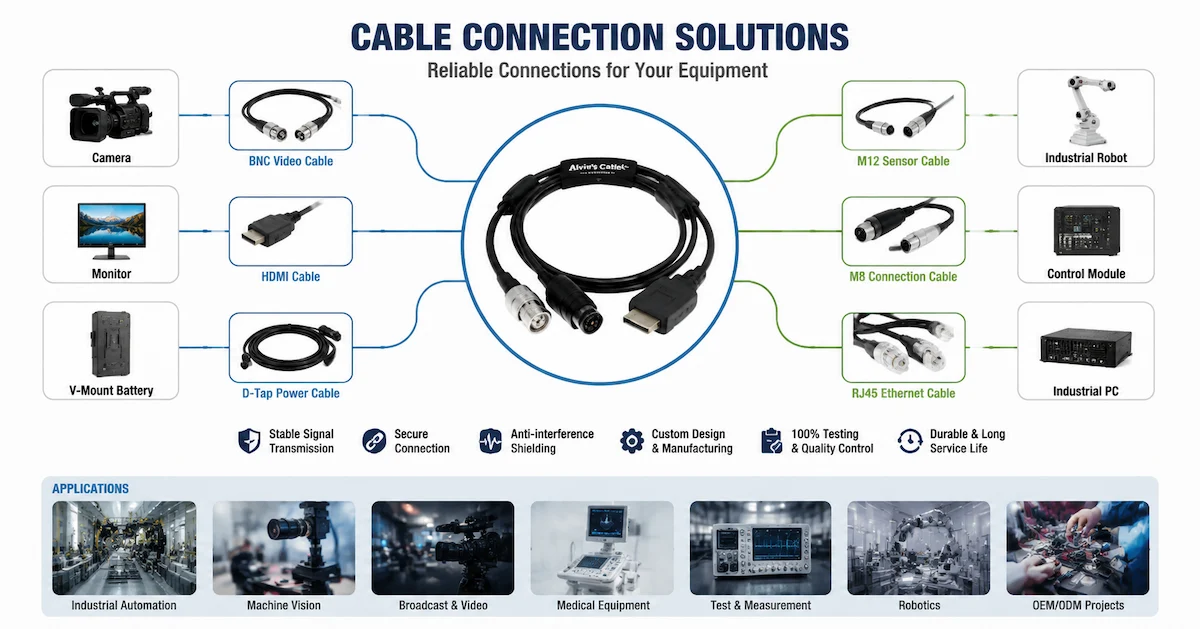
A cable OEM supplier supports equipment manufacturers and product brands that need cable assemblies developed according to their own technical requirements.
Unlike purchasing a standard cable from stock, OEM cable production may involve specific connectors, cable lengths, pinouts, shielding structures, jacket materials, branch layouts, labels, and packaging. The cable must also fit the buyer’s equipment and remain consistent across repeat production orders.
For industrial automation, professional video systems, machine vision, medical equipment, test instruments, robotics, and electronic devices, the right cable OEM supplier can reduce development risks and improve production efficiency.
The supplier should not only manufacture the cable. It should also help convert drawings, samples, and application requirements into a repeatable production solution.
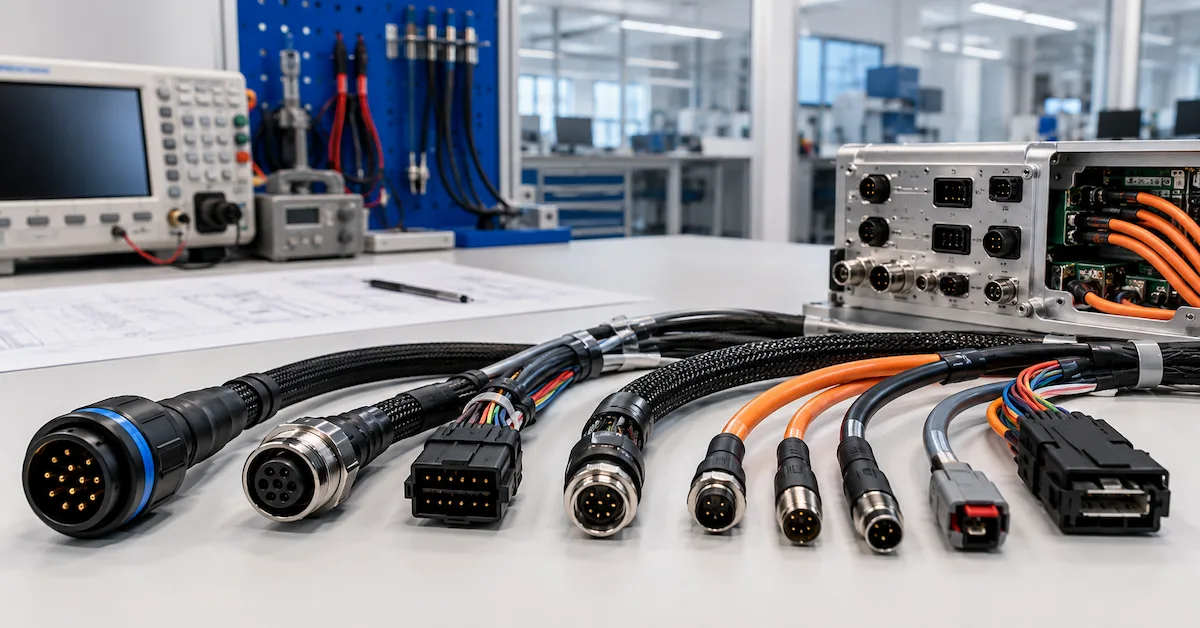
What Does a Cable OEM Supplier Do?
A cable OEM supplier develops and manufactures cable assemblies for another company’s product, equipment, or brand.
OEM support may include:
- Reviewing drawings and wiring diagrams
- Identifying or selecting connectors
- Confirming pin-to-pin wiring
- Selecting suitable cable materials
- Developing prototype samples
- Producing custom labels and packaging
- Performing electrical and functional testing
- Supporting pilot and repeat production
- Managing drawings and specification revisions
The finished cable assembly may be installed inside the buyer’s equipment, supplied as an accessory, or packaged under the buyer’s brand.
Who Needs OEM Cable Assembly Services?
| Buyer Type | OEM Requirement | Main Purchasing Concern |
|---|---|---|
| Equipment manufacturers | Product-specific cable assemblies | Compatibility and repeatability |
| Industrial automation companies | Sensor, control, and power cables | Reliability and interference resistance |
| Machine vision integrators | Camera, trigger, and data cables | Signal integrity |
| Professional video brands | Camera, monitor, and power cables | Connector fit and field durability |
| Medical equipment manufacturers | Device-specific wiring | Accuracy and consistency |
| Robotics companies | Flexible cable assemblies | Movement and service life |
| Test equipment brands | Measurement and signal cables | Stable electrical performance |
| Electronics distributors | Private-label cable products | Packaging and supply stability |
OEM cable services are most valuable when standard products cannot fully match the equipment or commercial requirements.
Cable OEM Supplier vs Standard Cable Supplier
| Supplier Type | Main Capability | Limitation | Best For |
| Retail cable seller | Supplies standard finished cables | Little customization | Replacement cables |
| Cable distributor | Offers multiple brands and products | Limited manufacturing control | Standard components |
| Custom cable supplier | Modifies cable specifications | OEM systems may vary | Small custom projects |
| Cable OEM supplier | Supports design, samples, production, and branding | Requires technical communication | Equipment brands and repeat production |
| Cable manufacturer | Controls production processes | Buyer may need complete specifications | Established cable designs |
A cable OEM supplier is particularly useful when the buyer needs technical development and repeat manufacturing from the same source.
What Can Be Customized in an OEM Cable Assembly?
Connector Selection
OEM cable assemblies may use:
- M8 and M12 connectors
- Hirose connectors
- RJ45 connectors
- BNC connectors
- D-TAP connectors
- XLR connectors
- Push-pull circular connectors
- HDMI or video interfaces
- DC power connectors
- Open-end wiring
- Customer-specified connectors
The connector must be confirmed by model, pin count, contact type, keying, orientation, and mating interface.
Cable Length and Routing
Standard cable lengths may create unnecessary clutter or installation stress. OEM production allows buyers to specify:
- Overall cable length
- Branch length
- Connector exit direction
- Straight or right-angle structure
- Cable routing points
- Label positions
- Installation clearance
Accurate dimensions improve equipment assembly and final product appearance.
Pinout and Electrical Design
A connector that fits mechanically can still be unusable if the wiring is incorrect.
Buyers should define:
- Pin-to-pin wiring
- Positive and negative polarity
- Signal names
- Voltage
- Continuous and peak current
- Grounding
- Shield termination
- Unused pins
The approved pinout should be controlled as part of the production documentation.
Cable Materials
Depending on the application, the cable may require:
- Flexible jacket materials
- Abrasion resistance
- Oil resistance
- Shielded conductors
- Twisted signal pairs
- Suitable wire gauge
- Reinforced outer protection
- High-flex construction
- Environmental sealing
Materials should be selected according to electrical, mechanical, and environmental requirements rather than appearance alone.
Branding and Packaging
OEM buyers may also require:
- Custom product labels
- Heat-shrink identification
- Cable numbering
- Branded packaging
- Barcode labels
- Installation instructions
- Bulk industrial packaging
- Individual retail packaging
These details should be approved before repeat production.
OEM Cable Development Process
A structured OEM process helps prevent misunderstandings and production errors.
| Development Stage | Main Activities | Buyer Deliverables |
| Requirement review | Confirm application, connectors, wiring, and environment | Drawings, photos, specifications, or samples |
| Technical evaluation | Review materials, electrical load, shielding, and routing | Technical clarification |
| Quotation | Calculate materials, labor, testing, and packaging | Estimated quantity and forecast |
| Prototype production | Build initial cable samples | Sample order |
| Sample validation | Test fit, wiring, signal, power, and routing | Approval or revision comments |
| Pilot production | Confirm repeatability in a small production batch | Pilot quantity |
| Mass production | Manufacture according to approved documentation | Purchase order |
| Repeat supply | Maintain specification and production consistency | Forecast and delivery schedule |
Skipping sample validation may result in larger problems during equipment assembly.
How to Evaluate a Cable OEM Supplier
Engineering Support
A professional supplier should be able to understand:
- Electrical requirements
- Connector interfaces
- Cable routing
- Shielding
- Strain relief
- Application environments
- Production constraints
The supplier does not need to redesign the buyer’s complete equipment, but it should identify cable-related risks before production.
Prototype Capability
Prototype production allows the buyer to verify:
- Connector compatibility
- Pinout accuracy
- Cable length
- Connector orientation
- Routing
- Flexibility
- Signal stability
- Power performance
The sample should be tested in the actual equipment whenever possible.
Manufacturing Consistency
A successful sample is only the beginning. The cable OEM supplier must reproduce the approved product consistently.
Buyers should evaluate:
- Material control
- Assembly instructions
- Crimping and soldering processes
- Worker training
- Inspection points
- Production records
- Approved reference samples
- Repeat-order capability
Quality Testing
Depending on the application, OEM cable testing may include:
- Continuity testing
- Short-circuit testing
- Pinout verification
- Polarity testing
- Connector fit inspection
- Dimensional inspection
- Pull or strain-relief inspection
- Functional testing
- Visual inspection
- Packaging verification
Testing requirements should be documented before production.
Drawing and Revision Control
OEM products may change during development. A cable length, connector, label, or pinout can be revised.
A supplier should manage:
- Drawing numbers
- Revision numbers
- Change dates
- Approved samples
- Updated bills of materials
- Old and new product versions
- Customer change approval
Poor revision control can result in obsolete cable versions entering production.
Common Risks in OEM Cable Purchasing
Choosing Only by Unit Price
A lower quotation may use different connectors, cable materials, shielding, testing, or assembly processes.
Buyers should compare the complete specification rather than only the price.
Providing Incomplete Technical Information
A connector photograph alone does not confirm pinout, voltage, current, shielding, or internal cable structure.
Provide drawings, equipment information, or samples whenever possible.
Skipping Application Testing
A cable may pass continuity testing but still be difficult to install or unsuitable for movement, vibration, or interference conditions.
Test samples in the real operating environment.
Allowing Unapproved Material Substitution
Connector or cable substitutions may affect compatibility, performance, appearance, and customer acceptance.
Critical material changes should require buyer approval.
Ignoring Future Demand
A cable may use a connector that is available for prototypes but difficult to source for repeat production.
Discuss expected annual demand and material availability during development.
Information Required for an OEM Cable Quote
To receive a faster and more accurate quotation, prepare:
- Equipment or product application
- Connector models or clear photographs
- Pinout or wiring diagram
- Cable and branch lengths
- Voltage and current requirements
- Signal or data requirements
- Shielding and grounding requirements
- Connector orientation
- Flexibility or movement requirements
- Operating environment
- Prototype and production quantities
- Estimated repeat demand
- Labeling and packaging requirements
- Drawings, specifications, or physical samples
Complete information reduces quotation uncertainty and development time.
Why Choose Alvin’s Cables as Your Cable OEM Supplier?
Alvin’s Cables supports custom cable assemblies and connector solutions for professional video equipment, industrial automation, machine vision, medical devices, test instruments, robotics, and OEM electronics.
OEM cable support can include:
- Drawing- and sample-based development
- Custom cable length and pinout
- Connector integration
- M8, M12, Hirose, RJ45, BNC, D-TAP, XLR, push-pull, and open-end solutions
- Signal, power, video, audio, data, and control cables
- Shielded and flexible cable structures
- Cable harnesses and multi-branch assemblies
- Strain relief and overmolding
- Prototype and sample production
- Low-to-mid-volume and repeat production
- Electrical and functional testing
- OEM labeling and packaging
Buyers can review available cable and connector categories through Alvin’s Cables Products, learn more about manufacturing capability on the About Us page, and review quality and service advantages through Why Choose Alvin’s Cables.
FAQ
1. What is a cable OEM supplier?
A cable OEM supplier develops and manufactures cable assemblies according to another company’s product specifications, drawings, equipment interfaces, and branding requirements.
2. Can an OEM cable be developed from a sample?
Yes. A supplier can evaluate a physical sample, but drawings, pinout information, and electrical requirements should also be provided whenever possible.
3. What cable features can be customized?
Connector type, cable length, pinout, shielding, wire gauge, jacket material, branch structure, strain relief, labels, and packaging can be customized.
4. Why is prototype approval important?
Prototype approval confirms connector fit, wiring, cable routing, flexibility, and electrical performance before larger production orders.
5. Can cable OEM suppliers support private-label packaging?
Yes. Packaging, labels, product codes, and identification can be customized according to the buyer’s requirements.
6. What determines the MOQ for an OEM cable?
MOQ may depend on connector purchasing requirements, cable materials, tooling, overmolding, packaging, and production setup.
7. Can Alvin’s Cables support repeat OEM production?
Yes. Alvin’s Cables supports prototype development, low-to-mid-volume manufacturing, repeat orders, testing, labeling, and packaging.
8. How can I request an OEM cable quotation?
Submit your drawings, connector details, wiring diagram, cable length, application requirements, quantities, and packaging needs through the Contact Us page.
Conclusion
Choosing the right cable OEM supplier helps equipment manufacturers transform technical requirements into reliable, production-ready cable assemblies.
A capable OEM partner should provide engineering communication, sample development, controlled manufacturing, quality testing, revision management, and repeat production support.
For a custom OEM cable assembly, contact Alvin’s Cables and provide your drawings, connector details, pinout, cable length, operating environment, forecast quantity, and packaging requirements.