In industrial automation, cables do more than connect equipment. They must also withstand the mechanical conditions in which they operate.
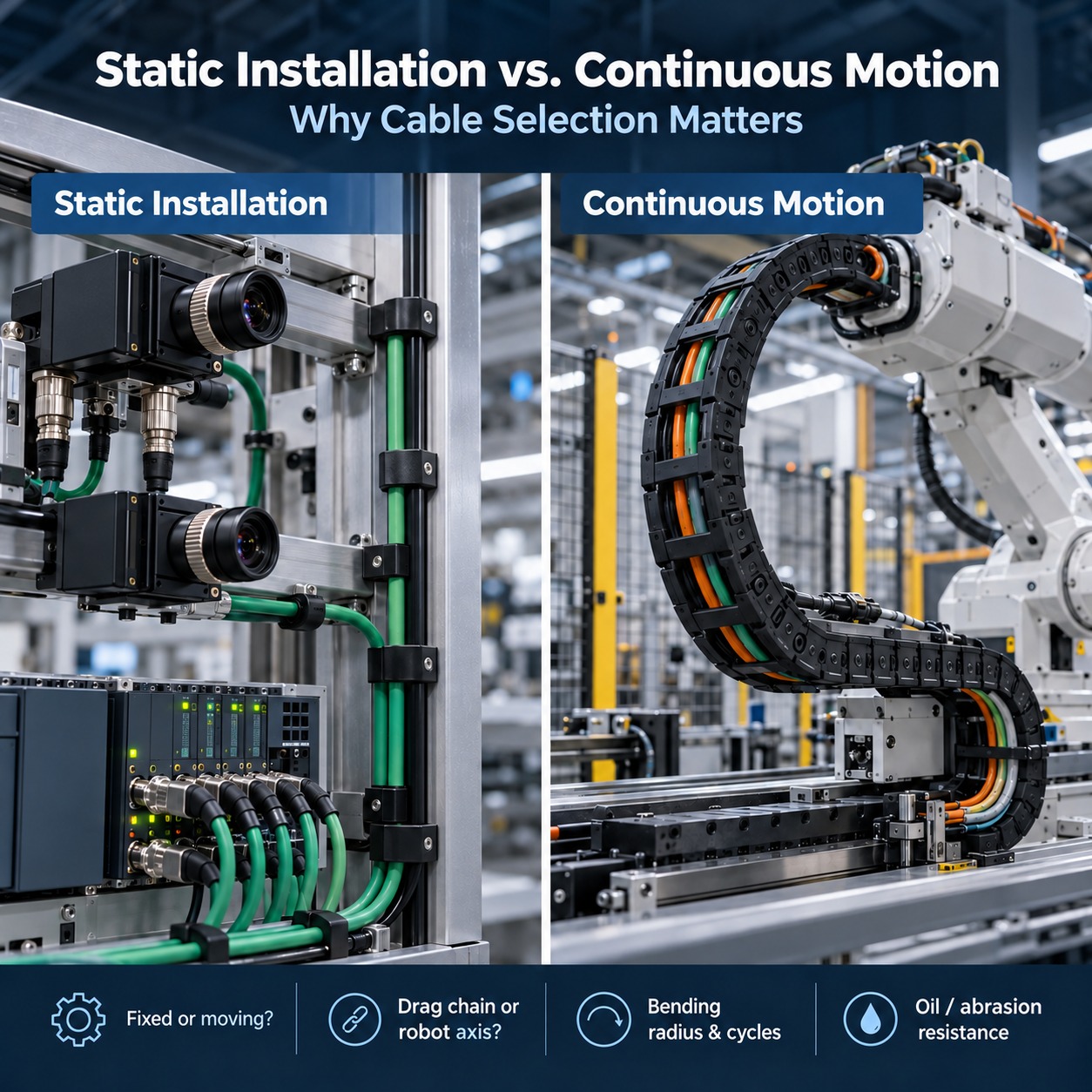
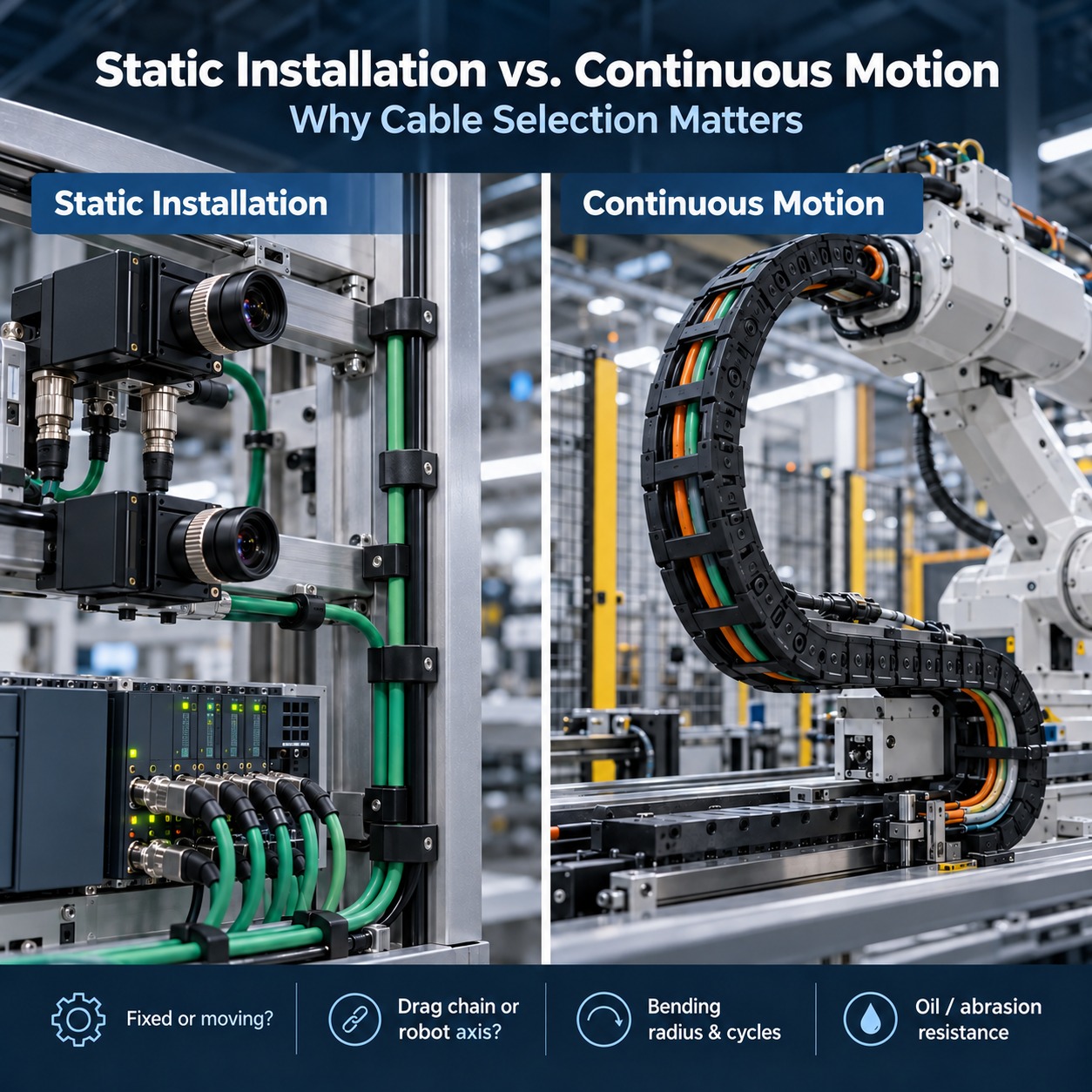
A cable installed inside a control cabinet faces different demands from one that moves repeatedly with a robotic arm, CNC machine, or automated inspection system.
Choosing the wrong cable construction for an application can contribute to premature wear, conductor fatigue, intermittent connections, and unplanned maintenance.
So, what is the difference between static installation cables and cables designed for continuous motion? And what should engineers consider when selecting an industrial cable?
1. What Is a Static Installation Cable?
A static installation cable is intended for applications where the cable remains in a fixed position during normal operation.
Typical examples include:
- Fixed wiring inside control cabinets
- Connections between stationary industrial equipment
- Fixed sensor and controller connections
- Wiring routed through stationary cable trays or conduits
During installation, the cable may need to be bent to fit the required routing. However, this does not mean it is designed to withstand repeated bending throughout the machine's operating life.
For fixed applications, cable selection should consider electrical requirements, conductor size, insulation and jacket materials, temperature range, and the installation environment.
A cable suitable for fixed installation may be an appropriate and economical choice when the application does not involve repeated movement.
2. What Is a Continuous-Flex Cable?
A continuous-flex cable is designed for applications where repeated movement is part of normal operation.
Depending on its construction and specified performance, it may be suitable for applications such as:
- Cable carriers and drag chains
- Moving axes in CNC machinery
- Automated production and inspection equipment
- Selected robotic and motion-control applications
- Moving machine components that require power, control, or data connections
Repeated movement creates mechanical stress within the conductors, insulation, shielding, and outer jacket. Over time, a cable that is not designed for the application's movement profile may experience damage or electrical interruptions.
Continuous-flex cable designs can use fine-stranded conductors and materials or constructions selected for repeated flexing. The exact design depends on the cable type and its intended operating conditions.
Important: A cable described as flexible is not automatically suitable for continuous motion. Its dynamic performance and permitted application must be verified against the manufacturer's specifications.
3. Static vs. Continuous-Flex Cables: Key Differences
| Selection Factor | Static Installation | Continuous Motion |
|---|---|---|
| Typical use | Fixed wiring and stationary connections | Drag chains and moving machine components |
| Mechanical demands | Primarily installation-related bending and fixed service conditions | Repeated bending or movement during operation |
| Conductor construction | Depends on the fixed-installation requirements | May use fine stranding designed for repeated flexing |
| Bending requirements | Installation bend radius and routing requirements | Dynamic bend radius and movement profile |
| Service-life considerations | Temperature, environment, electrical loading, and installation quality | All relevant electrical and environmental factors, plus movement cycles and mechanical stress |
| Application verification | Confirm suitability for fixed installation | Confirm suitability for the specific type of movement |
These are general selection principles, not universal specifications. Cable designs vary, so the product datasheet should always take precedence over assumptions based on a cable's appearance or name.
4. Why Does Cable Selection Matter in Industrial Automation?
Preventing Premature Cable Wear
A cable routed through a drag chain may bend and straighten repeatedly throughout every production cycle.
If its construction is unsuitable for that movement, mechanical fatigue can shorten its service life. Selecting a cable designed for the intended motion helps address this risk.
Maintaining Reliable Electrical Connections
Industrial cables may carry power, control signals, sensor signals, or high-speed data.
Mechanical damage can affect more than the cable's outer appearance. Depending on the failure mode, it may lead to intermittent signals, communication errors, or loss of electrical continuity.
For machine vision and industrial networking, cable construction and installation are therefore important parts of the overall connection design.
Supporting Equipment Maintenance
Replacing a cable routed through a moving machine assembly may require more than simply unplugging and reconnecting it.
Depending on the installation, maintenance may involve accessing cable carriers, removing protective covers, rerouting the cable, or checking the connection afterward.
Selecting a cable appropriate for the operating environment can help reduce avoidable cable-related maintenance.
It cannot, however, eliminate every possible cause of downtime.
5. Five Factors to Check Before Choosing an Industrial Cable
1. Type of Movement
First, identify how the cable will move.
Will it remain fixed after installation? Will it flex repeatedly inside a drag chain? Does it move with a robotic axis or experience torsion?
Bending, torsion, and other motion profiles create different mechanical demands. A cable suitable for one type of movement may not be suitable for another.
2. Dynamic Bend Radius
The bend radius is a critical installation and operating parameter.
A cable's permitted bend radius during installation may differ from the minimum radius allowed during repeated movement. Always check the manufacturer's specifications for the intended operating condition.
Avoid forcing a cable into a tighter bend simply because the connector fits.
3. Movement Speed and Cycle Requirements
A cable moving slowly through a controlled cable carrier may face different demands from one operating at high speed over frequent machine cycles.
Where applicable, review the rated flex life, travel distance, acceleration, and operating conditions specified for the cable.
Do not assume that every high-flex cable has the same cycle-life rating.
4. Operating Environment
Consider whether the cable will be exposed to:
- Oil or industrial fluids
- Abrasion or mechanical contact
- Temperature variations
- Moisture or washdown
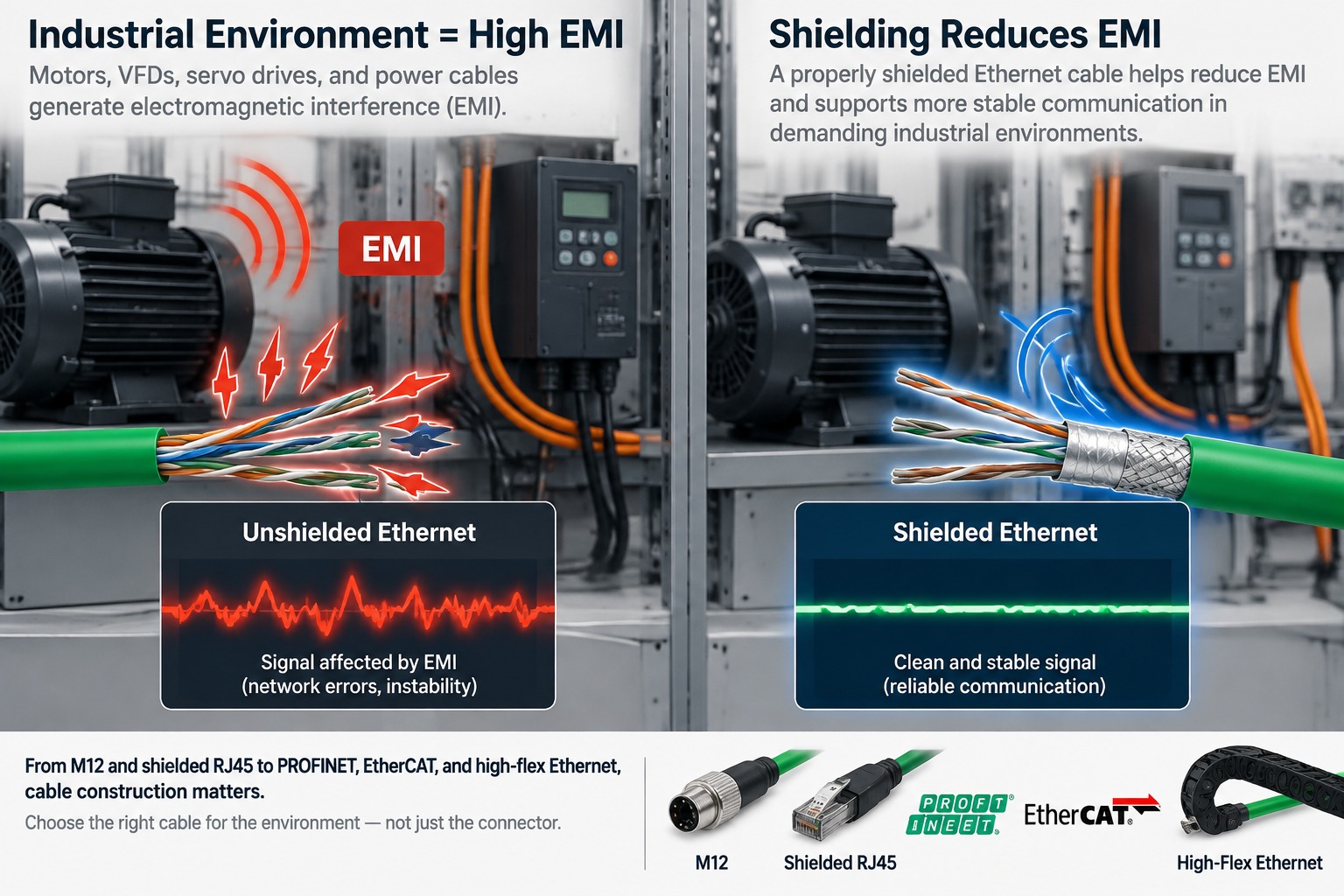
- Electromagnetic interference
- Dust and other environmental contaminants
Jacket material, shielding, connector protection, and overall construction should be selected according to the actual environment and verified specifications.
5. Electrical and Connector Requirements
Mechanical suitability is only one part of the selection process.
Confirm the required connector type, pin assignment, conductor size, voltage and current requirements, and data-transmission specifications.
For industrial Ethernet and machine vision applications, also verify the relevant data requirements and connector compatibility. A mechanically suitable cable is not necessarily electrically compatible with the equipment.
6. How This Applies to M12 and Industrial Ethernet Cables
Industrial automation systems commonly use M12 connectors and industrial Ethernet connections to link cameras, sensors, controllers, and other equipment.
However, choosing the connector is only the beginning.
For a stationary sensor connection, a cable specified for fixed installation may be appropriate. For a camera or network connection routed through a moving cable carrier, a cable explicitly designed and rated for that dynamic application may be required.
For example, Alvin's Cables offers industrial cable assemblies including:
- M12 industrial cable assemblies for compatible sensors, automation equipment, and industrial connections.
- M12-to-RJ45 Ethernet cables for suitable industrial networking applications.
- M12 X-Code Cat6A cables for compatible high-speed industrial Ethernet and machine vision systems.
- High-flex industrial camera and I/O cables for specified automation applications.
Explore relevant product options:
- M12 A-Code to RJ45 Industrial Ethernet Cable
- M12 X-Code Cat6A Industrial Ethernet Cable
- M12 A-Code 12-Pin Power and I/O Cable
Always verify the connector coding, pinout, electrical requirements, cable performance, and compatibility with your specific equipment before ordering.
7. When Should You Consider a Custom Cable Assembly?
Standard cable assemblies may not meet every equipment requirement.
A custom solution may be worth evaluating when you need:
- A specific cable length or connector orientation
- A combination of connectors that is not available as a standard product
- An open-wire or terminal connection for equipment integration
- A cable assembly configured for a particular installation environment
- A compatible cable construction for a defined motion profile
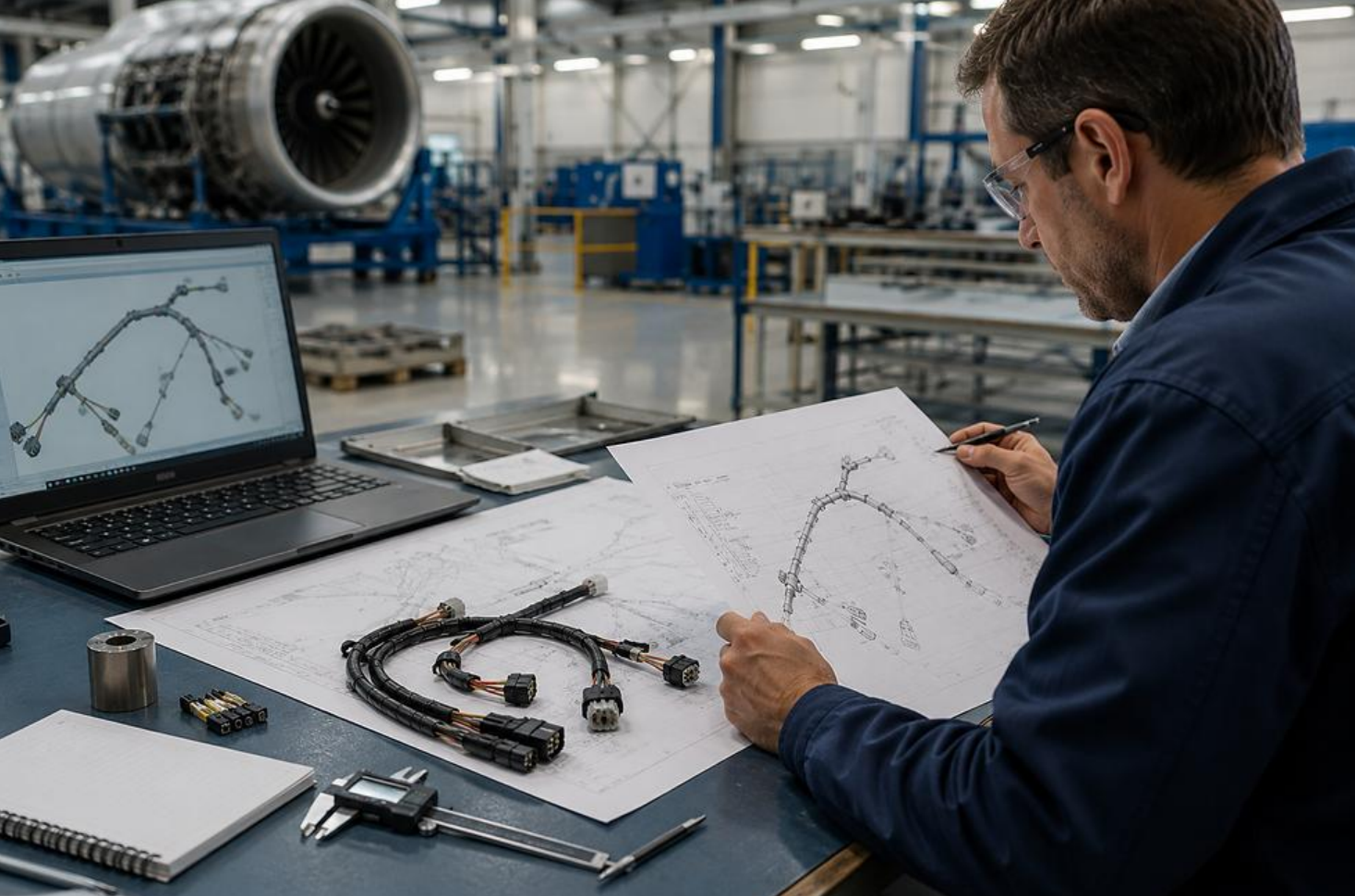
For a useful engineering review, prepare the equipment model, connector details, pinout or wiring diagram, required length, operating environment, and movement conditions.
These details help the engineering team evaluate whether the proposed cable configuration is feasible.
Conclusion: Choose the Cable for the Way It Operates
The difference between static installation and continuous motion is not simply whether a cable feels flexible.
It is whether the cable's construction and documented performance are appropriate for the mechanical, electrical, and environmental conditions of the application.
For fixed installations, focus on the requirements of the stationary connection. For drag chains, moving axes, and other dynamic applications, verify that the cable is designed for the specific movement profile.
At Alvin's Cables, we provide industrial cable assemblies and support custom cable inquiries for automation, machine vision, and specialized equipment applications.
Need help identifying a suitable cable for your equipment? Share your connector specifications, pinout, cable length, and application details with our team to discuss the available options.