A drone cable solution is not just a small accessory inside a UAV. It directly affects power stability, signal integrity, payload performance, flight safety, and long-term maintenance cost.
For drone manufacturers, inspection drone companies, camera payload integrators, and robotics solution providers, cable failure can lead to unstable video transmission, gimbal interruption, voltage drop, sensor error, or unexpected downtime. This is why UAV cable assemblies must be designed around real operating conditions, not only connector matching.
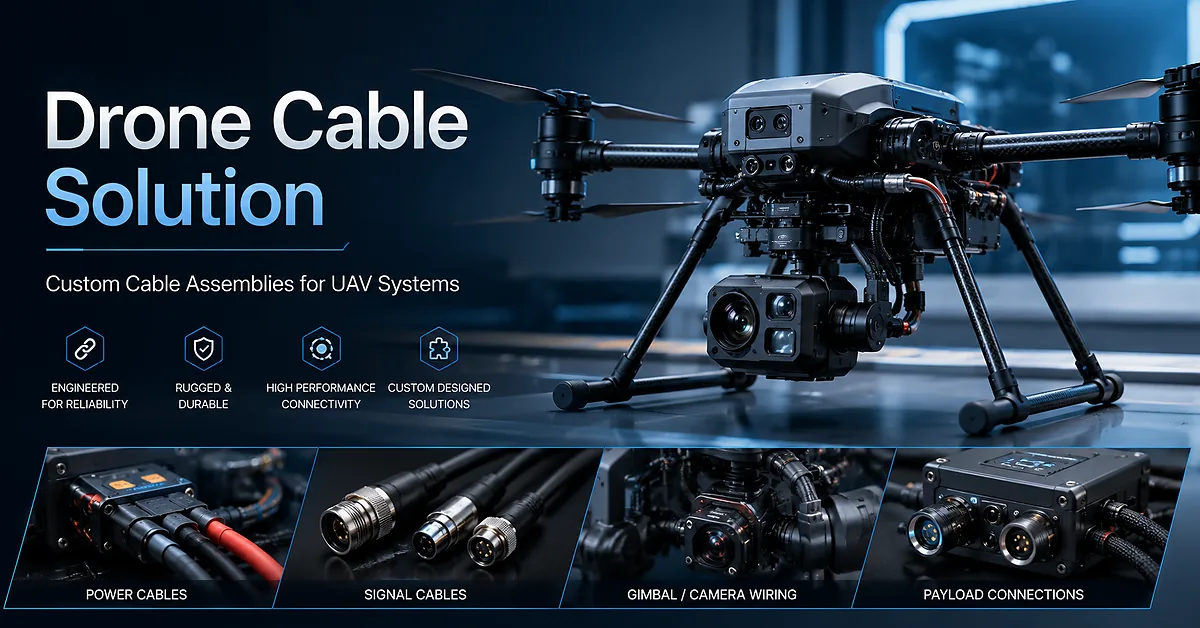
At Alvin’s Cables, cable assemblies and connector solutions are developed for industrial equipment, automation systems, professional imaging, and high-reliability electronic applications. For drone-related projects, this experience can support custom power cables, signal cables, camera cables, gimbal cables, and payload cable assemblies.
Quick Answer: What Is a Drone Cable Solution?
A drone cable solution is a customized cable and connector assembly used to connect key UAV modules such as batteries, flight controllers, cameras, gimbals, sensors, communication units, and payload systems. A good solution should provide stable power transmission, low-interference signal transfer, compact routing, vibration resistance, and reliable connector retention.
For B2B buyers, the best drone cable solution is usually not a single standard cable. It is a project-based assembly designed according to connector type, pinout, cable length, signal type, voltage/current load, bending space, shielding requirements, and environmental conditions.
Who Needs Custom Drone Cable Assemblies?
Custom UAV cable assemblies are suitable for:
- Drone manufacturers developing new UAV platforms
- Payload integrators connecting cameras, LiDAR, sensors, or thermal modules
- Industrial inspection drone companies
- Agricultural drone equipment suppliers
- Defense-adjacent rugged electronics integrators
- Film production drone teams using camera and monitor systems
- Robotics companies building aerial inspection or mapping platforms
- OEM electronics brands requiring batch-stable cable assemblies
This type of product is usually not for buyers who only need consumer replacement cables. It is more suitable for engineering-driven projects where connector compatibility, cable routing, electrical performance, and durability must be confirmed before bulk production.
Common Drone Cable Applications
Drone systems often use multiple cable types in one compact platform. Each cable has a different function and risk point.
| Application Area | Cable Function | Common Buyer Concern |
|---|---|---|
| Battery to power distribution | Power transmission | Voltage drop, heat, connector looseness |
| Camera module | Video, power, or control signal | Signal loss, EMI, compact routing |
| Gimbal system | Power and control connection | Flexibility, repeated movement, strain relief |
| Flight controller | Sensor and communication wiring | Stable signal, correct pinout |
| Payload module | LiDAR, thermal camera, mapping sensor | Custom connector, rugged structure |
| Ground station or test system | Data and control link | Reliable mating, fast maintenance |
A proper drone cable solution should match the full system design instead of only replacing one connector.
Key Technical Requirements for Drone Cable Solutions
1. Lightweight Structure
Weight is critical in UAV design. A cable that is too heavy can reduce flight time and make internal routing difficult. However, reducing weight should not sacrifice conductor quality, shielding, or connector stability.
The goal is to balance:
- Cable diameter
- Conductor size
- Jacket thickness
- Shielding structure
- Connector shell material
- Mechanical reinforcement
For drone OEM projects, Alvin’s Cables can support custom cable length and connector integration based on customer drawings, specifications, or samples. Buyers can share routing space, connector position, and module layout before confirming the final assembly.
2. Stable Power Transmission
Drone batteries, gimbals, cameras, and payloads require stable voltage and current delivery. Poor cable design may cause voltage drop, overheating, or intermittent power interruption.
When choosing a drone power cable, buyers should confirm:
- Rated voltage and current
- Wire gauge
- Connector current rating
- Contact resistance
- Cable length
- Operating temperature
- Heat generation under load
For high-current power cables, the design should avoid undersized conductors or weak connector contact. A low-quality cable may pass a simple continuity test but fail during real flight conditions.
3. Signal Integrity and Shielding
Modern drones often carry cameras, sensors, communication modules, GPS units, and control systems. These components can be sensitive to electromagnetic interference.
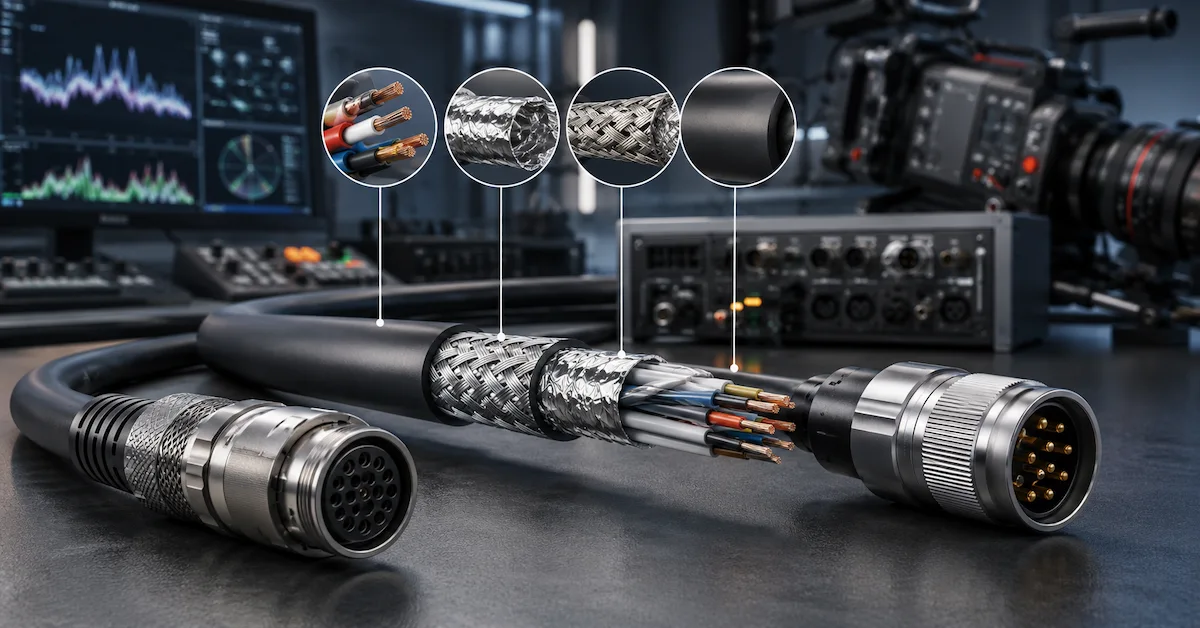
A reliable drone cable solution may require:
- Foil shielding
- Braided shielding
- Twisted pair structure
- Grounding design
- Shielded connector interface
- EMI/RFI resistance
This is especially important for camera payloads, industrial inspection drones, mapping drones, and UAVs operating near motors, ESCs, or high-current power lines.
4. High Flexibility for Gimbal and Moving Modules
Gimbal cables and camera cables must support repeated movement. A stiff cable can restrict motion, create mechanical stress, or damage the connector over time.
For gimbal and camera applications, buyers should consider:
- Soft cable jacket
- Small bending radius
- Strain relief design
- Flexible conductor structure
- Lightweight connector design
- Cable routing clearance
Alvin’s Cables has experience with professional video and camera cable solutions, which is useful for UAV camera payloads and aerial filming systems. Buyers can explore related product categories through Alvin’s Cables products.
5. Vibration Resistance
Drones experience vibration from motors, propellers, landing impact, and payload movement. Loose connectors may cause signal interruption or power failure.
To reduce this risk, a drone cable assembly may need:
- Locking connectors
- Threaded circular connectors
- Secure mating design
- Overmolded strain relief
- Mechanical reinforcement
- Proper cable clamping
For industrial and outdoor UAV projects, connector retention is often more important than appearance. A clean-looking cable that disconnects under vibration is not suitable for professional drone systems.
Common Connector Options for Drone Cable Projects
Different drone designs require different connector types. There is no single connector suitable for every UAV.
| Connector Type | Typical Use | Advantage | Best For |
| M8 connector | Compact signal connection | Small size, industrial reliability | Sensors, compact modules |
| M12 connector | Signal, power, industrial Ethernet | Rugged, stable mating | Industrial UAV payloads |
| Hirose connector | Camera and precision electronics | Compact multi-pin design | Camera, control, imaging modules |
| RJ45 / industrial Ethernet | Data transmission | Fast and familiar network connection | Ground station, test equipment, payload data |
| D-TAP | Power connection | Common in camera systems | Aerial filming setups |
| BNC | Video or signal connection | Stable signal interface | Testing or video-related systems |
| Custom open-end cable | Integration into PCB or module | Flexible engineering design | OEM drone assembly |
If the drone cable solution is used inside a compact UAV body, cable length, exit angle, connector orientation, and overmold shape should be confirmed before mass production.
How to Choose the Right Drone Cable Solution
Step 1: Define the Application
Start by identifying where the cable will be used:
- Battery power
- Camera payload
- Gimbal system
- Sensor connection
- Flight controller
- Communication module
- Testing or charging equipment
The application determines the electrical and mechanical design.
Step 2: Confirm Electrical Requirements
Buyers should provide voltage, current, signal type, data rate, pinout, and grounding requirements. For signal cables, shielding and impedance may also need to be reviewed.
Step 3: Confirm Connector Type
Connector selection should be based on module compatibility, mating cycles, vibration resistance, size limitation, and environmental requirements.
A connector that works on a test bench may not perform well inside a vibrating drone platform.
Step 4: Confirm Cable Length and Routing
Cable length should be long enough for installation but not so long that it creates unnecessary weight, resistance, or clutter.
For UAV projects, short and accurate cable routing is often better than using standard long cables.
Step 5: Check Flexibility and Strain Relief
For moving modules such as gimbals, the cable must bend smoothly without pulling the connector. Strain relief design helps protect solder joints and contact points.
Step 6: Validate Samples Before Bulk Orders
Before volume production, buyers should test samples in real assembly conditions. Important checks include:
- Connector fit
- Cable routing
- Power stability
- Signal stability
- Bending performance
- Vibration resistance
- Heat generation
- Installation convenience
Drone Cable Solution Specification Table
| Item | Recommended Consideration |
| Product Type | Custom drone cable assembly |
| Applications | UAV, drone camera, gimbal, payload, sensor, controller |
| Cable Type | Power cable, signal cable, data cable, camera cable, hybrid cable |
| Connector Options | M8, M12, Hirose, RJ45, BNC, D-TAP, open-end, custom connector |
| Cable Jacket | Flexible PVC, PUR, or project-specific material |
| Shielding | Optional foil, braid, or double shielding |
| Structure | Straight, right-angle, panel mount, open-end, overmolded |
| Custom Options | Pinout, length, connector orientation, labeling, packaging |
| Key Requirements | Lightweight, flexible, vibration-resistant, stable transmission |
| Testing | Continuity, short-circuit, functional, visual, and fit inspection |
Comparison: Standard Cable vs Custom Drone Cable Solution
| Option | Advantages | Limitations | Best For |
| Standard cable | Fast purchase, lower initial cost | May not fit UAV routing or pinout | Basic testing or simple replacement |
| Modified cable | Faster than full custom design | Limited structure optimization | Small adjustment projects |
| Custom drone cable solution | Better fit, stable performance, optimized length | Requires drawing/spec confirmation | OEM drone platforms and payload systems |
| Overmolded custom cable | Stronger strain relief and cleaner integration | Higher tooling or setup requirements | Batch production and rugged systems |
For B2B buyers, a custom drone cable solution usually provides better long-term value when the project requires stable supply, repeatable quality, and engineering compatibility.
Common Buyer Mistakes
Mistake 1: Choosing by Connector Shape Only
Two connectors may look similar but have different pinouts, coding, locking structures, or electrical ratings. Always confirm the full specification.
Mistake 2: Ignoring Cable Flexibility
A cable that works in a fixed system may fail in a drone gimbal or moving camera module. Flexibility and bending radius should be checked early.
Mistake 3: Using Unshielded Cables Near Motors
Motors, ESCs, and power lines can create interference. Sensitive signal cables should be routed carefully and may require shielding.
Mistake 4: Making Cables Too Long
Long cables add weight, increase clutter, and may affect power or signal performance. For drones, accurate length control is important.
Mistake 5: Skipping Sample Validation
A cable should be tested in the real drone structure before bulk purchase. Fit, routing, vibration, and connector retention cannot be fully judged from drawings alone.
OEM and Customization Support
Alvin’s Cables can support drone-related projects where standard cables are not enough. Buyers can provide drawings, samples, connector models, pin definitions, or application requirements.
Custom options may include:
- Custom cable length
- Custom pinout
- M8, M12, Hirose, RJ45, BNC, D-TAP, or open-end connectors
- Straight or right-angle connector design
- Shielded cable structure
- Flexible jacket selection
- Overmolded strain relief
- Labeling and packaging
- Prototype and low-to-mid volume production
To understand more about the company’s engineering and manufacturing background, buyers can visit About Alvin’s Cables. For quality, manufacturing, and solution advantages, visit Why Choose Alvin’s Cables.
What Information Should Buyers Provide for a Quote?
To get a faster and more accurate quotation, prepare the following details:
- Drone model or application description
- Connector type and part number
- Pinout or wiring diagram
- Cable length
- Voltage and current requirements
- Signal or data type
- Shielding requirements
- Cable flexibility requirements
- Quantity and expected production schedule
- Drawing, photo, sample, or specification file
If the project is still in development, the buyer can also provide available module information and installation space. The Alvin’s Cables team can help evaluate the cable assembly direction before production.
Why Alvin’s Cables for Drone Cable Solution Projects?
Drone systems require cables that are compact, stable, flexible, and reliable under vibration. Alvin’s Cables is suitable for buyers who need more than standard off-the-shelf cables.
Key advantages include:
- Cable assembly and connector solution experience
- Support for industrial, automation, medical, imaging, and OEM electronic applications
- Custom cable and connector integration
- Prototype to volume production support
- Overmolding and mechanical reinforcement options
- Multi-stage inspection and functional testing
- Product categories covering M12, M8, Hirose, RJ45, BNC, D-TAP, and more
For drone OEMs and payload integrators, the value of a good drone cable solution is not only lower failure risk. It also improves assembly efficiency, reduces field maintenance, and helps create a more stable product experience.
FAQ: Drone Cable Solution
1. What is the most important factor in a drone cable solution?
The most important factor is application fit. The cable must match the electrical requirements, connector type, pinout, routing space, flexibility, and vibration environment of the drone system.
2. Can Alvin’s Cables make custom drone cable assemblies?
Yes. Alvin’s Cables supports custom cable assembly projects based on drawings, specifications, connector models, samples, or application requirements.
3. What connectors are commonly used in drone cable assemblies?
Common options include M8, M12, Hirose, RJ45, BNC, D-TAP, open-end wiring, and custom connector combinations depending on the drone module and payload system.
Conclusion
A drone cable solution should be designed around the real UAV system, not selected only by connector appearance. Power stability, signal integrity, shielding, flexibility, cable length, vibration resistance, and strain relief all affect the final performance of a drone platform.
For drone manufacturers, payload integrators, inspection drone companies, and professional imaging teams, custom cable assemblies can reduce system risk and improve long-term reliability.
If you need a custom drone cable solution for UAV power, camera, gimbal, sensor, or payload systems, contact Alvin’s Cables through the Contact Us page and share your connector type, pinout, cable length, application environment, and order quantity.