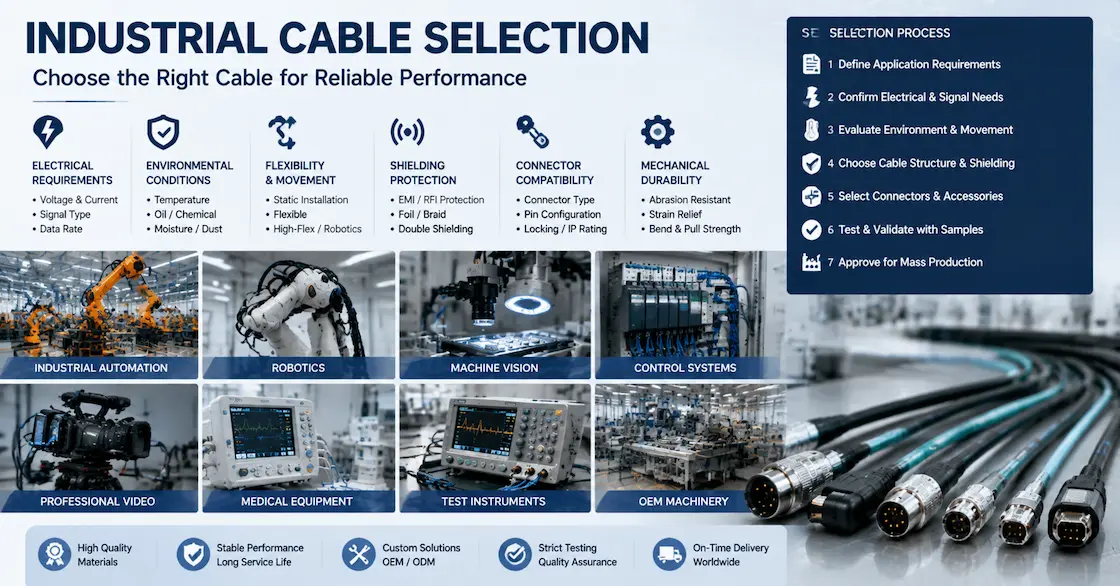
Choosing an industrial cable involves more than matching two connectors. Different industrial cable types are designed for different electrical loads, signal requirements, movement patterns, installation spaces, and environmental conditions.
A cable that performs reliably inside a fixed control cabinet may fail quickly when installed on a robotic arm. A highly flexible cable may be unnecessary for a stationary sensor. A heavily shielded cable may protect sensitive data but increase cable diameter and reduce routing flexibility.
This industrial cable comparison helps B2B buyers understand the main differences between standard industrial cables, shielded cables, high-flex cables, rugged cable assemblies, hybrid cables, and custom cable harnesses.
The correct choice should balance performance, durability, installation efficiency, production consistency, and total ownership cost.
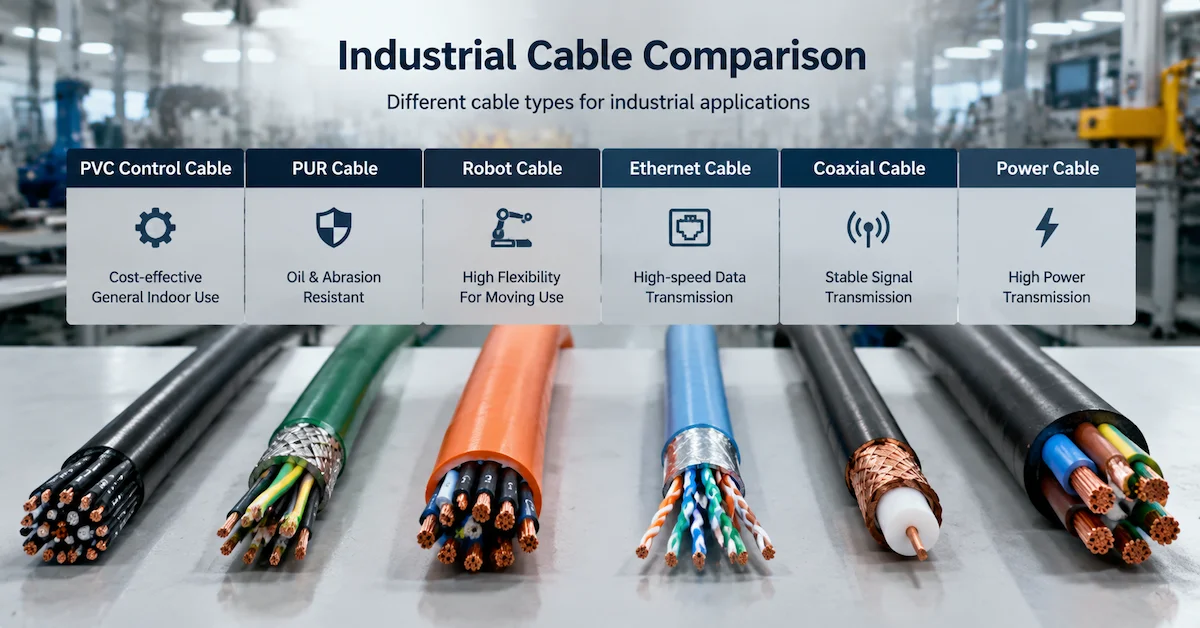
Quick Industrial Cable Comparison
| Cable Type | Main Strength | Main Limitation | Typical Application |
|---|---|---|---|
| Standard industrial cable | Cost-effective fixed connection | Limited movement resistance | Control cabinets and fixed machinery |
| Shielded industrial cable | EMI and signal protection | Larger diameter and higher cost | Sensors, cameras, and communication systems |
| Flexible cable | Easier routing in compact spaces | Not always suitable for continuous movement | Equipment panels and portable devices |
| High-flex cable | Repeated bending performance | Higher material and design requirements | Robotics and drag chains |
| Rugged industrial cable | Mechanical and environmental protection | May be heavier or less flexible | Outdoor and harsh industrial equipment |
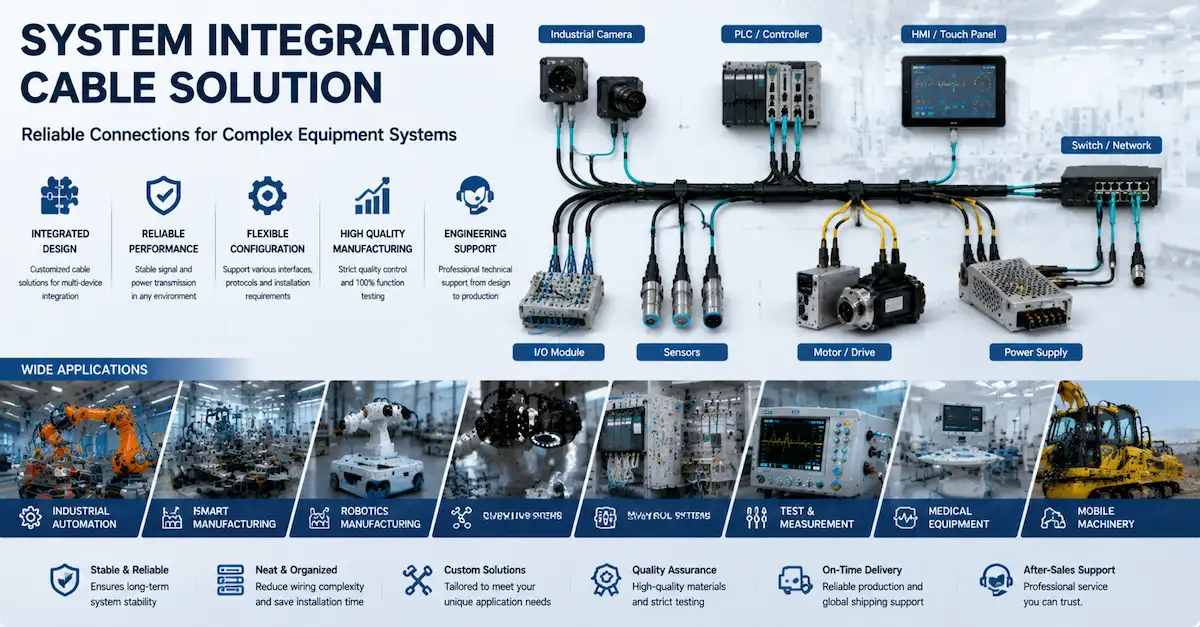
| Hybrid cable | Combines power, signal, or data | More complex design and testing | Cameras, robotics, and integrated equipment |
| Custom cable harness | Organized multi-device integration | Requires drawings and engineering review | OEM machinery and complex systems |
No single industrial cable type is best for every project. Buyers should select a solution according to the actual equipment and operating conditions.
What Should Buyers Compare?
A useful industrial cable comparison should evaluate both electrical and mechanical requirements.
Important factors include:
- Voltage and current
- Signal type
- Data transmission requirement
- Cable length
- Connector compatibility
- Shielding
- Flexibility
- Bending frequency
- Temperature range
- Moisture and oil exposure
- Vibration
- Installation space
- Required service life
- Production quantity
These factors should be confirmed before requesting samples or quotations.
Standard Industrial Cable
A standard industrial cable is generally suitable for stationary or low-movement applications where environmental conditions are controlled.
Typical applications include:
- Control cabinets
- Fixed sensors
- Stationary machinery
- Internal equipment wiring
- Basic power connections
Advantages
- Lower initial cost
- Easy material sourcing
- Simple production
- Suitable for common industrial connections
- Practical for fixed installation
Limitations
- Limited repeated-bending resistance
- Basic environmental protection
- May not provide sufficient EMI shielding
- Standard lengths and connectors may not fit every machine
A standard cable can be a cost-effective choice when movement and interference risks are low.
Shielded Industrial Cable
A shielded industrial cable includes metallic shielding around the conductors to reduce electromagnetic and radio-frequency interference.
Common shielding structures include:
- Foil shielding
- Braided shielding
- Foil and braid combination
- Shielded twisted pairs
- Shield-to-connector-shell termination
Shielded cables are commonly used for:
- Machine vision cameras
- Industrial sensors
- Data acquisition systems
- Test instruments
- Communication equipment
- Video and control signals
Advantages
- Better EMI/RFI protection
- Improved signal stability
- Suitable for sensitive data and control signals
- Helps reduce noise near motors and power equipment
Limitations
- Higher material cost
- Larger cable diameter
- Potentially reduced flexibility
- Requires correct grounding and termination
Shielding alone does not guarantee stable transmission. Cable structure, grounding, connector assembly, and installation routing must also be considered.
Flexible Cable
A flexible cable is designed to bend and route more easily than a standard cable. It is useful where equipment space is limited or cables are handled regularly.
Typical applications include:
- Compact control equipment
- Camera rigs
- Portable test instruments
- Equipment doors and panels
- Frequently serviced modules
Advantages
- Easier installation
- Smaller routing radius
- Reduced connector stress
- Better handling in compact equipment
Limitations
- Flexibility does not automatically mean high flex life
- May not withstand continuous drag-chain operation
- Softer jackets may offer less abrasion resistance
Buyers should distinguish between a flexible cable and a true high-flex cable.
High-Flex Industrial Cable
A high-flex cable is designed for repeated dynamic movement. It commonly uses fine-stranded conductors, optimized internal construction, flexible insulation, and movement-resistant jackets.
Common applications include:
- Robotic arms
- Drag-chain systems
- Automated gantries
- Moving machine vision cameras
- Packaging equipment
- Repeated-motion production lines
Advantages
- Designed for repeated bending
- Better conductor-fatigue resistance
- Suitable for continuous movement
- Can support power, signal, data, or video functions
Limitations
- Higher cost than fixed cables
- Requires correct bend-radius control
- Incorrect installation can still reduce cable life
- Shielding and flexibility must be balanced carefully
When comparing high-flex cables, buyers should provide movement frequency, bend radius, travel distance, and routing method.
Rugged Industrial Cable
A rugged industrial cable is designed for environments where cables may experience abrasion, moisture, vibration, temperature changes, oil, or mechanical impact.
Common features may include:
- Reinforced outer jackets
- Strong connector housings
- Sealed connector interfaces
- Overmolded strain relief
- Protective sleeving
- Oil- or abrasion-resistant materials
Typical applications include:
- Outdoor machinery
- Factory-floor equipment
- Mobile industrial systems
- Heavy production equipment
- Harsh inspection environments
Advantages
- Better mechanical protection
- Improved environmental resistance
- Longer service life in demanding conditions
- Stronger connector-to-cable transition
Limitations
- Increased cable weight
- Larger diameter
- Higher production cost
- Reduced flexibility in some designs
Environmental requirements should be defined clearly rather than using “rugged” as a general description.
Hybrid Power and Signal Cable
A hybrid cable combines multiple functions within one assembly, such as:
- Power and control
- Power and video
- Power and data
- Signal and sensor wiring
- Multiple communication channels
Hybrid cables are commonly used in:
- Professional camera systems
- Robotics
- Machine vision
- Medical equipment
- Integrated OEM machines
Advantages
- Fewer separate cables
- Cleaner equipment installation
- Reduced assembly time
- Better cable management
- Compact system integration
Limitations
- More complex electrical design
- Potential power-to-signal interference
- More demanding testing
- Greater dependence on accurate pinout control
Power and sensitive signal conductors may require separation, shielding, grounding, and suitable conductor sizing.
Custom Cable Harness
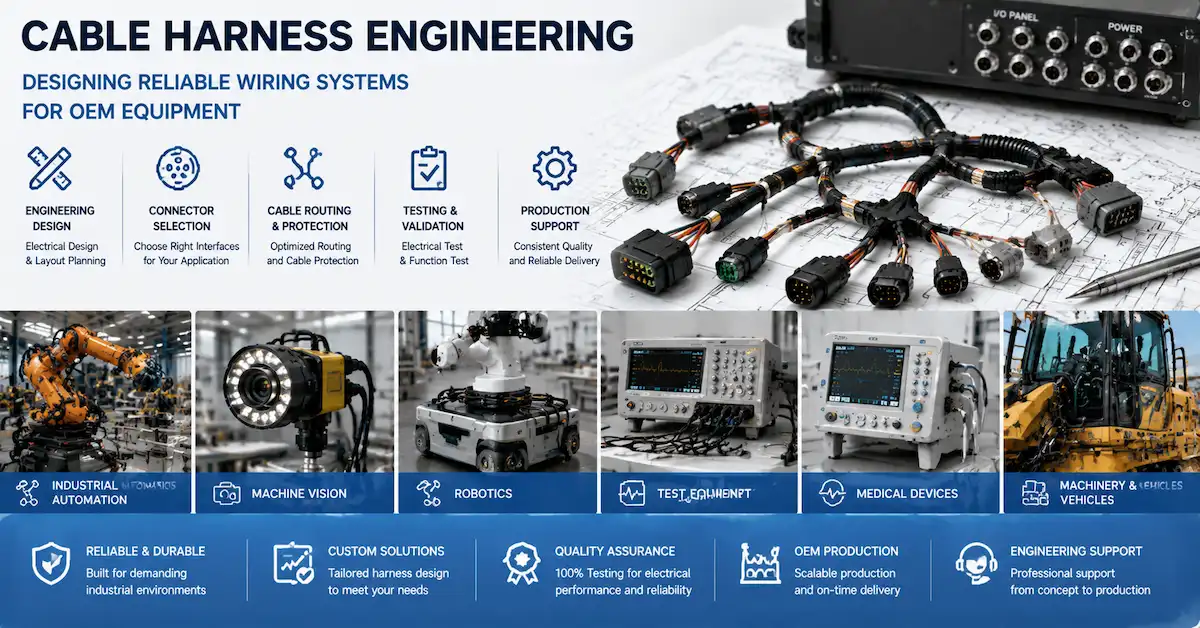
A custom cable harness organizes multiple wires, cable branches, connectors, labels, and protective components into one equipment-specific assembly.
Custom harnesses are suitable for:
- OEM machinery
- Automated equipment
- Control systems
- Medical devices
- Robotics
- Multi-module electronic systems
Advantages
- Matches the equipment layout
- Reduces installation time
- Simplifies production
- Improves connection organization
- Supports labeling and branch identification
- Provides consistent repeat assembly
Limitations
- Requires drawings or samples
- Needs prototype validation
- Changes must be controlled by revision
- Initial development takes longer than buying standard cables
For complex equipment, a custom harness can reduce total assembly and maintenance costs even when the cable unit price is higher.
Electrical Performance Comparison
| Requirement | Recommended Cable Direction |
| Basic fixed power connection | Standard industrial cable |
| Sensitive analog or sensor signal | Shielded cable |
| High-speed data transmission | Controlled, shielded signal cable |
| High-current equipment power | Correct wire gauge and rated connector |
| Power and data in one route | Engineered hybrid cable |
| Multiple modules and branches | Custom cable harness |
| Moving signal connection | High-flex shielded cable |
| Outdoor electrical connection | Rugged or sealed cable assembly |
Electrical performance must be evaluated together with cable length and connector ratings.
Mechanical and Environmental Comparison
| Operating Condition | Recommended Solution |
| Fixed indoor installation | Standard industrial cable |
| Tight equipment space | Flexible cable |
| Continuous repeated movement | High-flex cable |
| Drag-chain operation | Dynamic high-flex cable |
| Vibration and impact | Rugged cable assembly |
| Oil or industrial contamination | Application-suitable jacket material |
| Moisture or outdoor exposure | Sealed connector cable solution |
| Frequent plugging | Durable locking connector and strain relief |
| Complex internal routing | Custom cable harness |
The installation method can be as important as the cable itself. Excessive bending, poor clamping, and unsupported connector weight can shorten the life of any cable.
Cost Comparison and Total Ownership Cost
Initial price is only one part of an industrial cable comparison.
Buyers should also consider:
- Installation labor
- Equipment downtime
- Cable replacement frequency
- Maintenance access
- Production rework
- Quality inspection
- Connector availability
- Repeat-order consistency
| Cable Option | Initial Cost | Long-Term Value |
| Standard cable | Low | Good for fixed, low-risk use |
| Shielded cable | Medium | Better signal protection |
| High-flex cable | Medium to high | Lower replacement risk in moving systems |
| Rugged cable | Medium to high | Better reliability in harsh environments |
| Hybrid cable | Higher development cost | Reduces cable count and installation work |
| Custom harness | Higher initial engineering cost | Improves OEM assembly and repeatability |
The most cost-effective cable is the one that meets the application without unnecessary specifications or avoidable failure risks.
Industrial Cable Selection by Application
| Application | Recommended Cable Characteristics |
| Industrial control cabinet | Organized fixed wiring and clear labels |
| Robotic arm | High-flex construction and strain relief |
| Machine vision system | Shielded high-speed data cable |
| Outdoor machine | Rugged jacket and sealed connectors |
| Sensor network | Compact locking connectors and shielded pairs |
| Professional camera equipment | Flexible video, data, and power assemblies |
| OEM machinery | Custom harness with controlled branches |
| Test instrument | Stable contact and low-interference signal cable |
Questions to Ask an Industrial Cable Supplier
Before selecting a supplier, ask:
- Has the supplier manufactured cables for similar equipment?
- Can it review drawings and wiring diagrams?
- Can it identify and source the required connectors?
- Can it recommend standard, shielded, high-flex, or rugged structures?
- Can it develop prototypes before production?
- What electrical and functional tests are available?
- Can it maintain approved materials across repeat orders?
- How are drawing revisions controlled?
- Can it support OEM labels and packaging?
- Can it support future quantity increases?
A supplier should explain why a specific cable design is suitable rather than recommending the most expensive option automatically.
Information Required for a Cable Comparison Quote
To receive comparable quotations, provide every supplier with the same information:
- Equipment application
- Cable function
- Connector models
- Pinout or wiring diagram
- Cable and branch lengths
- Voltage and current
- Signal or data requirements
- Shielding requirements
- Movement and bend-radius conditions
- Temperature, moisture, oil, and vibration exposure
- Prototype quantity
- Production quantity
- Testing requirements
- Labeling and packaging requirements
Without a common specification, supplier quotations may use different materials and cannot be compared fairly.
Why Choose Alvin’s Cables for Industrial Cable Solutions?
Alvin’s Cables supports custom cable assemblies for industrial automation, robotics, machine vision, professional video equipment, test instruments, medical devices, and OEM machinery.
Available capabilities include:
- Standard and custom industrial cable assemblies
- Shielded signal and data cables
- Flexible and high-flex cable structures
- Rugged connector cable solutions
- Power and signal hybrid cables
- Multi-branch cable harnesses
- M8, M12, Hirose, RJ45, BNC, D-TAP, XLR, push-pull, and custom connectors
- Prototype and sample development
- Electrical and functional testing
- Low-to-mid-volume repeat production
- OEM labeling and packaging
Buyers can review cable and connector categories through Alvin’s Cables Products, learn more about manufacturing capabilities on the About Us page, and review service advantages through Why Choose Alvin’s Cables.
FAQ
1. What is the main difference between standard and industrial cables?
Industrial cables are designed according to more demanding electrical, mechanical, environmental, or production requirements, while standard cables are generally intended for basic connections.
2. What is the difference between flexible and high-flex cable?
A flexible cable is easy to bend and route. A high-flex cable is specifically designed to withstand repeated dynamic movement.
3. When should an industrial cable be shielded?
Shielding is commonly required when sensitive signals operate near motors, power supplies, industrial machines, or other interference sources.
4. Is a rugged cable always better?
No. A rugged cable may add cost, weight, and stiffness. It should be used when the operating environment requires additional protection.
5. Can power and signal be combined in one cable?
Yes, but conductor sizing, shielding, grounding, heat, and interference must be evaluated during engineering.
6. When should buyers use a custom cable harness?
A custom harness is suitable when equipment contains multiple devices, branches, connectors, or installation points that must be organized consistently.
7. Can Alvin’s Cables produce samples before bulk production?
Yes. Prototype and sample development can be used to verify connector fit, pinout, routing, flexibility, and equipment performance.
8. How can buyers compare cable quotations accurately?
Provide all suppliers with the same connector, conductor, shielding, cable-length, testing, labeling, and packaging requirements.
Conclusion
An effective industrial cable comparison should evaluate more than price. Buyers must consider electrical performance, movement, shielding, durability, environmental protection, installation efficiency, and future production requirements.
Standard cables are suitable for simple fixed installations, while shielded, high-flex, rugged, hybrid, and custom harness solutions address more demanding applications.
For help comparing industrial cable options, contact Alvin’s Cables through the Contact Us page and provide your application, connector details, wiring diagram, operating environment, and expected quantity.