Large-scale industrial projects require cable solutions that can meet strict technical specifications, delivery schedules, and long-term supply requirements. A professional industrial project cable supply partner helps engineering teams, OEM manufacturers, and system integrators obtain reliable cable assemblies for complex equipment and infrastructure.
Unlike standard cable purchasing, project-based cable supply involves multiple considerations:
- Technical requirements
- Product customization
- Project timelines
- Production planning
- Quality standards
- Delivery coordination
- Future replacement needs
For automation systems, industrial machinery, robotics, machine vision, and OEM equipment projects, choosing the right cable supplier directly affects project success.
What Is Industrial Project Cable Supply?
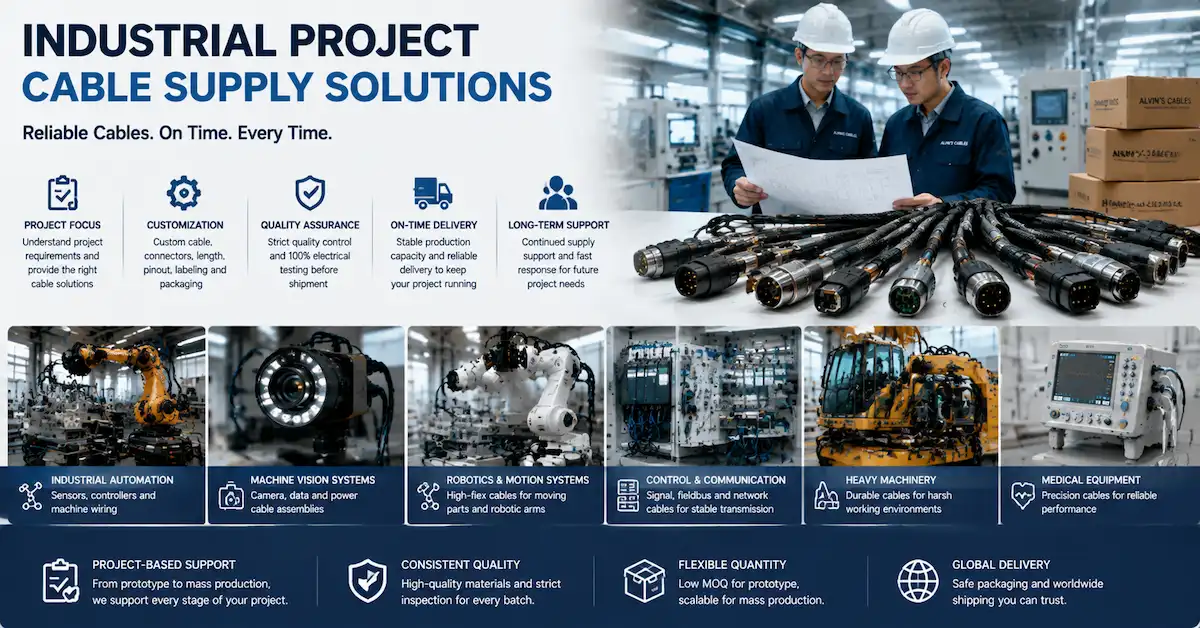
Industrial project cable supply refers to the process of providing customized or specialized cable solutions for industrial engineering projects.
A complete project supply service may include:
- Technical consultation
- Cable specification review
- Custom cable development
- Prototype samples
- Production planning
- Quality inspection
- Batch manufacturing
- Delivery coordination
- Long-term supply support
The supplier acts as a project partner rather than simply providing finished cable products.
Why Industrial Projects Need Professional Cable Supply
1. Project Requirements Are More Complex
Industrial projects often involve different cable requirements within the same system.
Examples include:
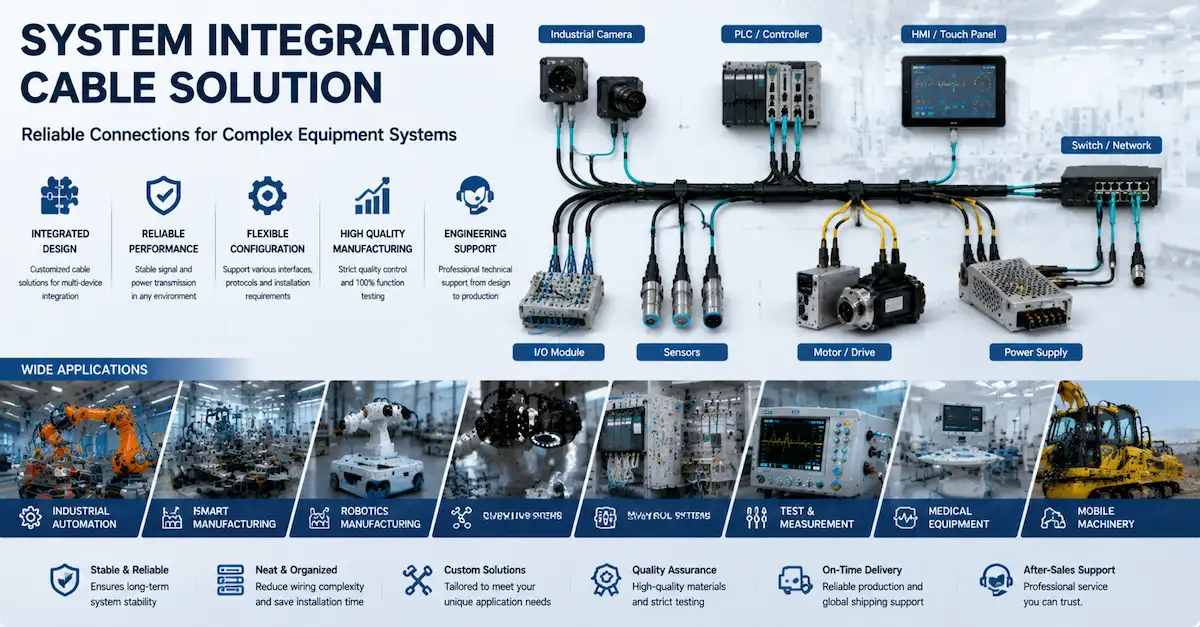
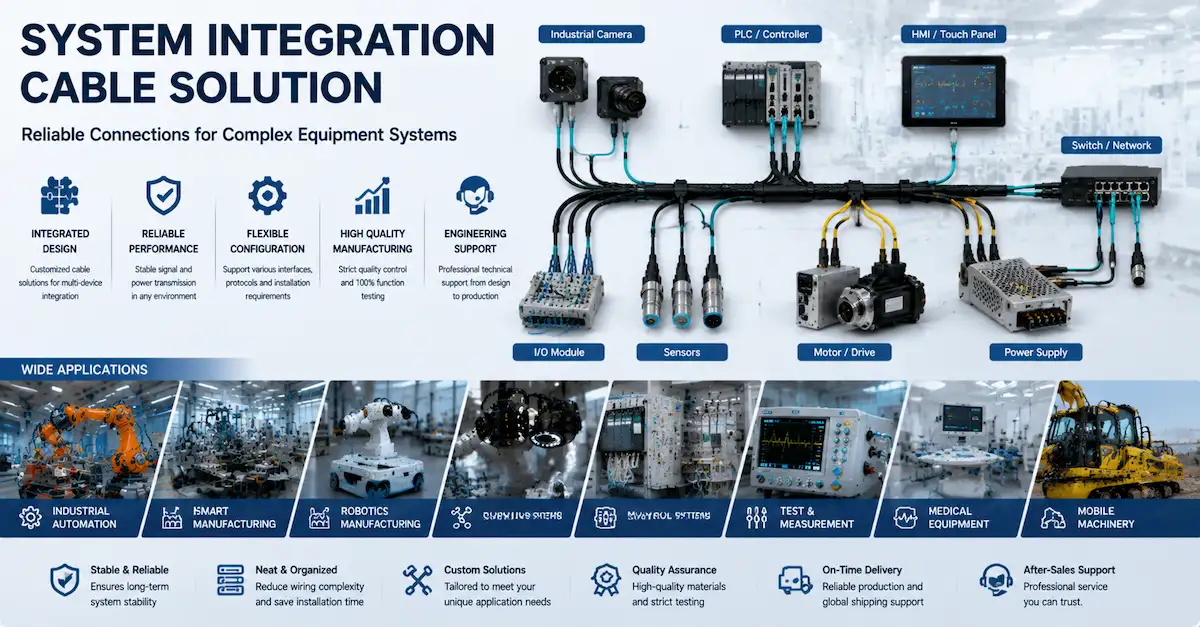
- Power cables
- Signal cables
- Data transmission cables
- Camera cables
- Control cables
- Cable harnesses
- Multi-device cable assemblies
Each cable may require different:
- Connectors
- Shielding
- Lengths
- Protection methods
- Electrical specifications
A professional supplier helps organize these requirements into practical solutions.
2. Stable Supply Prevents Project Delays
Engineering projects usually follow strict schedules.
Cable supply delays can affect:
- Equipment assembly
- Factory installation
- System testing
- Customer delivery
Reliable suppliers support projects through:
- Production planning
- Material preparation
- Quality monitoring
- Delivery scheduling
3. Consistent Quality Across Multiple Batches
Large projects often require hundreds or thousands of cable assemblies.
The supplier must maintain consistency in:
- Cable structure
- Connector models
- Pinout
- Dimensions
- Testing standards
- Packaging
Production control is essential for project success.
Applications of Industrial Project Cable Supply
| Application | Cable Requirement | Main Concern |
|---|---|---|
| Industrial automation projects | Control and sensor cables | System reliability |
| Factory equipment | Power and signal cables | Stable operation |
| Robotics projects | Flexible cable assemblies | Long service life |
| Machine vision systems | Camera and data cables | Signal integrity |
| OEM machinery | Customized wiring | Repeat production |
| Test systems | Precision signal cables | Accuracy |
| Medical equipment projects | Reliable cable connections | Consistency |
| Manufacturing upgrades | Replacement cable systems | Compatibility |
Key Factors When Choosing an Industrial Cable Supply Partner
1. Technical Capability
A professional supplier should understand:
- Equipment requirements
- Electrical specifications
- Cable structures
- Connector interfaces
- Installation conditions
Technical support helps prevent problems during project implementation.
2. Customization Ability
Industrial projects often require customized cable solutions.
Customization may include:
- Cable length
- Connector type
- Pinout configuration
- Shielding design
- Cable harness structure
- Protective materials
- Labels and packaging
3. Production Capacity
Project suppliers should have the ability to support:
- Prototype production
- Pilot orders
- Medium-volume production
- Repeat supply
Production capacity should match project requirements and future demand.
4. Quality Management
Industrial cable projects require strict quality control.
Important processes include:
Material Inspection
Checking:
- Cable specifications
- Connector quality
- Components
Production Inspection
Monitoring:
- Wire preparation
- Crimping
- Soldering
- Assembly
Final Testing
Including:
- Continuity testing
- Pinout testing
- Short circuit testing
- Functional testing
Industrial Project Cable Supply Process
| Project Stage | Supplier Responsibility |
| Requirement review | Understand equipment and cable needs |
| Technical evaluation | Confirm cable design and specifications |
| Sample development | Create prototype assemblies |
| Customer validation | Support testing and improvements |
| Production preparation | Finalize drawings and processes |
| Mass production | Manufacture approved cables |
| Delivery | Manage project shipment |
| Repeat supply | Maintain consistent production |
Industrial Project Supply vs Standard Cable Purchasing
| Factor | Standard Purchasing | Industrial Project Supply |
| Product type | Standard cables | Customized solutions |
| Engineering support | Limited | Full support |
| Production planning | Simple ordering | Project coordination |
| Quality control | Basic | Detailed inspection |
| Delivery management | Order-based | Schedule-based |
| Long-term support | Limited | Continuous cooperation |
Common Challenges in Industrial Cable Projects
Incomplete Specifications
Missing information may cause:
- Wrong cable selection
- Sample revisions
- Delivery delays
Provide:
- Drawings
- Samples
- Wiring information
- Equipment details
Changing Requirements
Industrial projects may evolve during development.
A reliable supplier should support:
- Design changes
- Revision control
- Updated samples
- Production adjustments
Managing Large Quantities
Large projects require:
- Material planning
- Production scheduling
- Quality consistency
- Delivery coordination
How to Evaluate an Industrial Cable Supplier?
| Evaluation Point | What to Check |
| Project experience | Have they handled similar projects? |
| Engineering support | Can they solve technical issues? |
| Manufacturing ability | Can they support required quantities? |
| Quality system | Are testing procedures available? |
| Delivery capability | Can they meet project schedules? |
| Communication | Can they manage project updates? |
| OEM support | Can they provide documentation and packaging? |
What Information Should Buyers Provide?
For industrial project cable supply, provide:
- Project application
- Equipment information
- Cable specifications
- Connector requirements
- Wiring diagrams
- Cable quantities
- Delivery schedule
- Environmental requirements
- Testing requirements
- Drawings or samples
Why Choose Alvin’s Cables for Industrial Project Cable Supply?
Alvin’s Cables provides industrial project cable supply solutions for automation equipment, robotics, machine vision systems, professional video equipment, test instruments, and OEM machinery.
Capabilities include:
- Project-based cable development
- Custom industrial cable assemblies
- Power and signal cable solutions
- Cable harness production
- Multi-device cable systems
- M8, M12, Hirose, RJ45, BNC, SDI, HDMI, D-TAP, XLR, and custom connectors
- Shielded and flexible cable structures
- Prototype development
- Electrical and functional testing
- OEM labeling and packaging
Buyers can explore available products through Alvin’s Cables Products, learn about manufacturing capabilities through About Alvin’s Cables, and review service advantages through Why Choose Alvin’s Cables.
FAQ
1. What is industrial project cable supply?
Industrial project cable supply provides customized and reliable cable solutions for engineering projects, OEM equipment, and industrial systems.
2. Why do industrial projects need custom cables?
Because different systems require specific connectors, wiring, lengths, shielding, and environmental protection.
3. Can suppliers support large cable quantities?
Yes. Professional cable manufacturers can support prototype, pilot, and mass production orders.
4. What industries need industrial cable supply?
Industries include automation, robotics, machinery, machine vision, medical equipment, and OEM manufacturing.
5. How do suppliers ensure cable quality?
Through material inspection, production control, electrical testing, and final inspection.
6. Can project cable suppliers support design changes?
Yes. Professional suppliers can manage revisions, updated samples, and production adjustments.
7. Why are project samples important?
Samples verify compatibility, performance, installation, and production feasibility.
8. What information is needed for project quotation?
Provide project details, cable requirements, drawings, samples, quantities, and delivery expectations.
Conclusion
Reliable industrial project cable supply helps engineering teams complete complex projects with stable quality, predictable delivery, and long-term support.
The right cable partner provides more than products. It provides technical understanding, manufacturing capability, quality control, and project coordination.
For industrial cable projects, contact Alvin’s Cables with your requirements, specifications, drawings, and project schedule.