An industrial grade cable is designed for applications where standard cables may not provide enough durability, reliability, or protection. In industrial automation, robotics, machine vision, manufacturing equipment, sensors, control systems, and OEM electronics, cables must maintain stable performance despite vibration, movement, temperature changes, dust, moisture, and continuous operation.
For B2B buyers, selecting an industrial grade cable is not only about choosing a stronger outer jacket. A reliable industrial cable assembly requires the right combination of conductor quality, insulation material, shielding structure, connector design, strain relief, environmental protection, and manufacturing consistency.
A poor cable choice can lead to signal interruption, equipment downtime, production delays, and increased maintenance costs. A properly designed industrial grade cable assembly helps improve equipment reliability and supports long-term operation.
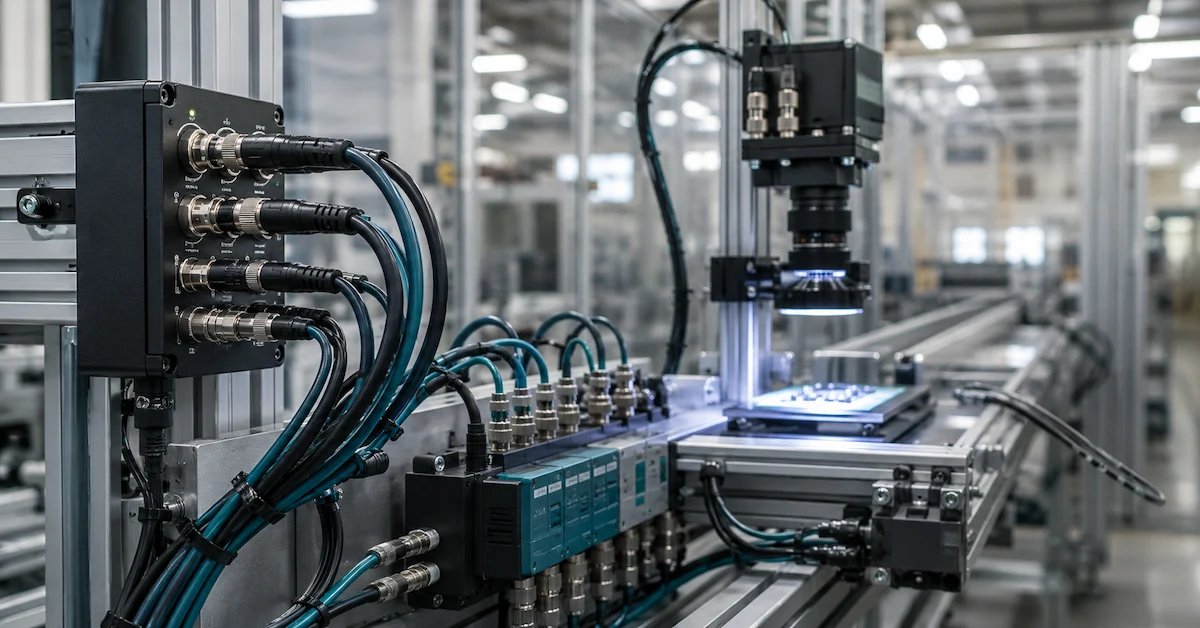
What Is an Industrial Grade Cable?
An industrial grade cable is a cable assembly engineered for industrial environments where higher mechanical, electrical, and environmental performance is required.
Compared with standard cables, industrial grade cables typically provide:
- Better mechanical durability
- Higher resistance to vibration
- Improved temperature performance
- Stronger connector protection
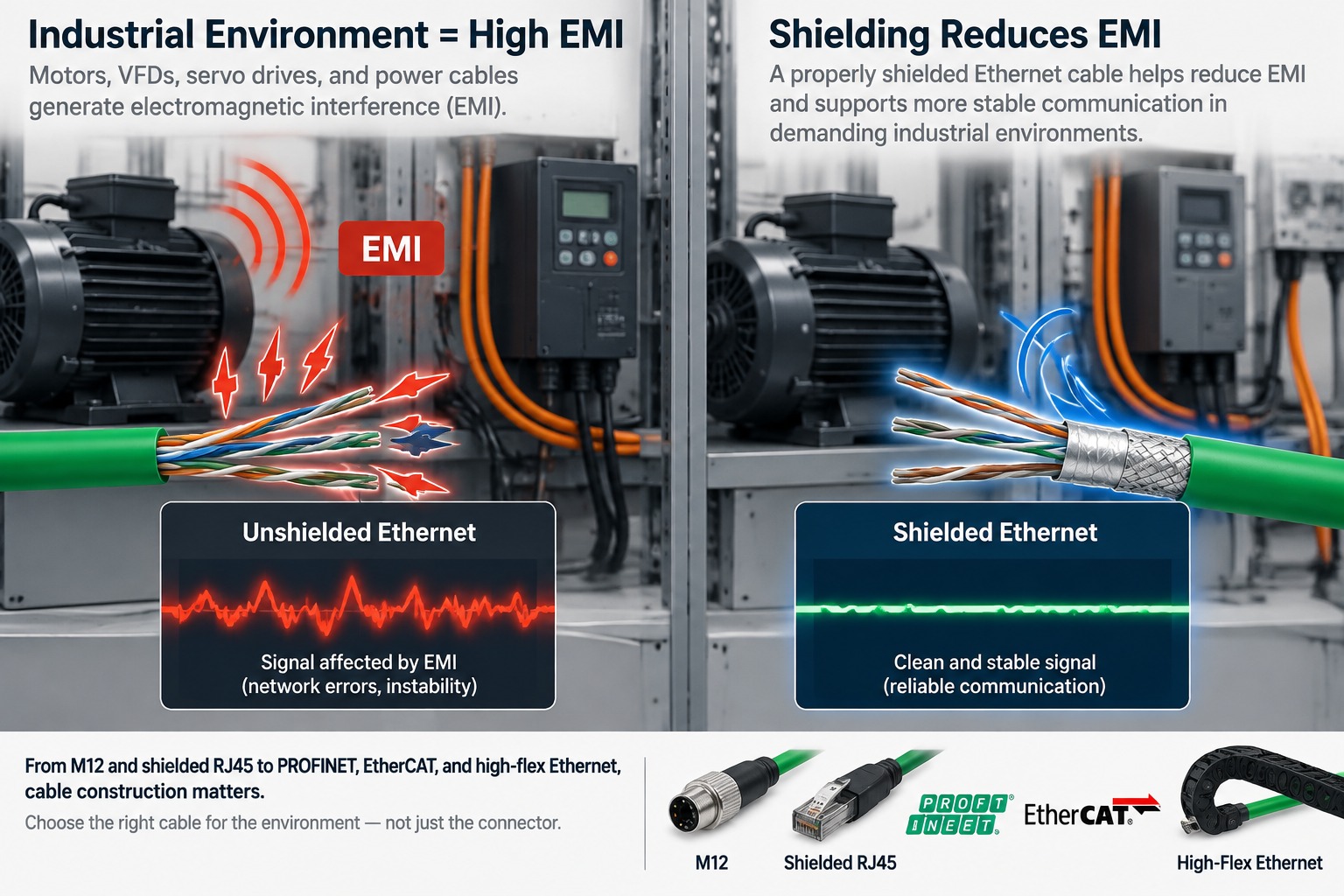
- Better EMI/RFI shielding
- More reliable signal transmission
- Longer service life
Industrial cable assemblies may be used for:
- PLC systems
- Industrial sensors
- Robotics equipment
- Machine vision cameras
- Automated production lines
- Control cabinets
- Test equipment
- Manufacturing machines
- OEM industrial devices
Where Are Industrial Grade Cables Used?
| Application | Cable Requirement | Buyer Concern |
|---|---|---|
| Industrial automation | Stable power and signal connection | Continuous operation reliability |
| Robotics | Flexible movement and vibration resistance | Cable fatigue |
| Machine vision | High-quality image transmission | Signal interference |
| Manufacturing equipment | Long-term machine operation | Downtime reduction |
| Sensors and controllers | Accurate signal transfer | Connection stability |
| Outdoor industrial systems | Environmental protection | Moisture and temperature |
| Test equipment | Accurate measurement signals | Electrical consistency |
| OEM machinery | Custom cable integration | Batch quality |
Industrial applications require cables designed for real working conditions rather than simple indoor use.
Why Industrial Grade Cable Performance Matters
1. Reducing Equipment Downtime
Industrial equipment often operates for long periods. Cable failure can stop production lines, inspection systems, or automated processes.
A reliable industrial grade cable helps reduce:
- Unexpected cable replacement
- Production interruption
- Maintenance frequency
- Signal failure
- Equipment downtime
For manufacturers, cable reliability directly affects operational efficiency.
2. Withstanding Mechanical Stress
Industrial cables often experience:
- Vibration
- Repeated bending
- Pulling force
- Twisting
- Abrasion
- Continuous movement
A durable industrial cable assembly may include:
- Flexible conductor design
- Reinforced jacket
- Strong connector housing
- Molded strain relief
- Proper bending radius
- Mechanical protection
These features help extend cable service life.
3. Protecting Against Harsh Environments
Industrial environments may expose cables to:
- Dust
- Water
- Oil
- Chemicals
- Heat
- Cold temperatures
- Mechanical impact
Depending on the application, industrial grade cable assemblies may require:
- Waterproof connectors
- Oil-resistant jacket materials
- Abrasion-resistant protection
- Sealed connection points
- Temperature-resistant insulation
- Rugged connector structures
4. Maintaining Signal and Power Stability
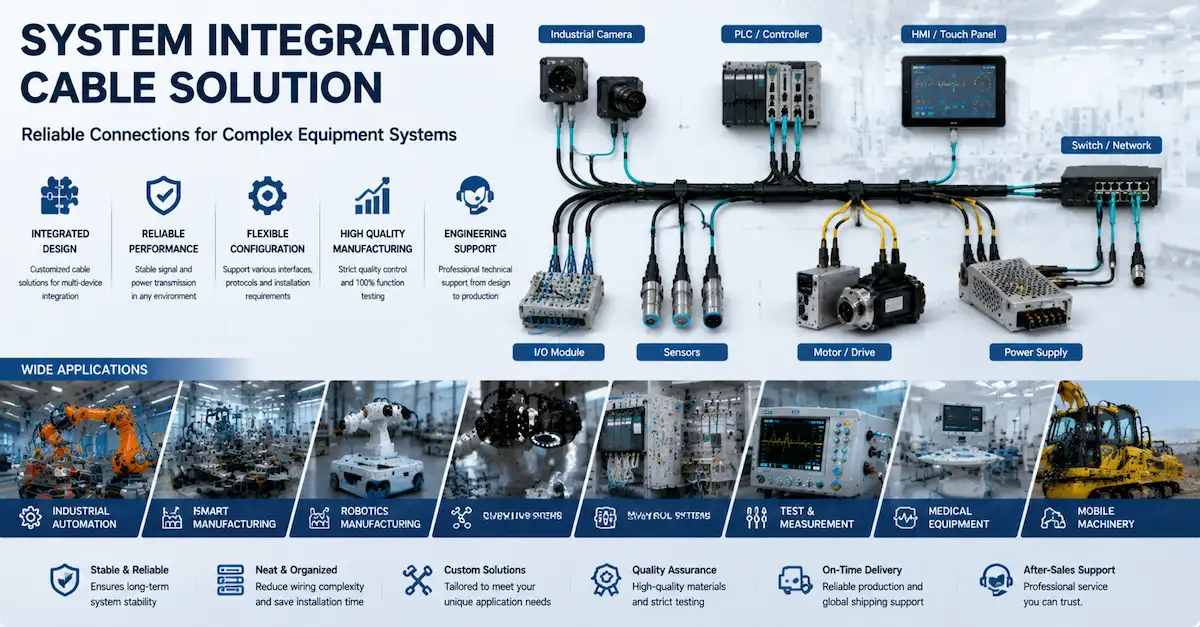
Industrial systems often combine power, control, data, and sensor signals. Poor cable design may create interference or unstable communication.
Important factors include:
- Shielding structure
- Conductor quality
- Connector contact reliability
- Grounding design
- Pinout accuracy
- Cable impedance
For automation and machine vision systems, stable transmission is essential.
Common Industrial Grade Cable Types
| Cable Type | Purpose | Best For |
| Industrial Ethernet cable | High-speed data communication | PLC and automation |
| M12 cable assembly | Sensor and industrial connection | Factory equipment |
| M8 cable assembly | Compact sensor connection | Small devices |
| Shielded industrial cable | EMI protection | Noisy environments |
| High flex industrial cable | Repeated movement | Robotics |
| Waterproof industrial cable | Outdoor and harsh environments | Industrial equipment |
| Custom industrial cable assembly | Project-specific solutions | OEM machines |
Industrial Grade Cable vs Standard Cable
| Option | Advantages | Limitations | Best For |
| Standard cable | Lower cost and easy sourcing | Limited protection | Basic applications |
| Flexible cable | Easier installation | Limited harsh environment performance | Light movement |
| Industrial grade cable | Better durability and protection | Higher design requirements | Industrial systems |
| Custom industrial assembly | Best equipment integration | Requires engineering evaluation | OEM and automation |
For professional industrial systems, choosing the right cable assembly can reduce total ownership costs.
Key Factors When Choosing Industrial Grade Cable
1. Environmental Requirements
Before selecting a cable, buyers should evaluate:
- Temperature range
- Moisture exposure
- Dust level
- Chemical contact
- Vibration
- Movement frequency
- Installation location
The cable structure should match the actual operating environment.
2. Connector Reliability
Industrial connectors must maintain stable performance under vibration and repeated use.
Important considerations include:
- Connector locking method
- Contact quality
- Waterproof rating
- Mechanical strength
- Cable exit protection
- Compatibility
Common industrial connector options include:
- M8
- M12
- RJ45 industrial Ethernet
- Hirose
- BNC
- Push-pull connectors
- Custom connectors
3. Shielding Requirements
Many industrial environments contain electrical noise sources.
Shielding options may include:
- Foil shielding
- Braided shielding
- Double shielding
- Twisted pair design
- Shield-to-connector grounding
The correct shielding depends on signal type and interference level.
4. Flexibility and Service Life
For moving equipment, flexibility is critical.
Buyers should evaluate:
- Bending radius
- Flex cycles
- Cable diameter
- Jacket material
- Strain relief
- Routing method
For robots and automated equipment, high flex industrial cable designs may be required.
Custom Industrial Grade Cable Options
| Custom Option | Purpose |
| Custom length | Fits machine installation |
| Custom connector | Matches equipment interface |
| Custom pinout | Supports special wiring |
| Shielded structure | Improves signal stability |
| Waterproof design | Supports harsh environments |
| Flexible jacket | Supports movement |
| Overmolding | Protects cable ends |
| Labeling | Simplifies maintenance |
| OEM packaging | Supports product delivery |
How to Choose an Industrial Grade Cable Supplier
A reliable supplier should understand both industrial applications and cable engineering.
Buyers should evaluate:
| Evaluation Point | What to Check |
| Industrial experience | Does the supplier understand factory applications? |
| Custom capability | Can they support drawings and samples? |
| Connector options | Can they provide industrial connectors? |
| Material selection | Can they recommend suitable materials? |
| Testing process | Do they verify cable performance? |
| Production consistency | Can they support repeat orders? |
| OEM support | Can they provide packaging and labeling? |
Choosing only the cheapest cable may increase replacement and downtime costs.
What Information Should Buyers Provide for a Quote?
Prepare:
- Application or machine type
- Working environment
- Connector type
- Cable length
- Signal or power requirement
- Pinout
- Shielding requirement
- Flexibility requirement
- Waterproof requirement
- Quantity
- Drawing, photo, specification, or sample
Why Choose Alvin’s Cables?
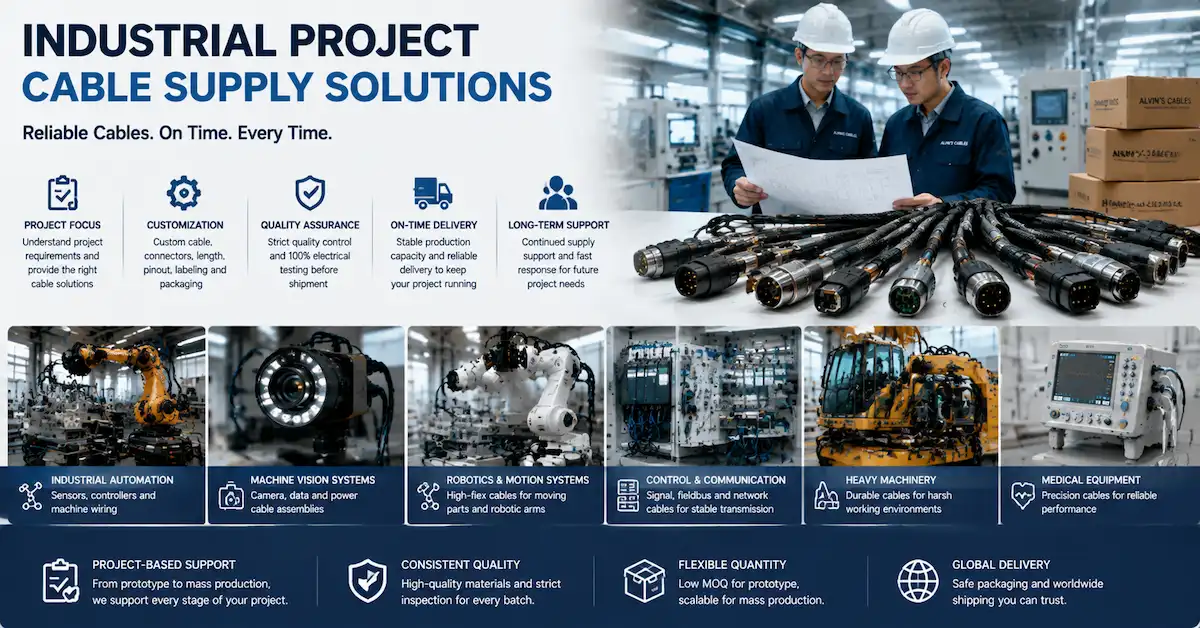
Alvin’s Cables supports custom cable assemblies and connector solutions for industrial automation, professional video systems, robotics, medical devices, test equipment, and OEM electronics.
For industrial grade cable projects, Alvin’s Cables can support:
- Custom industrial cable assemblies
- M8, M12, RJ45, Hirose, BNC, D-TAP, and custom connectors
- Shielded industrial cable structures
- Flexible and rugged cable designs
- Waterproof cable solutions
- Custom length and pinout
- Overmolding and strain relief
- Prototype development
- Low-to-mid volume production
- Multi-stage inspection and testing
- OEM labeling and packaging
Buyers can explore related products through Alvin’s Cables Products, learn more about company capability from About Alvin’s Cables, or review service advantages through Why Choose Alvin’s Cables.
FAQ
1. What is an industrial grade cable?
An industrial grade cable is designed for demanding environments requiring higher durability, protection, and reliable electrical performance.
2. Where are industrial grade cables used?
They are used in automation, robotics, machine vision, manufacturing equipment, sensors, test systems, and OEM machinery.
3. What makes industrial cables different from standard cables?
Industrial cables provide better resistance to vibration, temperature changes, moisture, mechanical stress, and interference.
4. Can industrial grade cables be customized?
Yes. They can be customized by connector type, length, pinout, shielding, jacket material, waterproof design, and packaging.
5. Do industrial cables need shielding?
Many industrial applications require shielding to reduce EMI/RFI interference and maintain stable communication.
6. Can Alvin’s Cables provide samples?
Yes. Alvin’s Cables supports prototype and sample development before bulk production.
7. What connectors are commonly used for industrial cables?
Common options include M8, M12, RJ45 industrial Ethernet, Hirose, BNC, push-pull, and custom connectors.
8. What should I provide for quotation?
Provide application details, connector type, cable length, environment requirements, quantity, and any drawings or samples.
Conclusion
An industrial grade cable provides reliable power, signal, and data transmission in demanding industrial environments. For automation, robotics, machine vision, manufacturing equipment, and OEM systems, the right cable design can reduce downtime and improve long-term equipment performance.
Buyers should evaluate materials, connectors, shielding, flexibility, environmental protection, testing, and supplier capability before placing orders.
If you need a custom industrial grade cable assembly, contact Alvin’s Cables with your connector type, application environment, cable length, and order quantity.