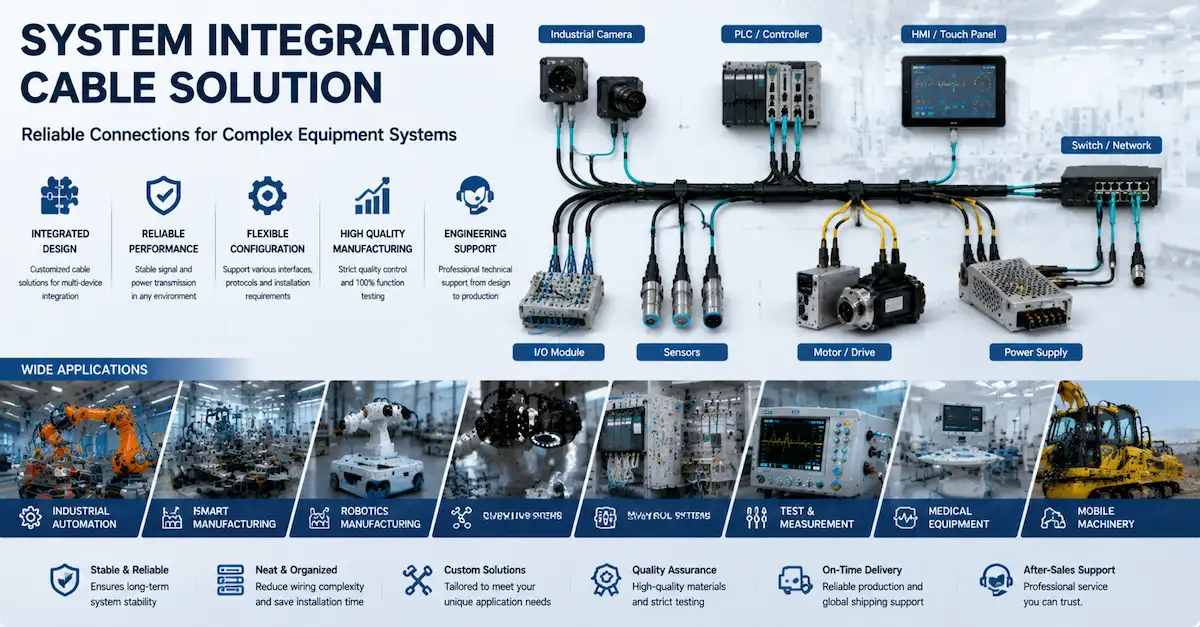
Modern industrial equipment contains increasingly complex electrical systems involving sensors, controllers, motors, cameras, power modules, and communication devices. Cable harness engineering helps transform these individual connections into organized, reliable, and production-ready wiring systems.
A professional cable harness design is not simply grouping multiple wires together. It requires careful engineering consideration of electrical performance, mechanical structure, installation space, maintenance requirements, and manufacturing efficiency.
For OEM equipment manufacturers, automation companies, robotics developers, and industrial system integrators, proper cable harness engineering helps improve product reliability, reduce assembly time, and support consistent mass production.
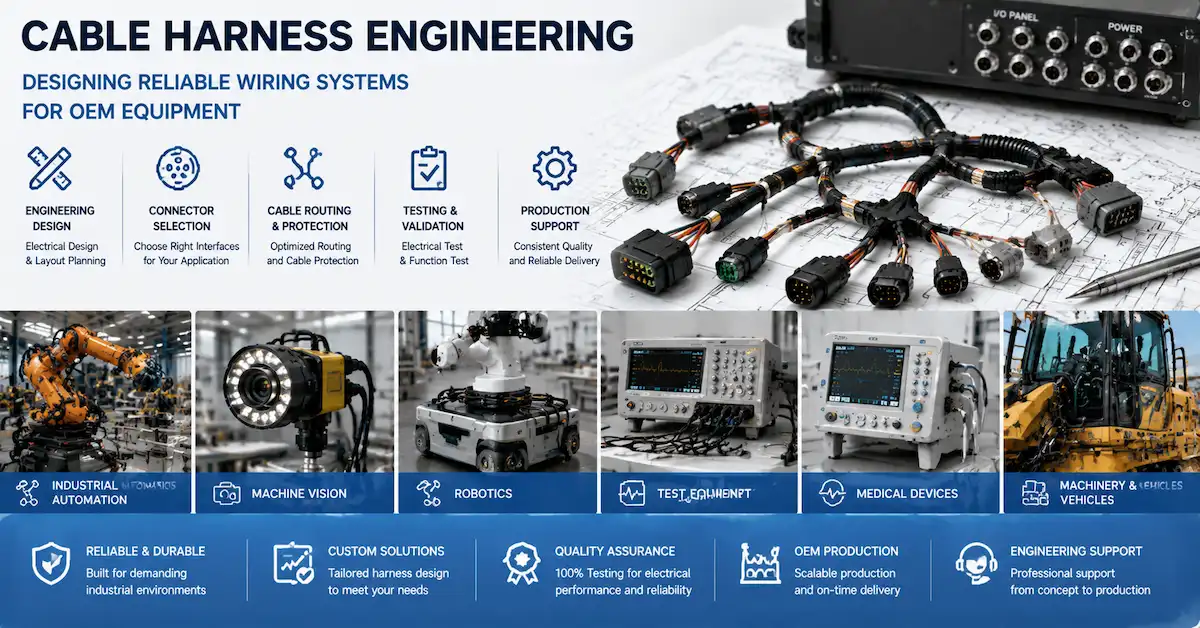
What Is Cable Harness Engineering?
Cable harness engineering is the process of designing, developing, and optimizing cable harness assemblies according to equipment requirements.
The engineering process covers:
- Electrical connection planning
- Wire and cable selection
- Connector configuration
- Circuit organization
- Cable routing design
- Branch structure planning
- Protection methods
- Manufacturing preparation
- Testing requirements
A complete cable harness engineering solution connects multiple electrical components into one organized assembly that can be installed efficiently.
Why Cable Harness Engineering Matters
1. Improving Electrical System Reliability
A poorly designed wiring system may cause:
- Incorrect connections
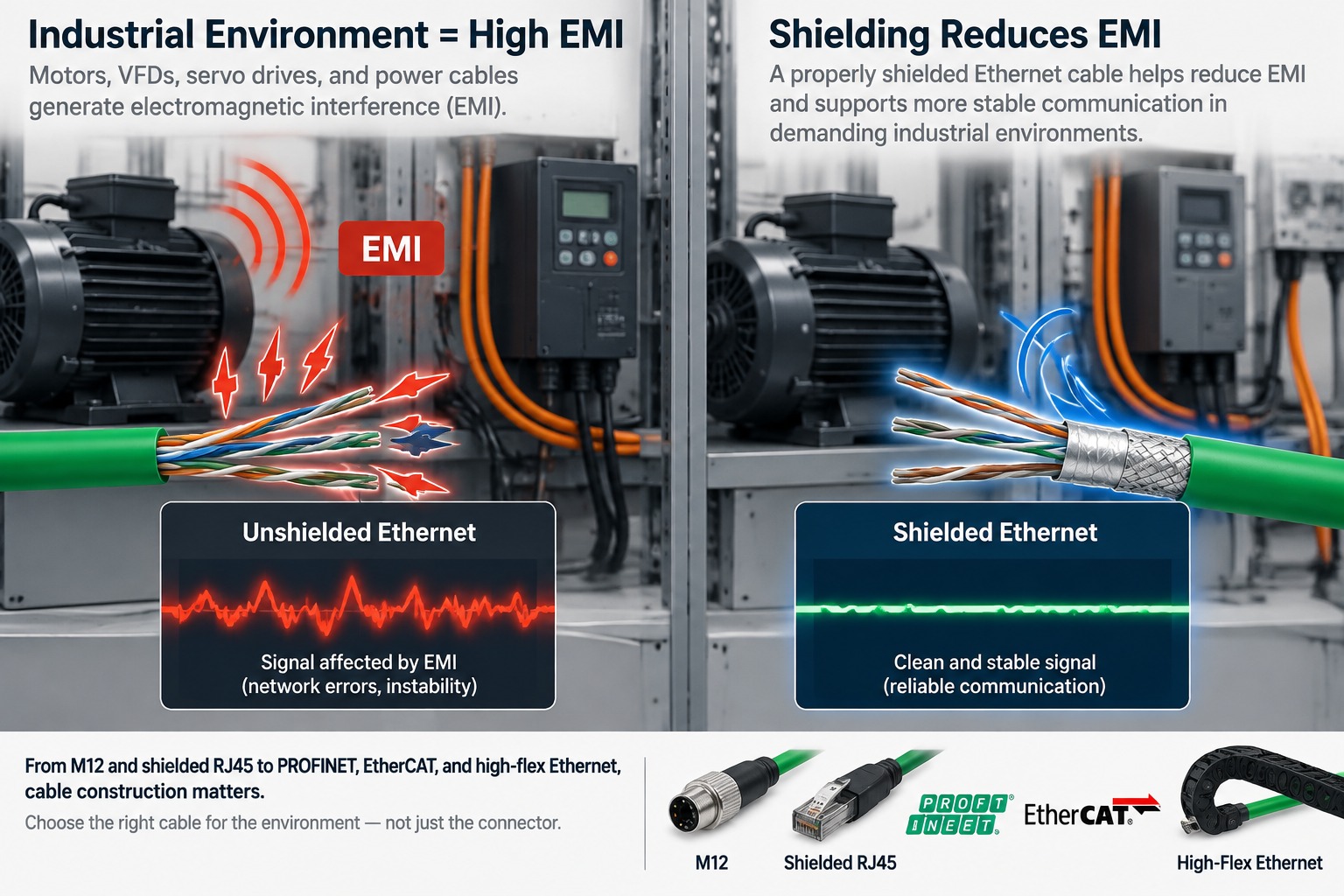
- Signal interference
- Power instability
- Difficult troubleshooting
- Equipment failures
Professional harness engineering ensures:
- Correct wiring logic
- Proper conductor selection
- Reliable connectors
- Clear identification
- Stable electrical performance
2. Simplifying Equipment Assembly
OEM manufacturers need efficient production processes.
A well-engineered cable harness helps:
- Reduce manual wiring time
- Minimize installation errors
- Improve assembly consistency
- Simplify production workflows
- Shorten manufacturing cycles
Pre-designed harness assemblies allow equipment builders to install complex wiring faster.
3. Optimizing Space and Cable Routing
Industrial equipment often has limited internal space.
Cable harness engineering considers:
- Component locations
- Cable paths
- Bend radius
- Connector accessibility
- Maintenance requirements
- Moving parts clearance
Proper routing improves both equipment appearance and serviceability.
4. Supporting Mass Production
A successful prototype must also be suitable for repeat manufacturing.
Engineering should consider:
- Assembly processes
- Material availability
- Production efficiency
- Testing procedures
- Documentation control
This ensures the harness can be reproduced consistently.
Main Elements of Cable Harness Engineering
1. Electrical Design
Electrical design defines how signals and power move through the harness.
Engineers evaluate:
- Voltage requirements
- Current capacity
- Signal types
- Grounding
- Shielding
- Circuit separation
Different circuits may require different cable structures.
Examples:
- Power circuits
- Sensor signals
- Communication lines
- Video transmission
- Control signals
2. Wire and Cable Selection
Selecting suitable wires is critical for performance.
Important factors include:
- Conductor size
- Insulation material
- Temperature rating
- Flexibility
- Shielding
- Environmental resistance
Applications with movement may require high-flex cables, while sensitive signals may require shielded cables.
3. Connector Selection
Connectors determine how the harness integrates with equipment.
Common connector options include:
- M8
- M12
- Hirose
- RJ45
- BNC
- XLR
- D-TAP
- Circular connectors
- Custom connectors
Engineering considerations include:
- Pin count
- Locking method
- Current rating
- Voltage rating
- Installation space
- Environmental protection
4. Harness Layout Design
Harness layout defines:
- Main cable path
- Branch positions
- Connector locations
- Cable lengths
- Protection areas
A good layout improves:
- Installation efficiency
- Maintenance convenience
- Mechanical reliability
5. Protection Design
Industrial harnesses may require additional protection.
Common solutions include:
- Braided sleeving
- Spiral wrapping
- Corrugated tubing
- Heat shrink
- Strain relief
- Overmolding
- Protective jackets
Protection methods depend on:
- Movement
- Vibration
- Temperature
- Environment
Cable Harness Engineering Process
| Stage | Engineering Activity |
|---|---|
| Requirement analysis | Understand equipment connections and electrical needs |
| Electrical design | Define wiring, circuits, and specifications |
| Component selection | Choose cables, connectors, and protection |
| 3D routing planning | Optimize installation paths |
| Prototype development | Build initial harness samples |
| Testing validation | Verify performance and compatibility |
| Manufacturing preparation | Create production documentation |
| Mass production | Manufacture approved harness design |
Cable Harness Engineering vs Simple Cable Assembly
| Factor | Cable Assembly | Cable Harness Engineering |
| Complexity | Single or limited connections | Multiple integrated connections |
| Design requirement | Lower | Higher |
| Routing planning | Basic | Detailed |
| Circuit management | Limited | Comprehensive |
| OEM integration | Moderate | Strong |
| Production optimization | Limited | Advanced |
Cable harness engineering is especially important for complex equipment with multiple electrical systems.
Applications of Cable Harness Engineering
| Industry | Harness Requirement |
| Industrial automation | Sensors, controllers, and machine wiring |
| Robotics | Flexible moving harness systems |
| Machine vision | Camera and communication connections |
| Medical equipment | Precise internal wiring |
| Test instruments | Stable signal transmission |
| OEM machinery | Integrated electrical systems |
| Electronics equipment | Compact wiring solutions |
How to Evaluate a Cable Harness Engineering Partner?
| Evaluation Point | What to Check |
| Engineering capability | Can they design complete harness systems? |
| Electrical knowledge | Can they manage complex wiring requirements? |
| Connector experience | Can they select suitable interfaces? |
| Manufacturing ability | Can they produce repeat batches? |
| Testing capability | Can they verify harness performance? |
| Documentation | Can they provide drawings and specifications? |
| OEM experience | Have they supported equipment manufacturers? |
A strong engineering partner should support the complete process from concept to production.
Common Cable Harness Engineering Challenges
Managing Complex Wiring
Complex equipment may include hundreds of connection points.
Solutions include:
- Clear wiring documentation
- Proper labeling
- Organized branch design
- Controlled revisions
Balancing Performance and Cost
Engineering should optimize:
- Materials
- Production methods
- Connector selection
- Assembly efficiency
The goal is reliable performance with practical manufacturing cost.
Designing for Future Maintenance
A good harness design considers:
- Easy access
- Clear identification
- Replaceable sections
- Service requirements
What Information Should Buyers Provide?
For cable harness engineering projects, provide:
- Equipment drawings
- Electrical diagrams
- Connector requirements
- Wire specifications
- Installation space
- Environmental conditions
- Movement requirements
- Quantity requirements
- Production expectations
- Existing samples if available
Why Choose Alvin’s Cables for Cable Harness Engineering?
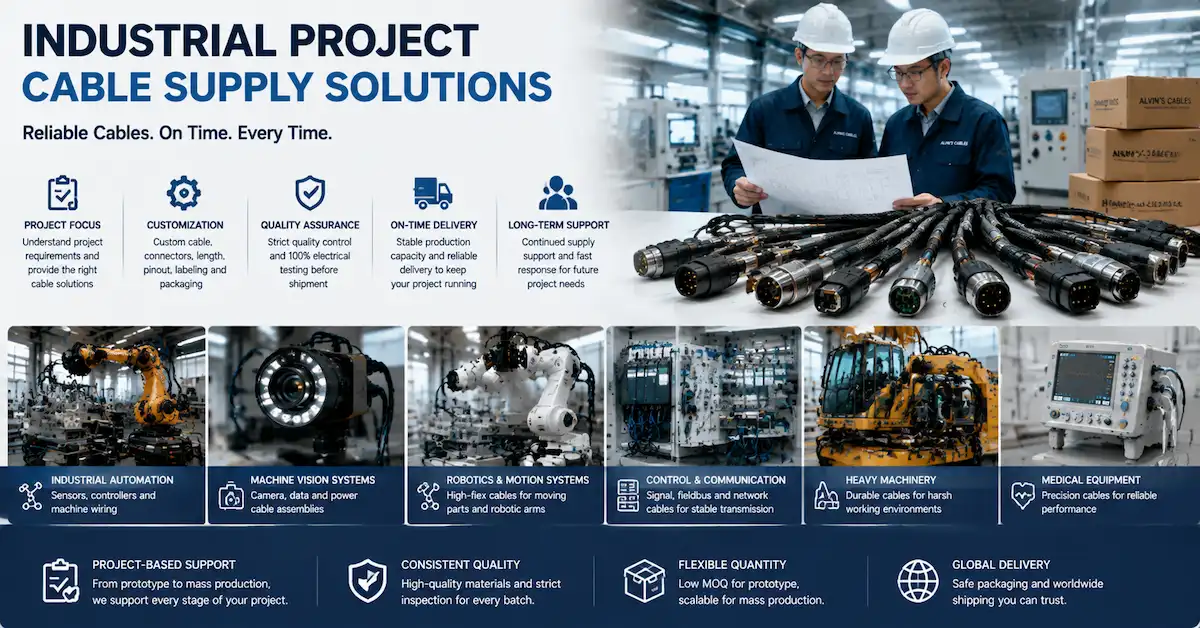
Alvin’s Cables provides cable harness engineering and custom cable assembly solutions for industrial automation, robotics, machine vision, professional video equipment, test instruments, and OEM electronics.
Capabilities include:
- Cable harness design
- Electrical and mechanical optimization
- Custom wiring solutions
- Multi-connector harness assemblies
- Industrial cable assemblies
- M8, M12, Hirose, RJ45, BNC, SDI, HDMI, D-TAP, XLR, and custom connectors
- Cable routing optimization
- Prototype development
- Electrical testing
- Functional validation
- OEM production support
Buyers can explore available products through Alvin’s Cables Products, learn about manufacturing capabilities through About Alvin’s Cables, and review service advantages through Why Choose Alvin’s Cables.
FAQ
1. What is cable harness engineering?
Cable harness engineering is the process of designing and optimizing wiring systems that connect multiple electrical components within equipment.
2. What is the difference between a cable assembly and a harness?
A cable assembly usually connects specific points, while a harness integrates multiple wires, connectors, and branches into a complete wiring system.
3. What industries use cable harness engineering?
Industries include automation, robotics, machinery, medical equipment, machine vision, and OEM electronics.
4. Why is harness design important?
Good harness design improves reliability, installation efficiency, maintenance convenience, and production consistency.
5. Can cable harnesses be customized?
Yes. Wire types, connectors, lengths, branches, protection, labels, and packaging can be customized.
6. What information is needed for harness design?
Provide equipment drawings, electrical requirements, connector details, wiring diagrams, and installation conditions.
7. Can Alvin’s Cables develop harness prototypes?
Yes. Prototype development and validation are available before mass production.
8. How does harness engineering improve production?
It reduces manual wiring, minimizes errors, and creates standardized installation processes.
Conclusion
Professional cable harness engineering helps manufacturers develop reliable, organized, and production-ready wiring systems for complex equipment.
The right engineering approach combines electrical design, connector selection, routing optimization, protection methods, testing, and manufacturing considerations.
For OEM and industrial cable harness projects, contact Alvin’s Cables with your equipment requirements, drawings, and technical specifications.