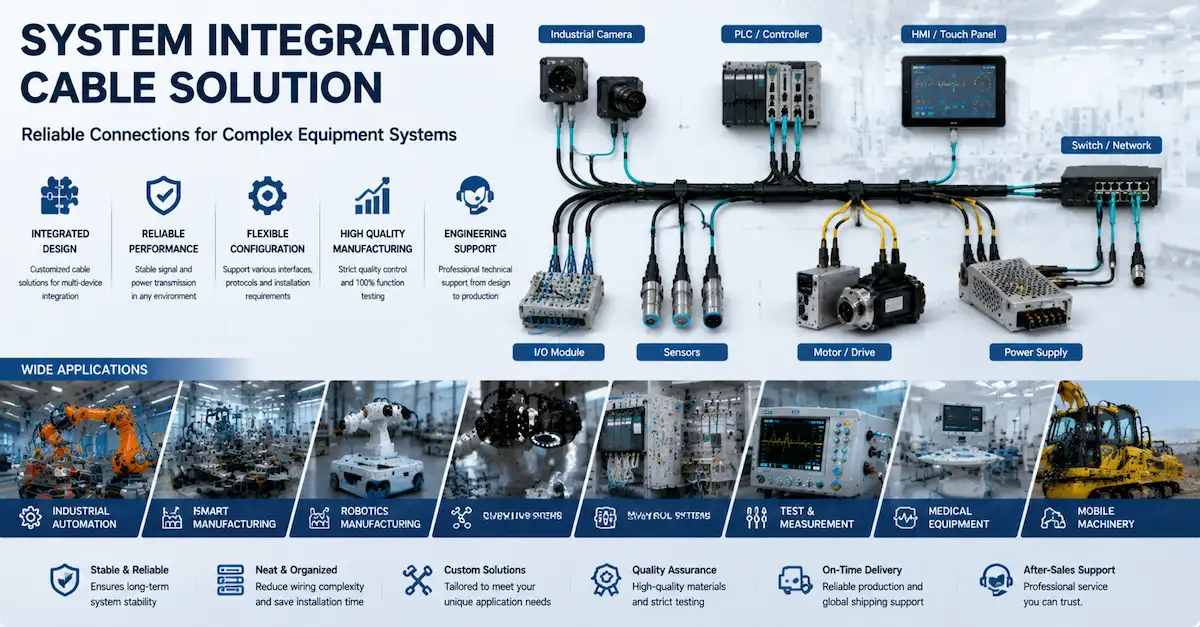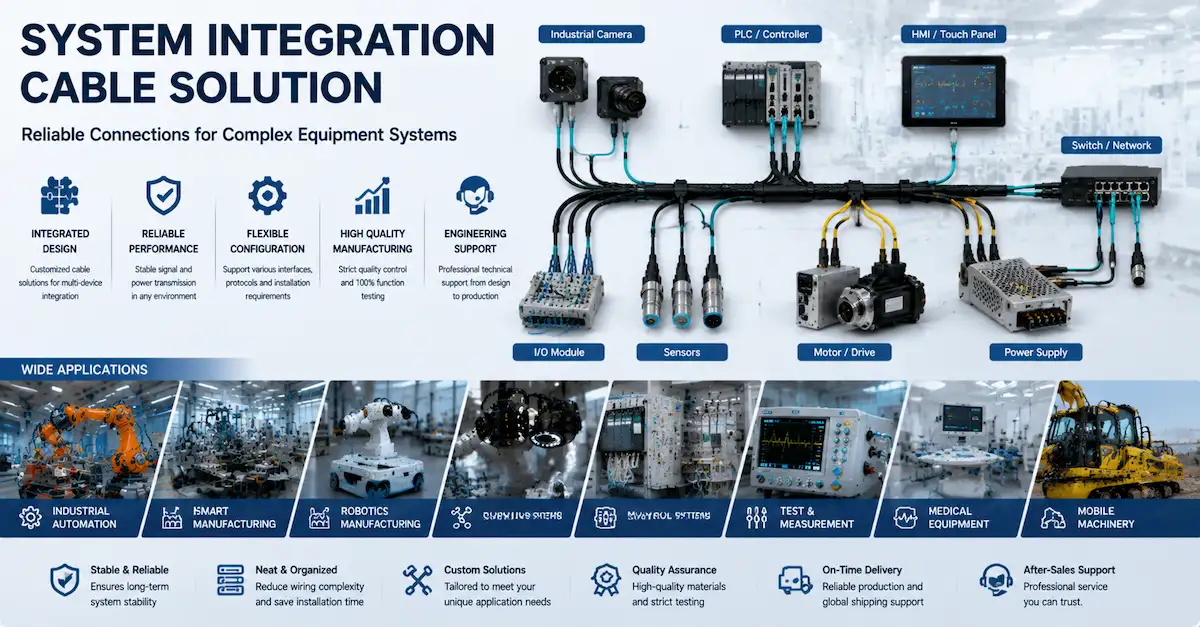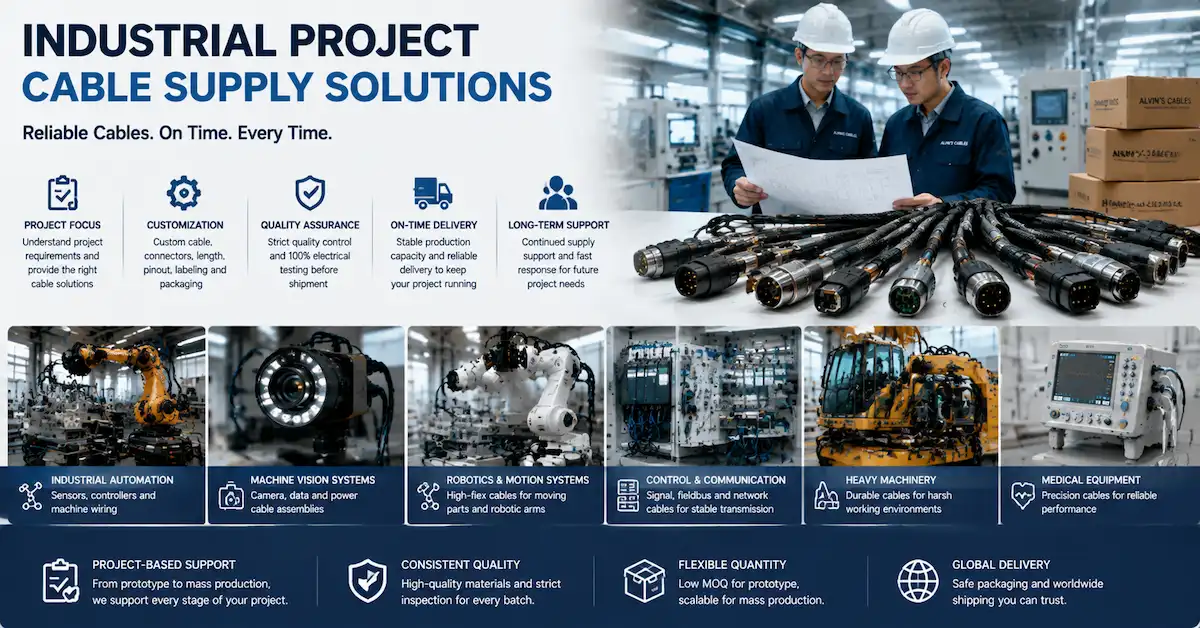
A reliable industrial cable supplier provides more than standard cables. For automation companies, machinery manufacturers, OEM equipment builders, and system integrators, the right supplier helps ensure stable power transmission, reliable signal communication, and long-term equipment performance.
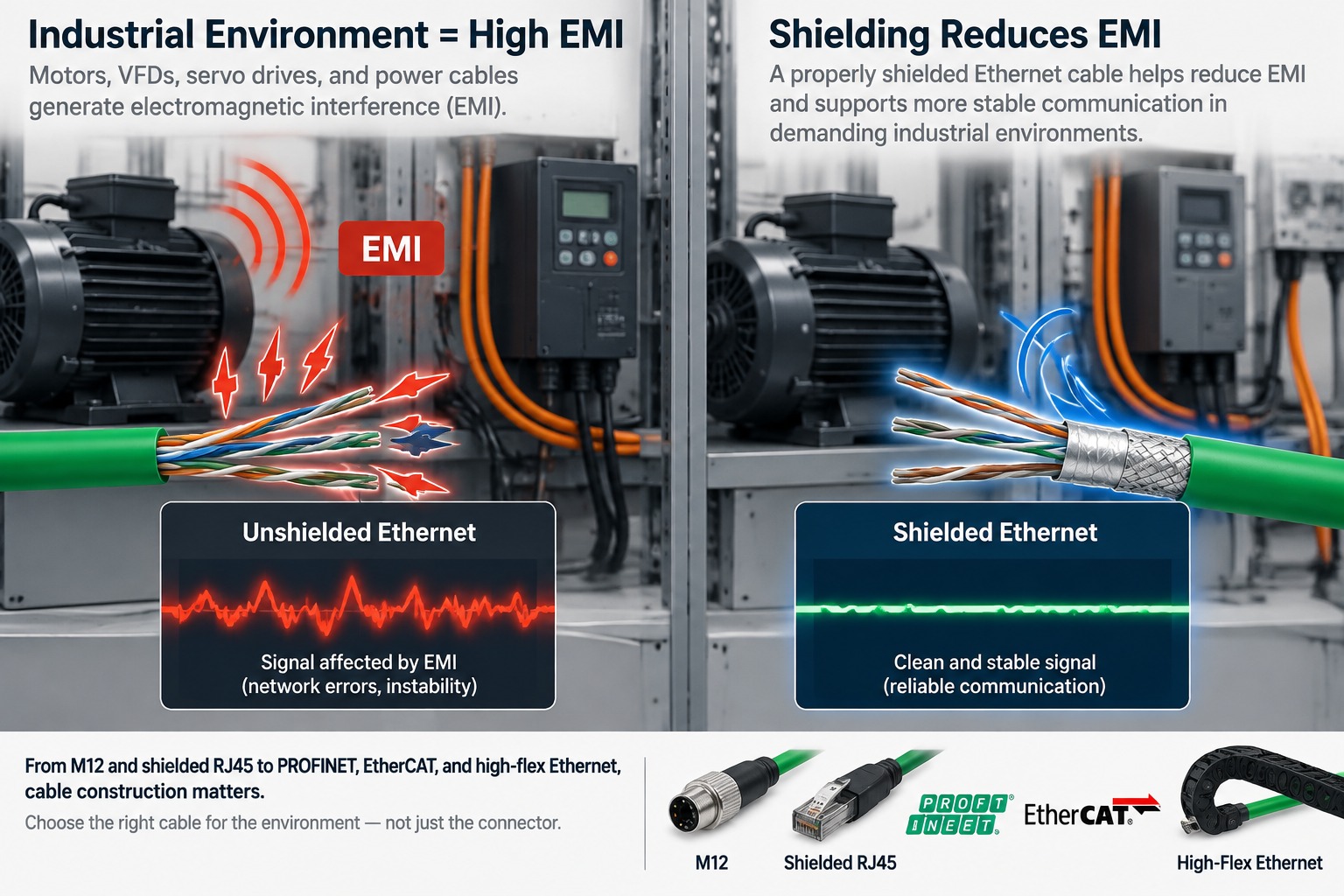
Industrial environments often involve vibration, continuous operation, temperature changes, electromagnetic interference, and mechanical stress. These conditions require cable solutions that are designed specifically for industrial applications.
For B2B buyers, choosing an industrial cable supplier should not only focus on price. Manufacturing capability, engineering support, customization ability, quality control, and long-term supply stability are equally important.
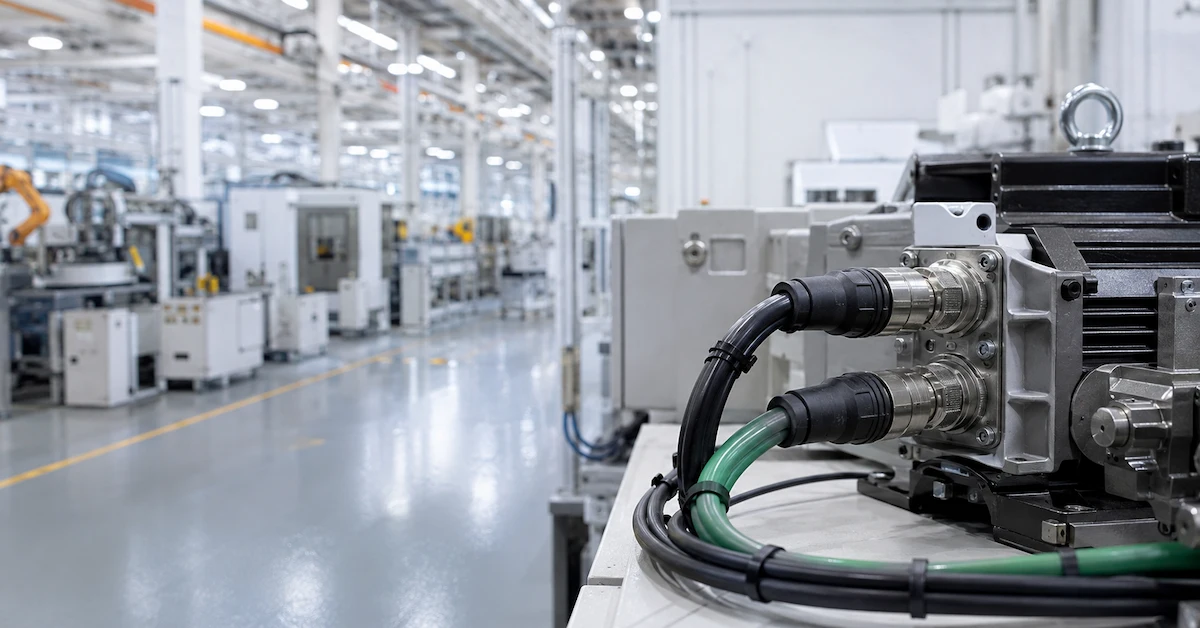
What Is an Industrial Cable Supplier?
An industrial cable supplier provides cable products and cable assemblies designed for industrial equipment, automation systems, machinery, and OEM applications.
Compared with general cable sellers, professional industrial cable suppliers usually support:
- Custom cable development
- Industrial connector solutions
- Cable assembly production
- Technical consultation
- Quality inspection
- Prototype development
- Bulk production
- OEM cooperation
Industrial cable solutions may include:
- Industrial cable assemblies
- Power cables
- Signal cables
- Sensor cables
- Shielded cables
- Flexible cables
- High flex cables
- Cable harnesses
- Custom connector cables
Who Needs an Industrial Cable Supplier?
| Buyer Type | Requirement | Main Concern |
|---|---|---|
| Automation manufacturers | Machine wiring solutions | Reliability |
| Machinery builders | Custom cable integration | Compatibility |
| Robotics companies | Moving cable solutions | Flexibility |
| OEM manufacturers | Long-term supply | Quality consistency |
| System integrators | Project cable solutions | Delivery capability |
| Industrial equipment brands | Stable cable performance | Product reliability |
| Electronics manufacturers | Internal wiring | Space optimization |
Companies that rely on continuous equipment operation need suppliers that understand industrial requirements.
Why Choosing the Right Industrial Cable Supplier Matters
1. Ensuring Equipment Reliability
Industrial equipment often operates for long periods. Cable failure can stop production, reduce efficiency, and increase maintenance costs.
A reliable industrial cable supplier helps reduce:
- Cable failure
- Signal interruption
- Equipment downtime
- Maintenance frequency
- Production risks
Reliable cable performance contributes directly to overall equipment stability.
2. Supporting Custom Industrial Applications
Industrial equipment often requires cables that cannot be purchased as standard products.
A professional supplier should support:
- Custom cable length
- Custom connector selection
- Custom pinout
- Shielding requirements
- Flexible cable designs
- Waterproof solutions
- Cable harness integration
- OEM specifications
Customization ensures the cable fits the actual machine design.
3. Providing Stable Quality Control
Industrial buyers need consistent quality across repeated orders.
A reliable supplier should manage:
- Material inspection
- Connector inspection
- Assembly control
- Electrical testing
- Functional testing
- Final inspection
Stable quality helps OEM customers maintain production efficiency.
4. Improving Supply Chain Stability
For manufacturers, supply reliability is critical.
A strong industrial cable supplier should provide:
- Production planning
- Repeat order support
- Stable capacity
- Delivery management
- Technical communication
- Long-term cooperation
This reduces supply chain risks and improves production planning.
Common Industrial Cable Applications
| Application | Cable Requirement | Buyer Concern |
| Industrial automation | Power and signal connection | Stable operation |
| Robotics | Flexible movement cable | Flex life |
| Machine vision | Camera and sensor cables | Signal quality |
| Factory equipment | Control wiring | Reliability |
| Testing systems | Accurate signal transmission | Electrical stability |
| Outdoor machinery | Environmental protection | Durability |
| Control cabinets | Organized wiring | Installation efficiency |
| OEM equipment | Custom cable integration | Repeat production |
Common Industrial Cable Solutions
| Cable Type | Application | Advantage |
| Industrial cable assembly | Machinery and automation | Reliable integration |
| M8 cable assembly | Compact sensors | Small and reliable |
| M12 cable assembly | Industrial communication | Rugged connection |
| Shielded cable | Noisy environments | EMI protection |
| High flex cable | Moving equipment | Bending resistance |
| Power cable assembly | Equipment power | Stable current delivery |
| Cable harness | Complex wiring | Organized installation |
| Custom connector cable | Special equipment | Better compatibility |
Industrial Cable Supplier vs Standard Cable Supplier
| Option | Advantages | Limitations | Best For |
| Standard cable supplier | Easy sourcing | Limited customization | Simple applications |
| Distributor | Fast availability | Limited engineering support | Standard products |
| Industrial cable supplier | Technical support and customization | Requires project communication | Industrial applications |
| Cable manufacturer | Full production control | Requires specifications | OEM projects |
For industrial applications, choosing a supplier with engineering and manufacturing capability provides better long-term value.
How to Evaluate an Industrial Cable Supplier
Before selecting a supplier, buyers should evaluate:
| Evaluation Point | What to Check |
| Industrial experience | Do they understand industrial applications? |
| Manufacturing ability | Can they support required volume? |
| Custom capability | Can they produce according to drawings? |
| Connector knowledge | Can they recommend suitable connectors? |
| Testing ability | Do they verify electrical performance? |
| Quality control | Do they maintain consistent standards? |
| Delivery capability | Can they support production schedules? |
| OEM support | Can they provide labeling and packaging? |
A good supplier should provide technical solutions, not only products.
What Information Should Buyers Provide?
For accurate quotation, buyers should prepare:
- Equipment application
- Cable type
- Connector requirements
- Cable length
- Signal or power requirements
- Pinout details
- Shielding requirements
- Environmental conditions
- Quantity
- Drawing, specification, or sample
Complete information helps suppliers provide accurate solutions.
Why Choose Alvin’s Cables as Your Industrial Cable Supplier?
Alvin’s Cables provides custom cable assembly solutions for industrial automation, professional video equipment, robotics, medical devices, test instruments, and OEM electronics.
As an industrial cable supplier, Alvin’s Cables can support:
- Custom industrial cable assemblies
- Signal and power cable solutions
- M8, M12, Hirose, RJ45, BNC, D-TAP, and custom connectors
- Shielded and flexible cable structures
- High flex cable solutions
- Cable harness development
- Custom cable length and pinout
- Prototype and sample approval
- Bulk production
- Electrical and functional testing
- OEM labeling and packaging
Buyers can explore related products through Alvin’s Cables Products, learn more about company capability from About Alvin’s Cables, or review service advantages through Why Choose Alvin’s Cables.
FAQ
1. What is an industrial cable supplier?
An industrial cable supplier provides cable products and assemblies designed for machinery, automation, industrial equipment, and OEM applications.
2. What industries use industrial cable suppliers?
Industries include automation, robotics, machinery, electronics, manufacturing, testing equipment, and OEM production.
3. Can industrial cable suppliers provide custom solutions?
Yes. They can customize cable length, connectors, pinout, shielding, materials, and packaging.
4. Why is shielding important for industrial cables?
Shielding helps reduce EMI/RFI interference and improves signal stability in industrial environments.
5. What connectors are commonly used in industrial cables?
Common connectors include M8, M12, RJ45 industrial Ethernet, Hirose, BNC, push-pull, and custom connectors.
6. Can Alvin’s Cables support OEM projects?
Yes. Alvin’s Cables supports custom OEM cable assemblies with testing and packaging requirements.
7. What should I provide for quotation?
Provide cable specifications, connector details, application environment, quantity, drawings, and special requirements.
8. How do I choose a reliable industrial cable supplier?
Evaluate manufacturing capability, customization, quality control, testing, communication, and long-term supply support.
Conclusion
Choosing the right industrial cable supplier helps manufacturers achieve reliable equipment performance, stable production, and long-term supply security.
A professional supplier provides more than cables. It provides engineering support, customization capability, quality assurance, and reliable cooperation.
If you need a custom industrial cable solution for automation, robotics, machinery, or OEM equipment, contact Alvin’s Cables with your cable requirements, specifications, and application details.