Selecting the correct cable is essential for industrial equipment reliability, safety, and long-term performance. A proper industrial cable selection process ensures that cables can handle required electrical loads, environmental conditions, mechanical stress, and communication requirements.
Industrial environments are often more demanding than general applications. Cables may face:
- Continuous operation
- Vibration
- Repeated movement
- Electromagnetic interference
- Temperature changes
- Oil and chemical exposure
- Tight installation spaces
Choosing the wrong cable can result in signal loss, overheating, premature failure, and unexpected equipment downtime.
For OEM manufacturers, automation companies, robotics developers, and industrial equipment suppliers, cable selection should be based on engineering requirements rather than price alone.
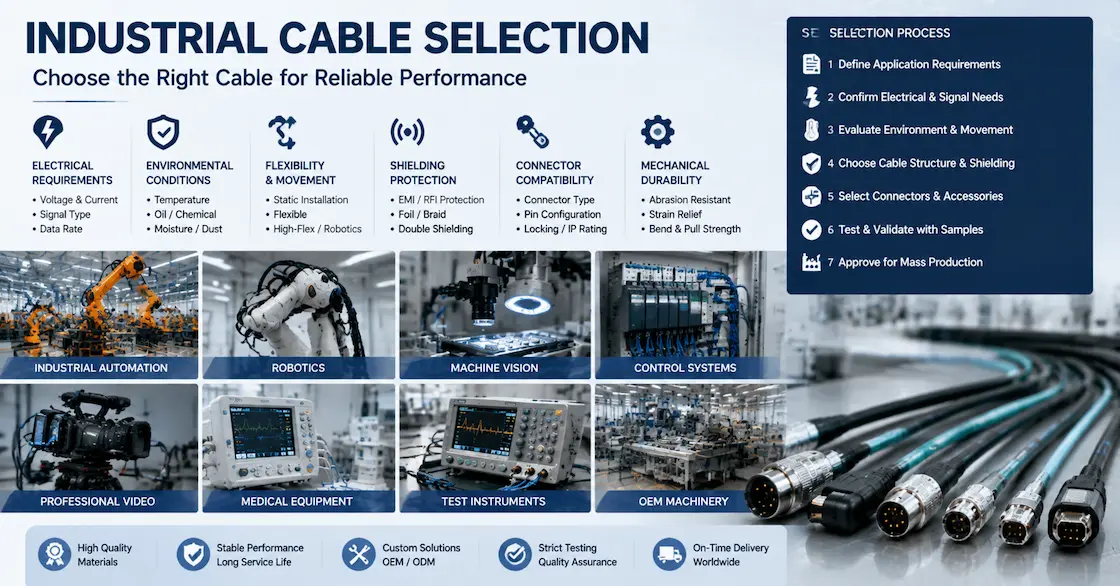
Why Industrial Cable Selection Matters
A cable is a critical component that connects different parts of an industrial system.
The correct cable selection helps ensure:
- Stable power transmission
- Reliable signal communication
- Reduced maintenance costs
- Longer service life
- Improved equipment safety
- Better production efficiency
Incorrect cable selection may lead to:
- Voltage drop
- Signal interference
- Cable damage
- Connector failure
- Production interruption
Key Factors in Industrial Cable Selection
1. Electrical Requirements
Electrical performance is the first consideration when selecting industrial cables.
Important parameters include:
- Voltage rating
- Current capacity
- Power requirements
- Signal type
- Data transmission speed
- Frequency requirements
Power Cable Selection
For power applications, buyers should consider:
- Operating voltage
- Continuous current
- Peak current
- Cable length
- Wire gauge
- Heat generation
A cable with insufficient current capacity may cause overheating and reduce equipment reliability.
Signal Cable Selection
Signal applications require attention to:
- Signal type
- Transmission distance
- Noise environment
- Shielding requirements
- Data rate
Sensitive systems such as machine vision and testing equipment require more precise cable selection.
2. Working Environment
Industrial environments significantly affect cable performance.
Before selecting a cable, evaluate:
| Environment Factor | Cable Requirement |
|---|---|
| High temperature | Heat-resistant jacket materials |
| Oil exposure | Oil-resistant cable jacket |
| Moisture | Waterproof protection |
| Vibration | Rugged construction |
| Dust | Protected cable structure |
| Chemical exposure | Chemical-resistant materials |
| Outdoor use | UV and weather resistance |
The same cable may perform differently depending on the installation environment.
3. Cable Flexibility Requirements
Cable movement is an important factor in industrial applications.
Different applications require different flexibility levels.
| Cable Type | Application |
| Standard cable | Fixed installation |
| Flexible cable | Equipment movement |
| High-flex cable | Robotics and repeated bending |
| Rugged cable | Harsh industrial environments |
For moving equipment, cable flexibility directly affects service life.
Applications requiring high-flex cables include:
- Robotic arms
- CNC machines
- Automated production lines
- Moving camera systems
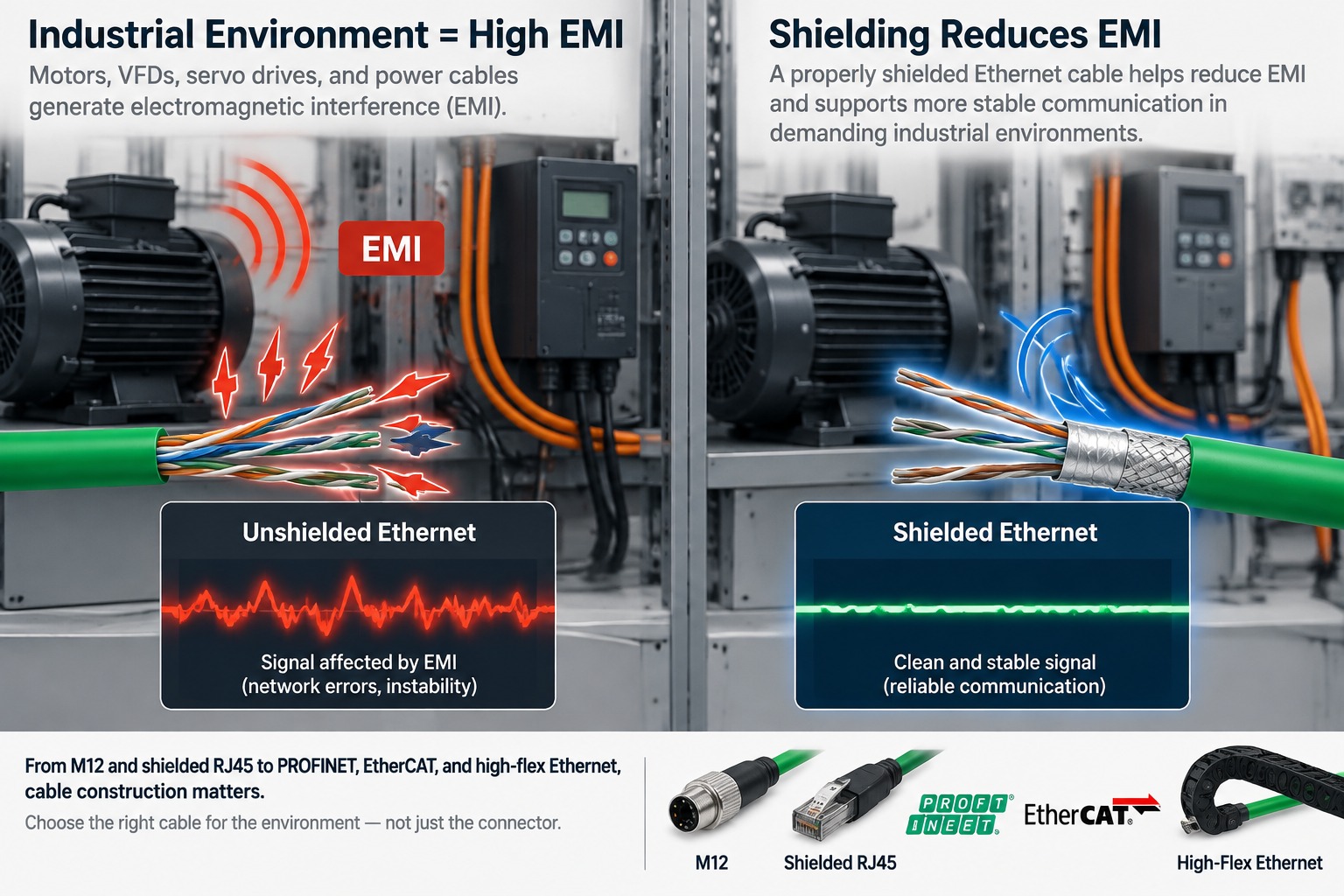
4. Shielding Requirements
Electromagnetic interference can affect industrial equipment performance.
Sources of interference include:
- Motors
- Power supplies
- Frequency converters
- Industrial controllers
- High-current cables
Shielding options include:
Foil Shielding
Suitable for:
- High-frequency interference protection
- Lightweight applications
Braided Shielding
Suitable for:
- Better mechanical protection
- Industrial environments
Double Shielding
Suitable for:
- Sensitive signal applications
- High-interference environments
Shielding is especially important for:
- Machine vision systems
- Data cables
- Test equipment
- Communication systems
5. Connector Selection
Cable performance also depends on connector quality.
Important connector factors include:
- Connector type
- Pin count
- Current rating
- Voltage rating
- Locking method
- Environmental protection
Common industrial connectors include:
- M8
- M12
- RJ45
- Hirose
- BNC
- XLR
- Circular connectors
- Custom connectors
The connector should match both the equipment interface and application environment.
6. Mechanical Protection
Industrial cables often experience mechanical stress.
Protection requirements may include:
- Strain relief
- Protective sleeving
- Overmolding
- Reinforced jackets
- Abrasion resistance
A well-designed cable assembly prevents damage caused by:
- Pulling force
- Bending
- Vibration
- Repeated installation
Industrial Cable Selection by Application
| Application | Recommended Cable Considerations |
| Industrial automation | Shielding, durability, signal stability |
| Robotics | Flexibility, bending cycles, strain relief |
| Machine vision | High-speed transmission, EMI protection |
| Control systems | Accurate wiring, reliable connectors |
| Professional video | Signal quality, connector compatibility |
| Medical equipment | Consistency and safety |
| Test equipment | Low interference and accuracy |
| OEM machinery | Customization and repeat production |
Industrial Cable Selection Mistakes to Avoid
Choosing Only Based on Price
Lower-cost cables may use:
- Lower-quality conductors
- Weak shielding
- Poor connectors
- Limited testing
The cheapest cable may create higher long-term costs.
Ignoring Environmental Conditions
A cable designed for indoor use may fail in:
- Outdoor environments
- High vibration areas
- Chemical exposure
- Moving applications
Selecting Incorrect Cable Flexibility
Using a fixed cable in a moving application can cause:
- Internal conductor damage
- Jacket cracking
- Short service life
Ignoring Future Production Needs
For OEM products, buyers should consider:
- Repeat availability
- Material stability
- Supplier production capability
Industrial Cable Selection Process
Step 1: Define Application Requirements
Identify:
- Equipment type
- Cable function
- Installation environment
- Expected service life
Step 2: Confirm Electrical Requirements
Evaluate:
- Voltage
- Current
- Signal type
- Data requirements
Step 3: Select Cable Structure
Determine:
- Conductor size
- Shielding
- Jacket material
- Flexibility level
Step 4: Confirm Connectors
Check:
- Interface compatibility
- Pin configuration
- Locking method
Step 5: Validate Through Samples
Test:
- Equipment compatibility
- Performance
- Installation convenience
- Durability
How to Choose an Industrial Cable Supplier?
A reliable supplier should provide:
| Evaluation Point | What to Check |
| Engineering support | Can they recommend suitable cables? |
| Customization | Can they modify cable structures? |
| Manufacturing | Can they support repeat production? |
| Testing | Can they verify performance? |
| Quality control | Are processes documented? |
| Delivery | Can they maintain stable supply? |
A professional supplier should help customers select the right cable, not only sell products.
What Information Should Buyers Provide?
For accurate industrial cable selection, provide:
- Equipment application
- Cable function
- Voltage requirement
- Current requirement
- Signal type
- Cable length
- Connector requirements
- Flexibility requirements
- Environmental conditions
- Quantity
- Drawings or samples
Why Choose Alvin’s Cables for Industrial Cable Solutions?
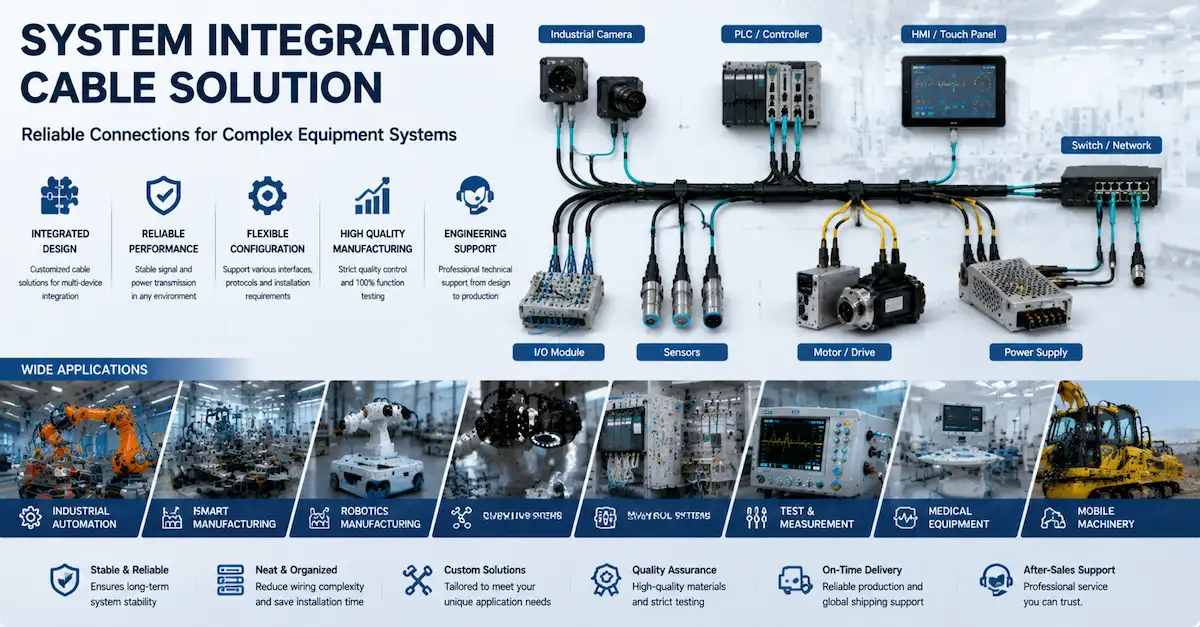
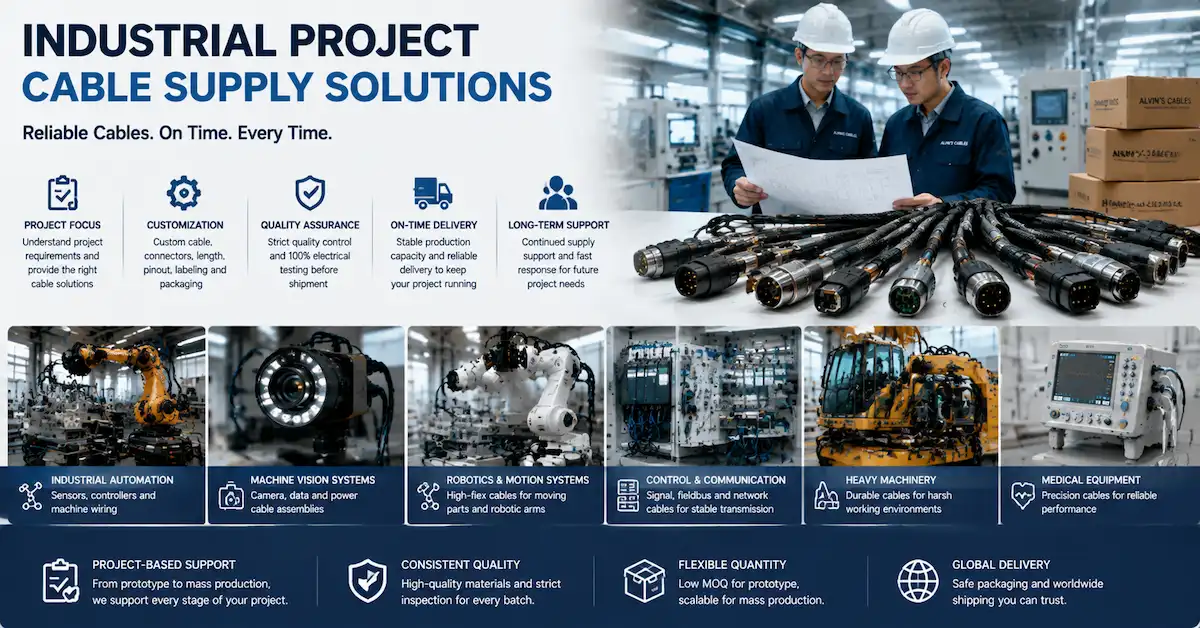
Alvin’s Cables provides customized industrial cable solutions for automation equipment, robotics, machine vision systems, professional video equipment, test instruments, and OEM machinery.
Capabilities include:
- Industrial cable selection support
- Custom cable assemblies
- Signal and power cables
- Shielded cable solutions
- High-flex cable assemblies
- Cable harness production
- M8, M12, Hirose, RJ45, BNC, SDI, HDMI, D-TAP, XLR, and custom connectors
- Prototype development
- Electrical and functional testing
- OEM labeling and packaging
Buyers can explore available products through Alvin’s Cables Products, learn about manufacturing capabilities through About Alvin’s Cables, and review service advantages through Why Choose Alvin’s Cables.
FAQ
1. What is industrial cable selection?
Industrial cable selection is the process of choosing suitable cables based on electrical, mechanical, environmental, and application requirements.
2. What factors should be considered when selecting industrial cables?
Important factors include voltage, current, signal type, shielding, flexibility, environment, connectors, and durability.
3. Why is shielding important in industrial cables?
Shielding reduces electromagnetic interference and improves signal reliability.
4. How do I choose a cable for robotics?
Robotic applications usually require high-flex cables with strong bending resistance and durable protection.
5. Can industrial cables be customized?
Yes. Cable length, connectors, shielding, materials, and structures can be customized.
6. Why does cable flexibility matter?
Proper flexibility prevents internal damage and extends cable service life in moving applications.
7. Can Alvin’s Cables help select the right cable?
Yes. Alvin’s Cables provides engineering support based on equipment requirements and application conditions.
8. What information is needed for cable selection?
Provide application details, electrical requirements, environment, connector information, and quantity.
Conclusion
A correct industrial cable selection process helps businesses improve equipment reliability, reduce failures, and achieve stable long-term operation.
The right cable depends on more than appearance or price. Electrical performance, environment, flexibility, shielding, connectors, and manufacturing quality must all be considered.
For customized industrial cable solutions, contact Alvin’s Cables with your application requirements and technical specifications.