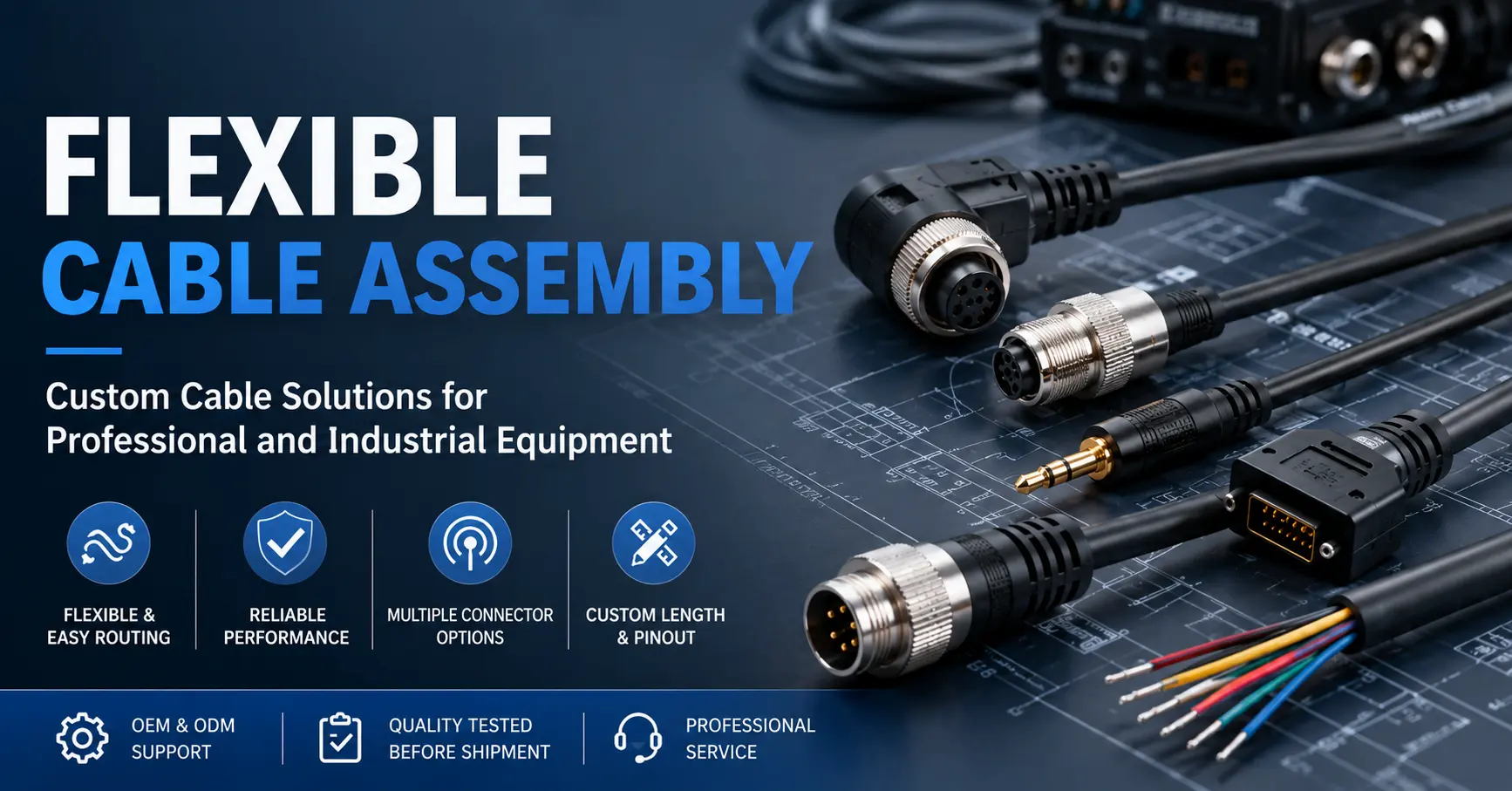
The best custom cable manufacturer is not necessarily the largest factory or the supplier offering the lowest quotation. It is the manufacturer that can understand your application, convert technical requirements into a reliable cable assembly, validate the design, and reproduce the approved product consistently.
For industrial automation, professional camera systems, machine vision equipment, medical devices, robotics, test instruments, and OEM electronics, cable assemblies may carry power, video, data, control signals, or several functions at the same time.
A cable that looks correct externally may still fail because of an incorrect pinout, unsuitable conductor size, weak shielding, poor connector termination, or insufficient strain relief.
B2B buyers should therefore evaluate a custom cable manufacturer as an engineering and production partner rather than simply a cable source.
What Does a Custom Cable Manufacturer Do?
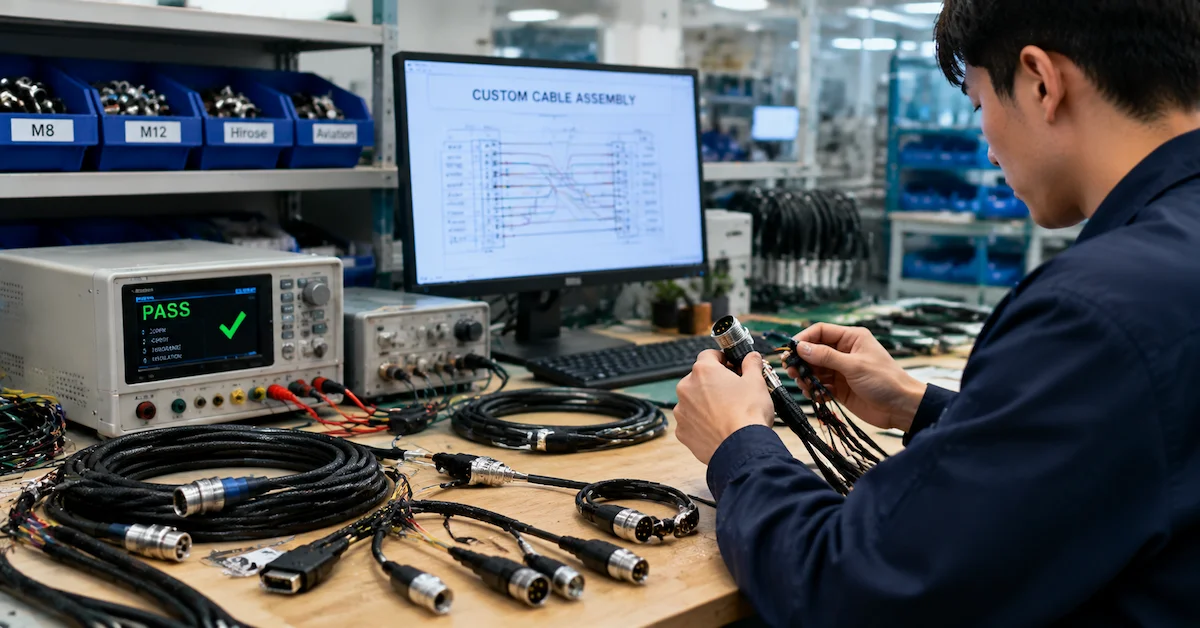
A custom cable manufacturer develops cable assemblies according to the customer’s equipment, electrical, mechanical, environmental, and commercial requirements.
Custom manufacturing services may include:
- Connector identification and sourcing
- Cable and conductor selection
- Pinout and wiring development
- Cable-length customization
- Shielding and grounding design
- Multi-branch harness development
- Straight or right-angle connector assembly
- Strain relief and overmolding
- Prototype production
- Electrical and functional testing
- OEM labels and packaging
- Repeat production management
The manufacturer may work from a drawing, wiring diagram, technical specification, equipment photograph, or physical sample.
Who Needs a Custom Cable Manufacturer?
| Buyer Type | Typical Requirement | Main Purchasing Concern |
|---|---|---|
| OEM equipment manufacturers | Product-specific cable assemblies | Compatibility and repeatability |
| Industrial automation companies | Sensor, control, and power cables | Reliability and EMI protection |
| Camera equipment brands | Video, power, and control cables | Signal stability and field durability |
| Machine vision integrators | Camera, trigger, lighting, and data cables | High-speed transmission |
| Medical equipment manufacturers | Device-specific connections | Accuracy and consistency |
| Robotics companies | Flexible moving cable assemblies | Flex life and strain relief |
| Test equipment manufacturers | Signal and measurement cables | Contact and signal stability |
| Distributors | Private-label cable products | Supply continuity and packaging |
The more specialized the equipment, the more important engineering support becomes.
What Makes the Best Custom Cable Manufacturer?
1. Strong Application Understanding
A capable manufacturer should first understand what the cable does.
Important questions include:
- What equipment will the cable connect?
- Will it transmit power, data, video, audio, or control signals?
- Is the cable fixed or moving?
- Will it operate near motors or power cables?
- Is the installation space limited?
- Will it be used indoors, outdoors, or in a rugged environment?
A manufacturer that understands the application can identify technical risks before sample production.
2. Connector and Interface Expertise
Custom cables frequently use specialized interfaces.
Common options include:
- M8 and M12
- Hirose
- BNC and SDI
- HDMI
- RJ45
- D-TAP
- XLR
- DC power connectors
- Push-pull circular connectors
- Open-end wiring
- Customer-specific connectors
Similar-looking connectors may differ in pin count, keying, contact type, shell size, locking structure, and electrical rating.
The manufacturer should verify the exact interface instead of relying only on visual similarity.
3. Accurate Pinout Control
Pinout accuracy is essential for custom cable production.
Buyers should provide:
- Pin-to-pin wiring
- Signal names
- Voltage and current
- Positive and negative polarity
- Grounding requirements
- Shield termination
- Unused-pin instructions
An incorrect pinout may cause unstable operation, signal failure, or equipment damage even when the connectors fit correctly.
The approved wiring diagram should remain under revision control for future orders.
4. Appropriate Material Selection
The most expensive material is not always necessary, while the cheapest material may not meet the application requirements.
A professional manufacturer should help evaluate:
- Conductor material
- Wire gauge
- Insulation
- Cable jacket
- Shielding structure
- Connector grade
- Protective sleeving
- Strain-relief material
Material selection should consider electrical load, signal sensitivity, movement, temperature, abrasion, moisture, and expected service life.
5. Prototype and Sample Capability
The best custom cable manufacturer should support prototype development before bulk production.
A prototype allows the buyer to verify:
- Connector fit
- Pinout
- Cable length
- Connector orientation
- Cable routing
- Flexibility
- Signal stability
- Power performance
- Installation convenience
Samples should be tested in the actual equipment whenever possible.
Custom Cable Development Process
| Stage | Manufacturer Activity | Buyer Responsibility |
| Requirement review | Confirm application, connector, wiring, and environment | Provide drawings, samples, or specifications |
| Technical evaluation | Recommend cable, connector, shielding, and protection | Answer technical questions |
| Quotation | Calculate materials, production, testing, and packaging | Confirm quantity and commercial needs |
| Prototype production | Build initial cable samples | Place sample order |
| Equipment validation | Support revisions and technical clarification | Test samples in actual equipment |
| Pilot production | Verify repeatability in a small batch | Approve production process |
| Mass production | Manufacture using approved documentation | Issue purchase order |
| Repeat supply | Maintain specification and batch consistency | Provide forecasts and revision updates |
A structured development process reduces the risk of expensive corrections after mass production begins.
Testing Capabilities Buyers Should Check
Custom cable testing should match the application.
Basic Electrical Testing
Common checks include:
- Continuity
- Short circuit
- Pinout
- Polarity
- Ground connection
Mechanical Inspection
Depending on the product, inspection may include:
- Cable and branch length
- Connector orientation
- Strain relief
- Pull resistance
- Overmolding appearance
- Label position
Functional Testing
Functional verification may involve:
- Camera and monitor connection
- Signal transmission
- Power delivery
- Communication testing
- Sensor or controller operation
- Equipment-side compatibility
A manufacturer should clearly explain which tests are included in the quotation.
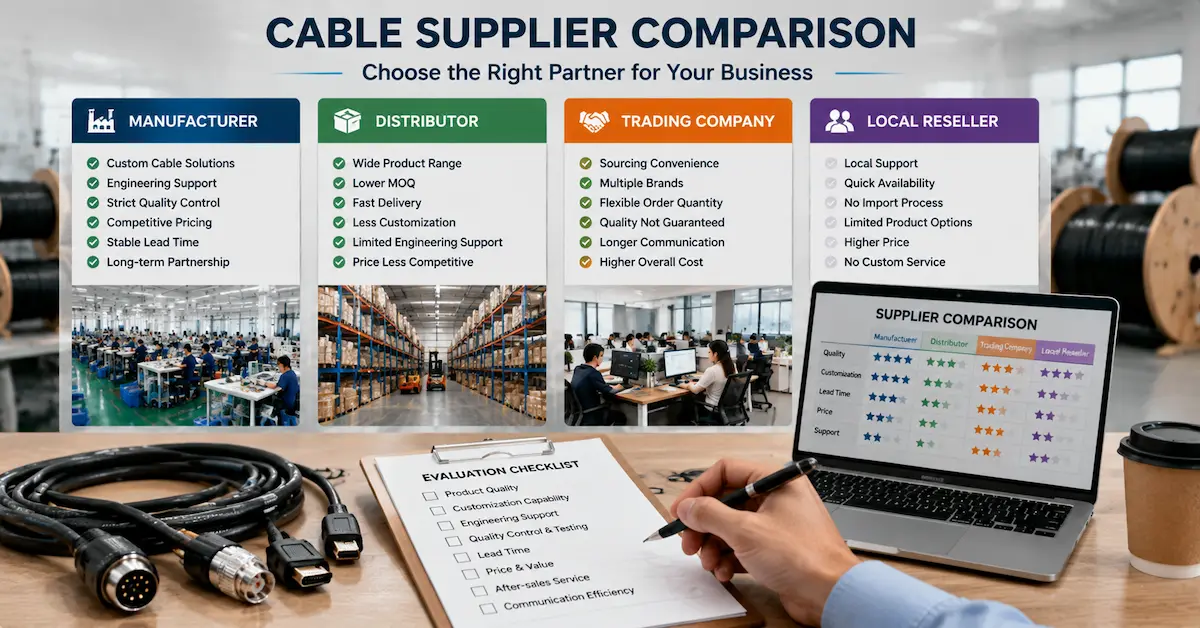
Standard Cable Supplier vs Custom Cable Manufacturer
| Supplier Type | Main Advantage | Main Limitation | Best For |
| Retail cable seller | Immediate availability | Little customization | Basic replacement |
| Cable distributor | Broad standard product range | Limited production control | Common interfaces |
| Custom cable supplier | Modifies lengths or connectors | Engineering depth varies | Small custom orders |
| Custom cable manufacturer | Engineering, samples, production, and testing | Requires project communication | OEM and professional equipment |
| Cable harness manufacturer | Strong multi-wire integration | May focus less on external video or AV cables | Complex internal wiring |
Buyers should choose the supplier type according to the technical and production complexity of the project.
How to Compare Custom Cable Manufacturers
| Evaluation Point | What Buyers Should Confirm |
| Industry experience | Has the manufacturer produced cables for similar applications? |
| Engineering support | Can it review connectors, pinouts, current, and signal requirements? |
| Prototype capability | Can it produce samples before volume production? |
| Connector sourcing | Can it support original and compatible options when required? |
| Material control | Are cable and connector specifications documented? |
| Testing | Are electrical and functional checks available? |
| Revision control | Are drawings and product changes managed properly? |
| Batch consistency | Can approved samples be reproduced reliably? |
| Production capacity | Can the manufacturer support current and future demand? |
| OEM support | Are labels, packaging, and product identification available? |
| Communication | Are technical questions answered clearly and promptly? |
| Delivery planning | Can repeat-order lead times be managed predictably? |
This comparison should be based on the same technical specification. Quotations using different connectors, wire gauges, shielding, or testing methods are not directly comparable.
Common Buyer Mistakes
Choosing Only by the Lowest Price
A low quotation may use different conductors, connectors, shielding, jackets, or testing processes.
The buyer should compare total value, not only unit cost.
Sending Only a Product Photograph
A photograph does not show the internal wiring, voltage, current, signal type, grounding, or shielding.
Provide technical documentation whenever possible.
Skipping Prototype Validation
A cable can pass continuity testing but still be too stiff, too long, or difficult to install.
Equipment-side validation is essential.
Ignoring Future Connector Availability
A connector may be available for samples but difficult to source for long-term production.
Discuss repeat demand and material planning during development.
Allowing Uncontrolled Product Changes
Connector substitutions or drawing revisions can affect compatibility and performance.
Critical changes should require buyer approval.
What Information Is Needed for a Quotation?
To receive an accurate quotation from a custom cable manufacturer, provide:
- Equipment application
- Connector models or detailed photographs
- Pinout or wiring diagram
- Cable and branch lengths
- Voltage and current
- Signal, video, audio, or data requirements
- Shielding and grounding requirements
- Connector orientation
- Flexibility or movement requirements
- Operating environment
- Prototype quantity
- Expected production quantity
- Annual demand estimate
- Labeling and packaging requirements
- Drawings, specifications, or physical samples
Complete information reduces quotation uncertainty and sample revisions.
Why Consider Alvin’s Cables for Custom Cable Manufacturing?
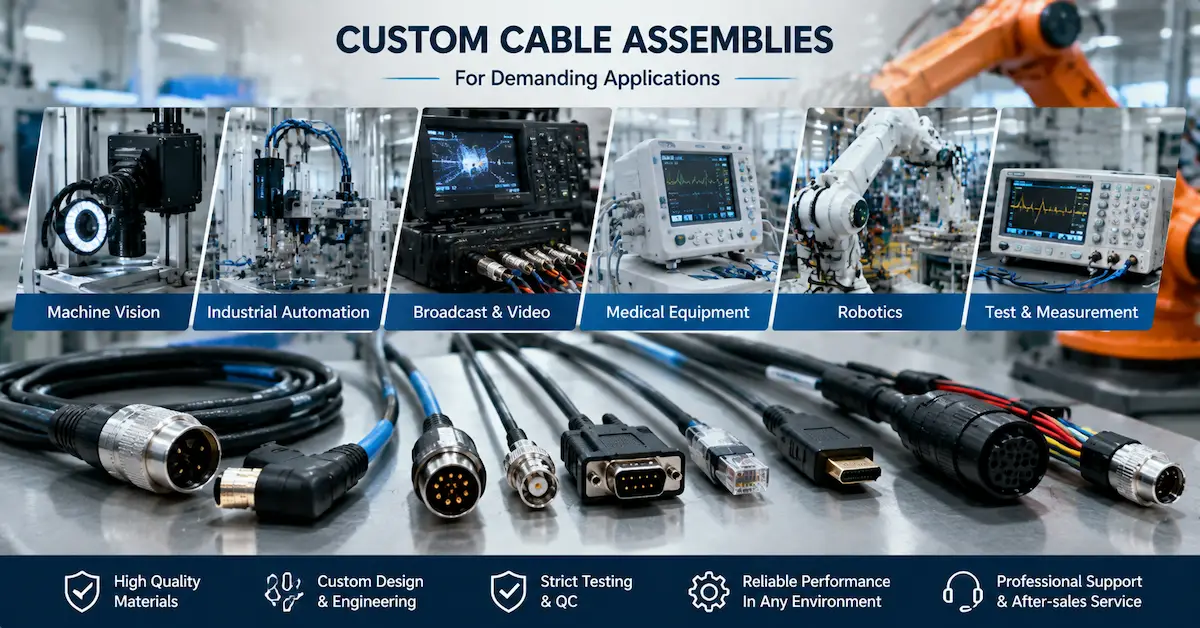
Alvin’s Cables supports custom cable assemblies and connector solutions for professional video equipment, industrial automation, machine vision, medical devices, test instruments, robotics, and OEM electronics.
Custom manufacturing capabilities can include:
- Drawing- and sample-based cable development
- Custom cable length and pinout
- Signal, power, video, audio, data, and control cables
- M8, M12, Hirose, RJ45, BNC, SDI, HDMI, D-TAP, XLR, push-pull, and open-end solutions
- Shielded and flexible cable structures
- Multi-connector cables and cable harnesses
- Strain relief and overmolding
- Prototype and pilot production
- Low-to-mid-volume repeat manufacturing
- Electrical and functional testing
- OEM labeling and packaging
Buyers can review available cable and connector categories through Alvin’s Cables Products, learn more about company capabilities on the About Us page, and review service advantages through Why Choose Alvin’s Cables.
FAQ
1. What is the best custom cable manufacturer?
The best custom cable manufacturer is the supplier that can meet the specific project’s technical, quality, production, delivery, and commercial requirements consistently.
2. Can custom cables be manufactured from samples?
Yes. Manufacturers can evaluate physical samples, but pinout, electrical requirements, and application information should also be provided.
3. What parts of a cable assembly can be customized?
Connectors, cable length, branch layout, pinout, wire gauge, shielding, jacket, strain relief, labels, and packaging can be customized.
4. Why are prototype cables important?
Prototypes allow buyers to verify fit, wiring, routing, signal performance, power delivery, and mechanical suitability before mass production.
5. What testing should custom cables receive?
Testing may include continuity, short circuit, pinout, polarity, dimensions, connector fit, functional performance, and visual inspection.
6. Can a custom cable manufacturer support small quantities?
Many manufacturers can support prototype and low-to-mid-volume production, although MOQ depends on materials, connectors, tooling, and packaging.
7. How should buyers compare cable quotations?
Compare quotations using identical connectors, conductors, shielding, lengths, testing, labels, and packaging requirements.
8. How can I request a custom cable quotation?
Submit your connector information, wiring diagram, cable dimensions, electrical requirements, application environment, and quantities through the Contact Us page.
Conclusion
Finding the best custom cable manufacturer requires evaluating more than price. The right partner should understand the application, verify connectors and pinouts, select suitable materials, develop prototypes, perform appropriate testing, and maintain consistent repeat production.
For OEM and professional equipment projects, a capable cable manufacturer can reduce development risks, simplify equipment integration, and support a more reliable supply chain.
Contact Alvin’s Cables with your drawings, samples, connector details, wiring requirements, quantities, and application information to evaluate a custom cable assembly solution.