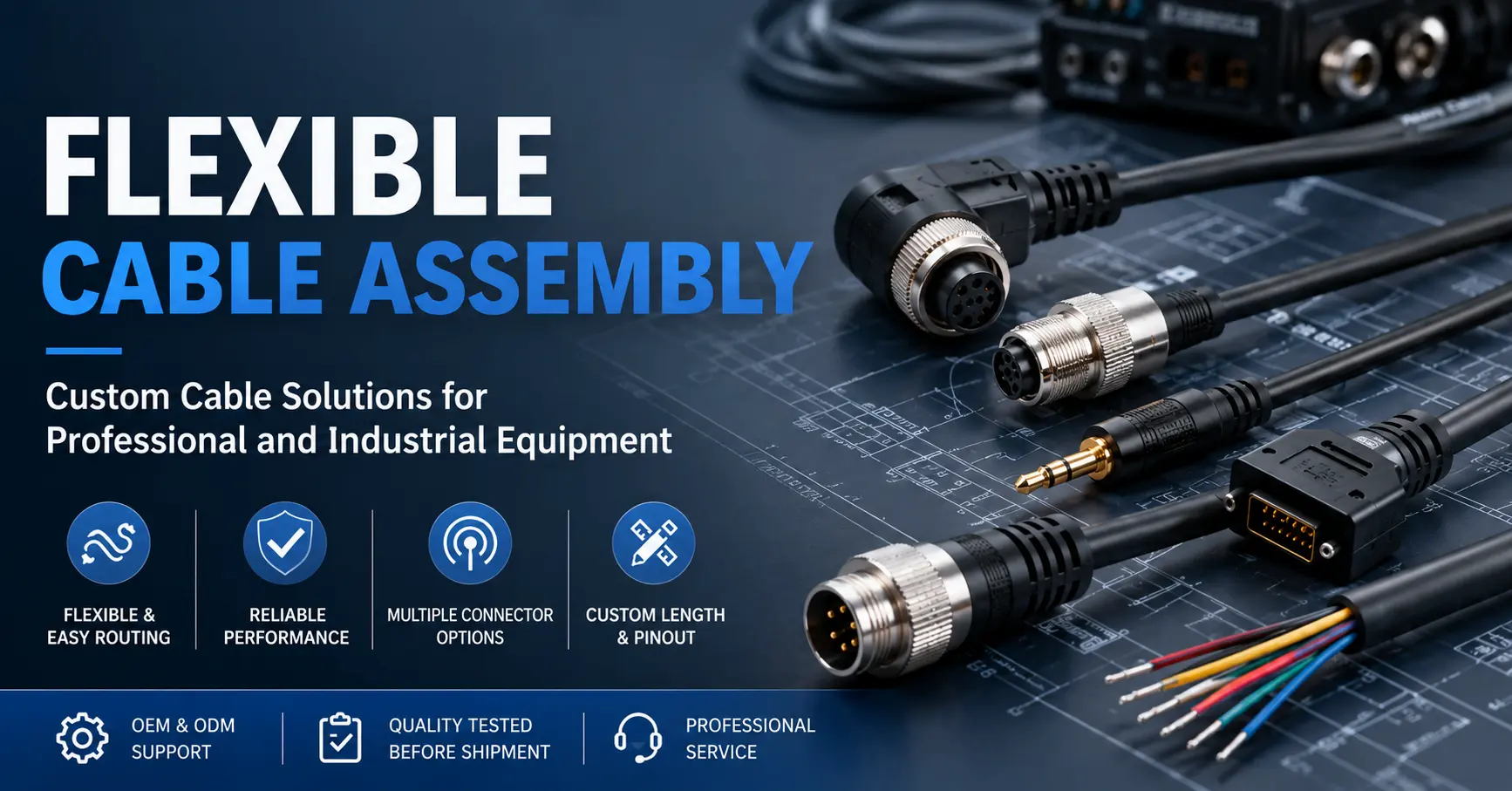
For OEM manufacturers, industrial equipment companies, and professional system integrators, cable quality directly affects equipment performance, production efficiency, and customer satisfaction.
A proper cable quality comparison helps buyers understand why two cables with similar appearances may have completely different performance levels.
Cable quality is determined by multiple factors, including:
- Raw materials
- Cable structure
- Connector quality
- Shielding design
- Manufacturing processes
- Testing standards
- Application suitability
Choosing the right cable is not only about purchasing a component. It is about selecting a reliable connection solution that can operate consistently throughout the product lifecycle.
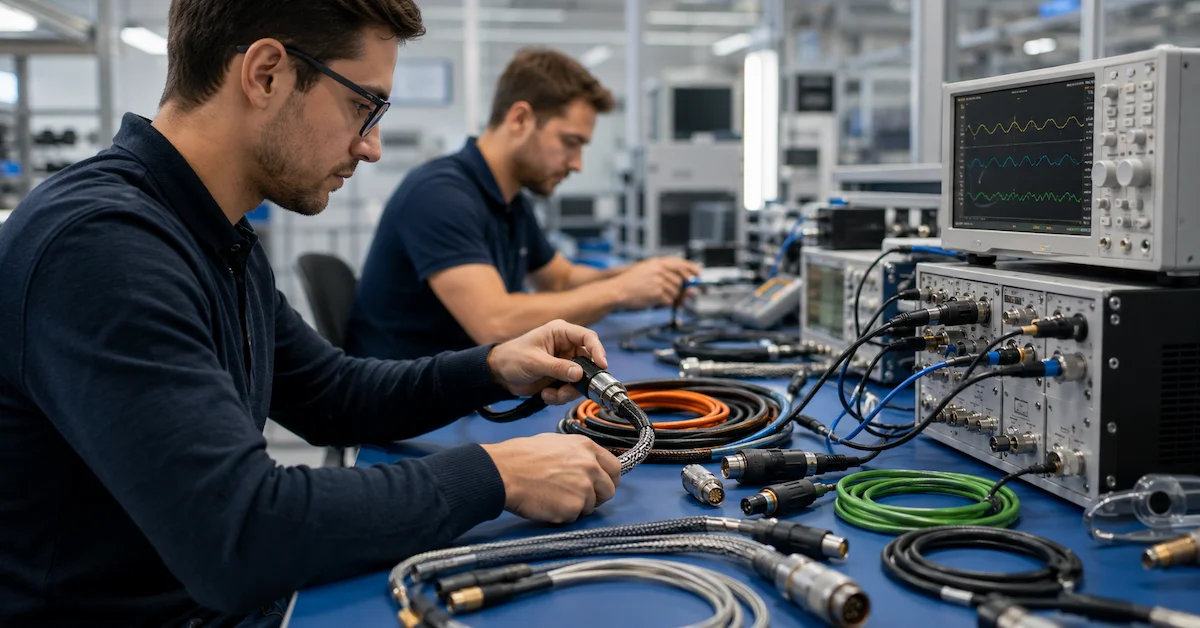
Why Cable Quality Matters
Cables often work as critical connections for:
- Power transmission
- Signal communication
- Video transmission
- Data transfer
- Equipment control
A low-quality cable may cause:
- Signal instability
- Voltage drop
- Electrical interference
- Connector failure
- Short service life
- Equipment downtime
For industrial and OEM applications, cable failures can create much higher costs than the original purchasing price.
Key Factors in Cable Quality Comparison
1. Conductor Material Comparison
The conductor is one of the most important parts of a cable because it directly affects electrical performance.
Important factors include:
- Conductivity
- Wire gauge
- Resistance
- Current capacity
- Heat generation
| Conductor Type | Advantage | Typical Application |
|---|---|---|
| High-quality copper conductor | Better conductivity and stability | Industrial and professional equipment |
| Standard copper conductor | Balanced cost and performance | General applications |
| Lower-grade conductor | Lower initial cost | Less demanding applications |
A suitable conductor should match the required voltage, current, and operating environment.
2. Cable Structure Comparison
Cable construction affects:
- Flexibility
- Durability
- Signal quality
- Environmental resistance
Important structural elements include:
- Insulation layer
- Shielding layer
- Outer jacket
- Internal arrangement
- Reinforcement structure
| Cable Structure | Benefit | Application |
| Flexible structure | Easier installation and movement | Robotics |
| Shielded structure | Reduces interference | Signal systems |
| Rugged jacket design | Better protection | Industrial environments |
| Multi-core structure | Supports multiple functions | Complex equipment |
3. Shielding Performance Comparison
Shielding is important for applications sensitive to electromagnetic interference.
Poor shielding may cause:
- Signal noise
- Data errors
- Communication interruption
- Image distortion
Common shielding methods include:
Foil Shielding
Advantages:
- Lightweight
- Good high-frequency protection
Braided Shielding
Advantages:
- Better mechanical strength
- Improved durability
Double Shielding
Advantages:
- Higher interference protection
- Suitable for demanding environments
Applications include:
- Machine vision
- Industrial automation
- Test equipment
- Professional video systems
4. Connector Quality Comparison
Connectors directly affect:
- Connection stability
- Mechanical durability
- Signal performance
- Installation reliability
A quality connector should provide:
- Accurate dimensions
- Reliable contacts
- Secure locking
- Proper electrical rating
- Long mating life
Common professional connectors include:
- M8
- M12
- Hirose
- BNC
- SDI
- HDMI
- RJ45
- XLR
- D-TAP
- Push-pull connectors
5. Cable Flexibility Comparison
Different applications require different flexibility levels.
| Cable Type | Flexibility Requirement | Application |
| Standard cable | Low movement | Fixed installation |
| Flexible cable | Regular movement | Equipment wiring |
| High-flex cable | Continuous movement | Robotics |
| Rugged cable | Harsh environment | Industrial systems |
Using the wrong cable flexibility may result in:
- Internal conductor damage
- Jacket cracking
- Connector stress
- Reduced service life
Cable Quality Comparison: Standard vs Professional Cable
| Factor | Standard Cable | Professional Cable |
| Materials | General materials | Application-selected materials |
| Testing | Basic inspection | Detailed electrical testing |
| Shielding | Standard protection | Optimized shielding |
| Connector quality | General connectors | Professional-grade connectors |
| Durability | Normal usage | Industrial requirements |
| Customization | Limited | Fully customizable |
| Repeat production | Depends on supplier | Controlled manufacturing |
Manufacturing Process and Quality Control
High-quality cables depend on controlled manufacturing processes.
A professional cable manufacturer should manage:
Material Inspection
Including:
- Cable specifications
- Connector quality
- Wire materials
- Component consistency
Assembly Process
Including:
- Cutting accuracy
- Wire preparation
- Crimping
- Soldering
- Connector assembly
- Strain relief
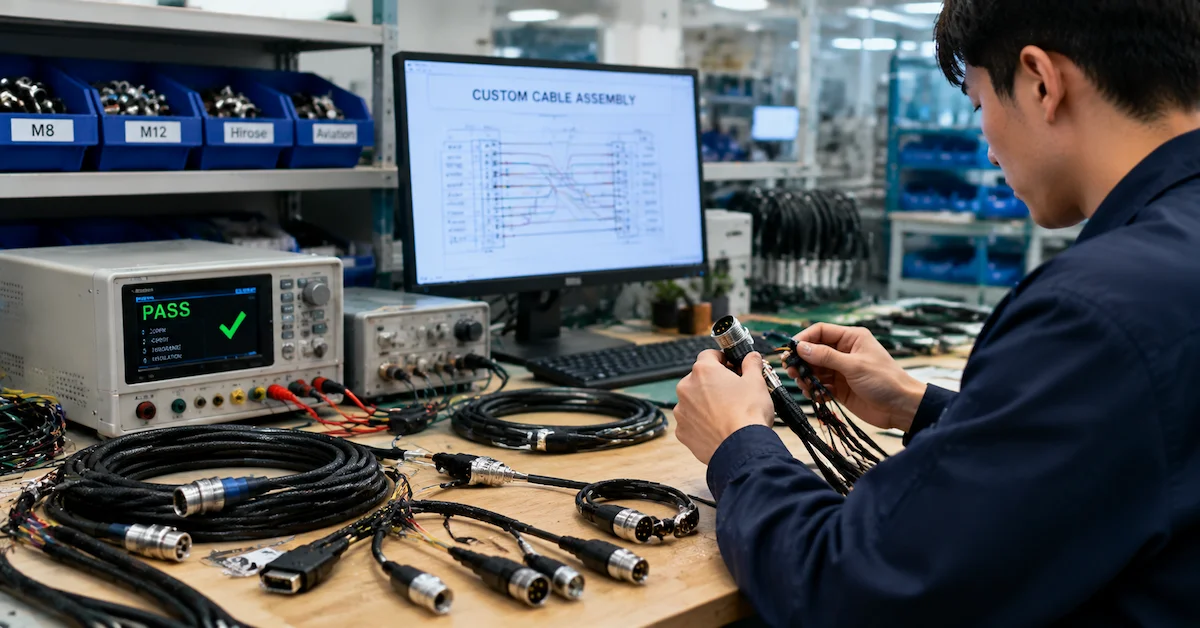
Final Testing
Common tests include:
- Continuity testing
- Short circuit testing
- Pinout verification
- Polarity testing
- Functional testing
- Visual inspection
Testing ensures that finished cables meet customer requirements.
Cable Quality Comparison by Application
| Application | Important Quality Factors |
| Industrial automation | Durability, shielding, reliability |
| Robotics | Flexibility, bending life, strain relief |
| Machine vision | Signal integrity, transmission stability |
| Professional video | Low signal loss, connector quality |
| Medical equipment | Accuracy and consistency |
| Test instruments | Stable electrical performance |
| OEM machinery | Repeat production capability |
The best cable is not always the most expensive cable. It is the cable that matches the application requirements.
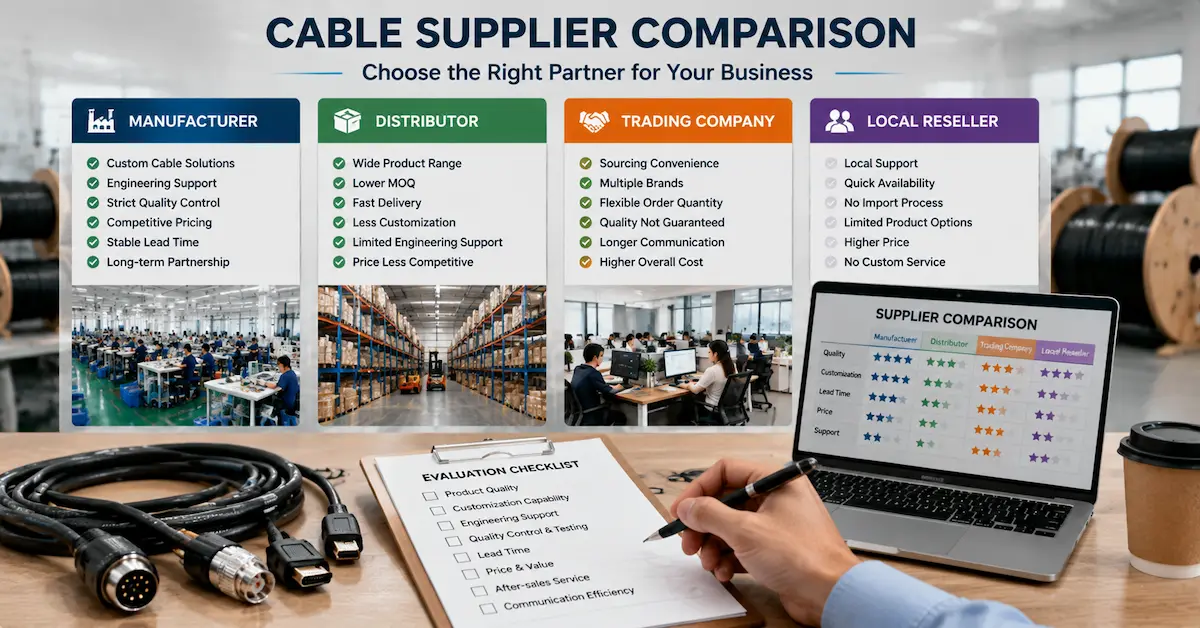
How to Evaluate Cable Quality Before Purchasing
Buyers should review:
| Evaluation Item | Questions |
| Materials | Are cable materials clearly specified? |
| Structure | Does the cable match the application? |
| Connectors | Are connector models confirmed? |
| Testing | What tests are included? |
| Production | Is manufacturing controlled? |
| Samples | Can performance be verified? |
| Consistency | Can future batches match? |
Common Mistakes in Cable Quality Selection
Choosing Only by Appearance
Two cables may look identical but differ internally.
Important differences may include:
- Conductor quality
- Shielding structure
- Connector contacts
- Insulation materials
Selecting the Lowest Price
Lower price may indicate:
- Lower-grade materials
- Reduced testing
- Limited quality control
Ignoring Application Conditions
A cable designed for indoor use may fail in:
- High vibration environments
- Robotics applications
- Outdoor conditions
- High-temperature areas
Skipping Sample Testing
Samples should be verified before large production orders.
What Information Should Buyers Provide?
For a cable quality evaluation, provide:
- Application environment
- Cable function
- Power requirements
- Signal requirements
- Connector type
- Cable length
- Flexibility requirements
- Quantity
- Testing requirements
- Drawings or samples
Why Choose Alvin’s Cables for High Quality Cable Solutions?
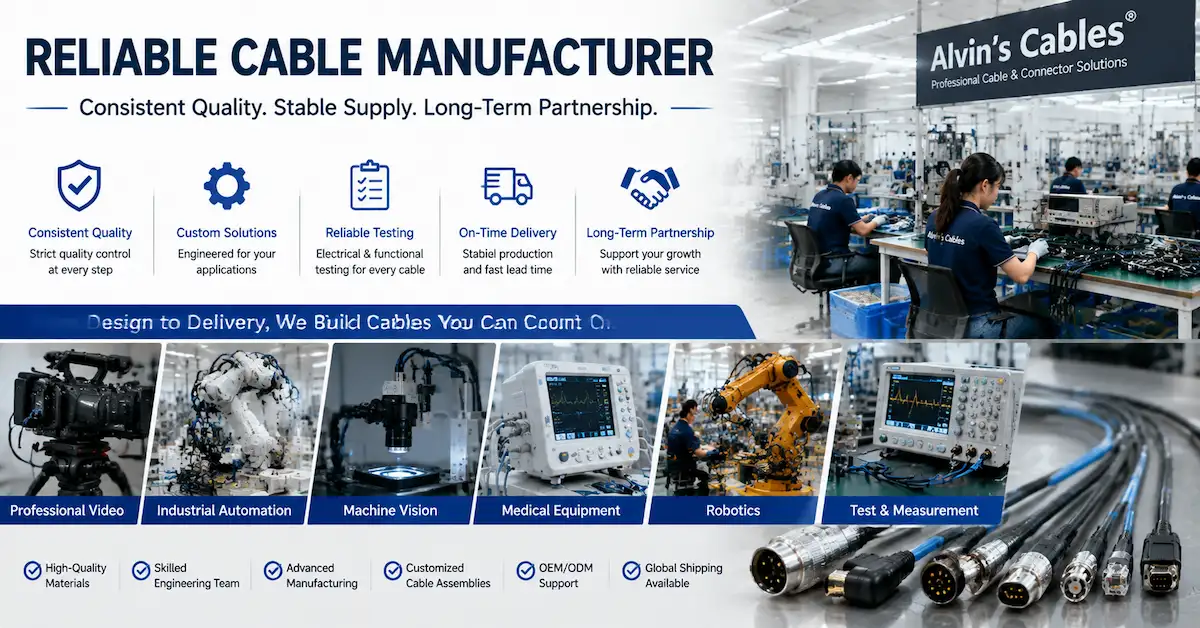
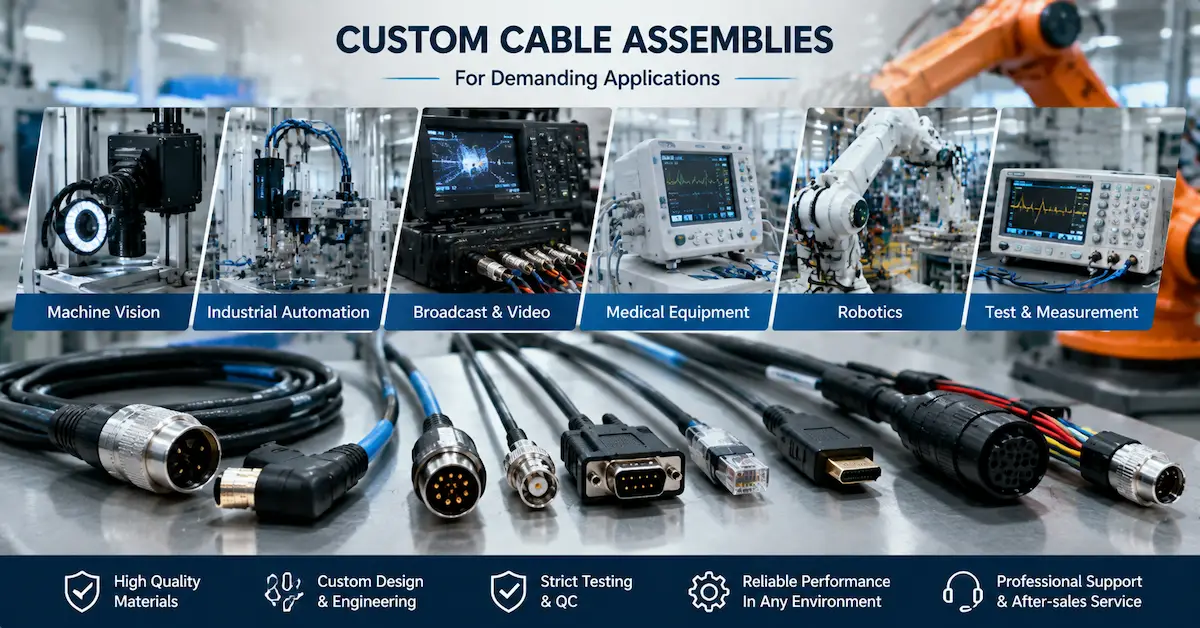
Alvin’s Cables provides custom cable assemblies designed for industrial automation, professional video systems, machine vision, robotics, medical equipment, test instruments, and OEM electronics.
Capabilities include:
- High-quality cable assemblies
- Custom cable development
- Signal and power cable solutions
- Shielded cable structures
- Flexible and rugged cable designs
- Cable harness production
- M8, M12, Hirose, RJ45, BNC, SDI, HDMI, D-TAP, XLR, and custom connectors
- Prototype development
- Electrical and functional testing
- OEM labeling and packaging
Buyers can explore available products through Alvin’s Cables Products, learn about manufacturing capabilities through About Alvin’s Cables, and review service advantages through Why Choose Alvin’s Cables.
FAQ
1. What factors determine cable quality?
Cable quality depends on materials, structure, connectors, shielding, manufacturing processes, and testing standards.
2. Are expensive cables always better?
Not always. The best cable is the one that matches the application requirements.
3. Why is shielding important?
Shielding reduces electromagnetic interference and improves signal reliability.
4. How can buyers compare cable quality?
Compare materials, construction, testing, application suitability, and supplier manufacturing capability.
5. Why are connectors important?
Connectors affect connection reliability, signal performance, and service life.
6. What testing should quality cables receive?
Testing may include continuity, short circuit, pinout, polarity, and functional testing.
7. Can cable quality be customized?
Yes. Cable materials, connectors, shielding, length, and structure can be customized.
8. How do I select a high-quality cable supplier?
Evaluate engineering ability, manufacturing control, testing capability, and repeat production experience.
Conclusion
A complete cable quality comparison helps buyers make better purchasing decisions by evaluating materials, construction, testing, and application requirements.
High-quality cables are not defined only by price or appearance. They are built through proper engineering, reliable materials, controlled manufacturing, and consistent testing.
For OEM and industrial cable requirements, work with Alvin’s Cables to develop reliable cable solutions based on your application needs.