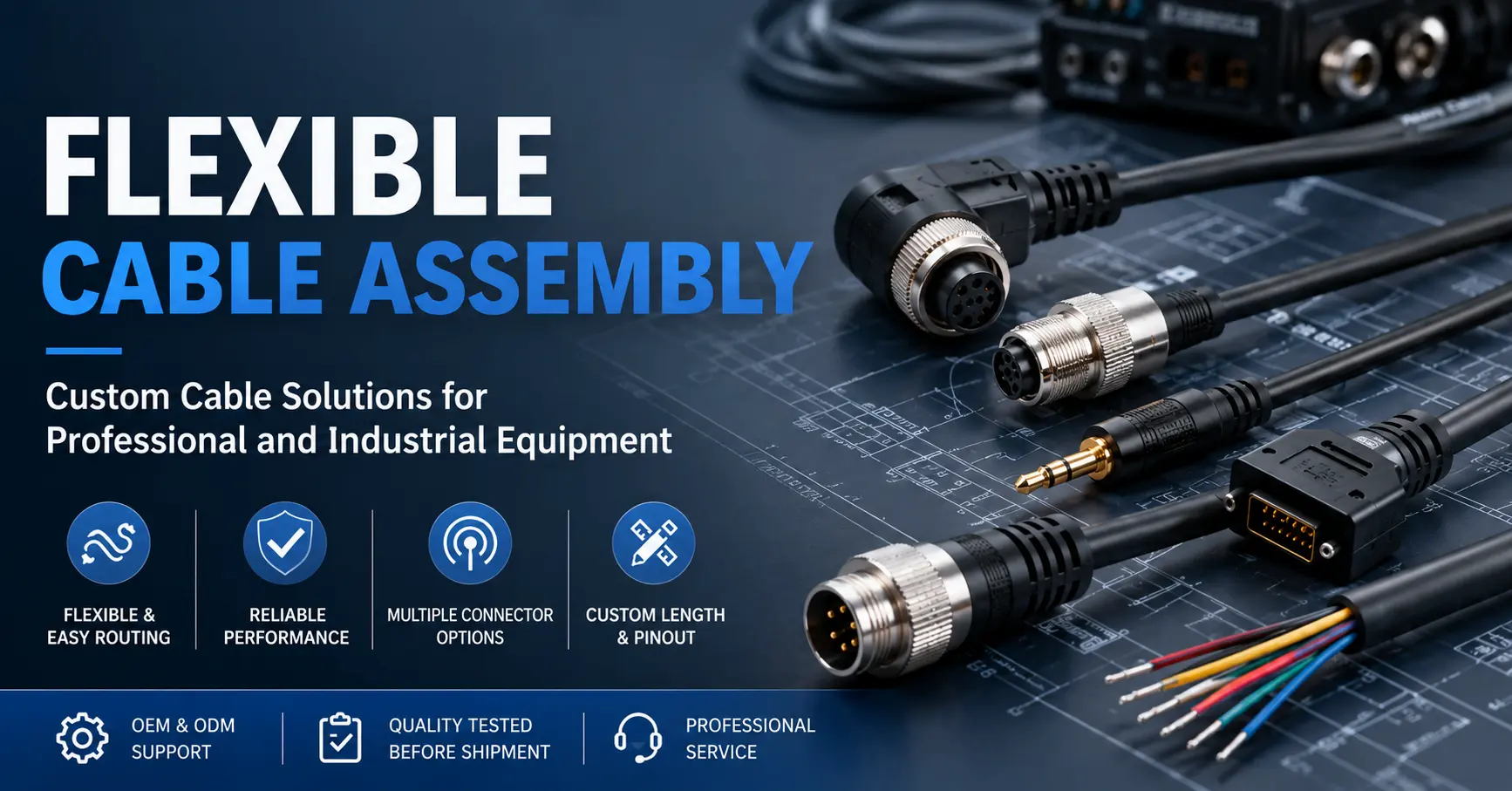
When sourcing cable products for industrial equipment, professional electronics, or OEM applications, buyers often search for top cable manufacturers that can provide reliable quality, technical support, and stable production.
However, identifying a leading cable manufacturer requires more than checking factory size or product catalogs. A strong manufacturer should have the ability to understand application requirements, develop customized cable assemblies, control production quality, manage supply chains, and support long-term cooperation.
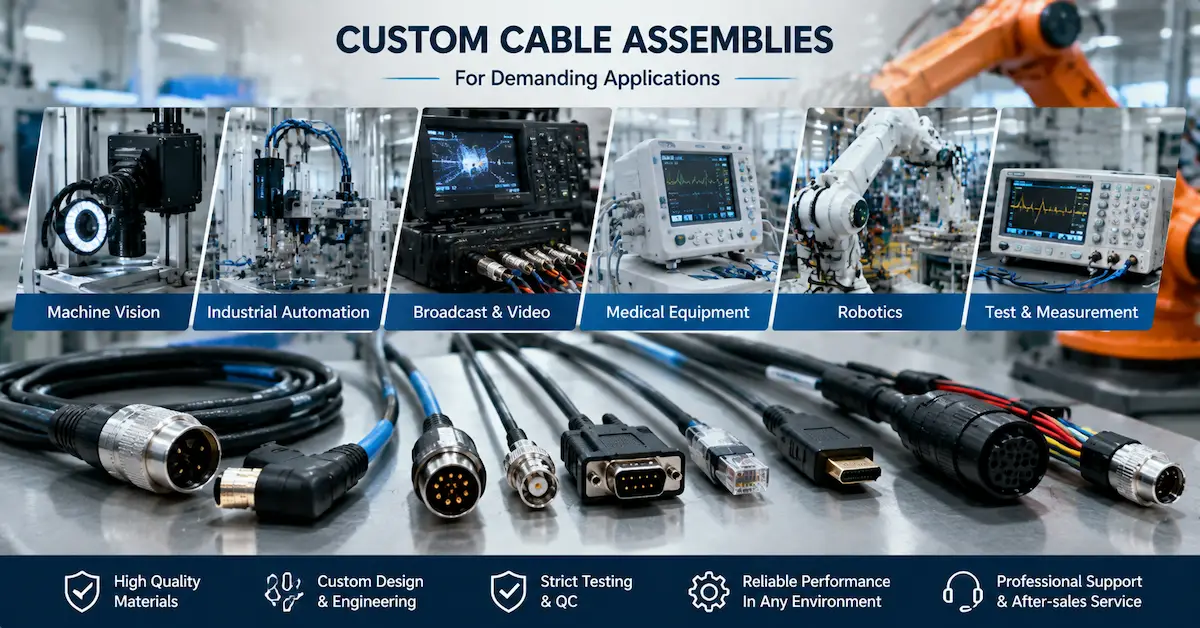
For industries such as automation, robotics, machine vision, professional video, medical equipment, and testing systems, cable performance directly affects the reliability of the final product.
The right cable manufacturer becomes a technical partner rather than only a supplier.
What Defines a Top Cable Manufacturer?
A top cable manufacturer typically combines several important capabilities:
- Strong engineering support
- Advanced production processes
- Reliable material management
- Custom cable development
- Strict quality control
- Professional testing
- Stable delivery capability
- OEM cooperation experience
Production scale alone does not determine manufacturing quality. A smaller specialized manufacturer with strong engineering capability may provide better solutions for complex custom projects.
Why Choosing the Right Cable Manufacturer Matters
1. Cable Quality Affects Equipment Performance
Cables may appear simple, but their internal structure determines:
- Signal stability
- Power delivery
- Data transmission
- Mechanical durability
- Service life
Poor cable quality may result in:
- Signal interruption
- Power failure
- Equipment downtime
- Maintenance costs
- Customer complaints
A professional manufacturer controls the entire production process to maintain consistency.
2. Customization Capability Is Essential
Many industrial and OEM applications cannot use standard cables.
A capable manufacturer should support:
- Custom cable length
- Custom connectors
- Special pinouts
- Shielding requirements
- Cable harness design
- Overmolding
- Labeling
- OEM packaging
Customization allows buyers to create cables that fit their equipment perfectly.
3. Stable Supply Supports Long-Term Production
OEM buyers need manufacturers that can maintain the same specifications across repeated orders.
Important capabilities include:
- Drawing control
- Material tracking
- Production records
- Approved samples
- Testing standards
- Revision management
Stable supply reduces production risks and unexpected changes.
Industries Served by Leading Cable Manufacturers
| Industry | Typical Cable Requirement | Key Performance Factor |
|---|---|---|
| Industrial automation | Sensor, control, and power cables | Reliability |
| Robotics | Flexible cable assemblies | Bend resistance |
| Machine vision | Camera and data cables | Signal integrity |
| Professional video | SDI, HDMI, BNC cables | Transmission quality |
| Medical equipment | Precision cable assemblies | Consistency |
| Test equipment | Signal cables | Accuracy |
| OEM electronics | Custom wiring systems | Integration |
| Industrial machinery | Rugged cable assemblies | Durability |
Common Products From Top Cable Manufacturers
Custom Cable Assemblies
Used for:
- Industrial equipment
- OEM products
- Electronic systems
- Professional devices
Features:
- Custom connectors
- Specific wiring
- Application-based design
Cable Harnesses
Used for:
- Machines
- Control cabinets
- Robotics
Benefits:
- Organized wiring
- Faster installation
- Reduced assembly errors
Signal and Data Cables
Used for:
- Cameras
- Sensors
- Communication systems
Requirements:
- Stable transmission
- EMI protection
- Accurate impedance control
Power Cable Assemblies
Used for:
- Machinery
- Cameras
- Battery systems
Requirements:
- Correct current capacity
- Reliable connectors
- Safety performance
How to Evaluate Top Cable Manufacturers
1. Engineering Capability
A professional manufacturer should support:
- Technical review
- Connector selection
- Cable structure recommendation
- Pinout confirmation
- Prototype development
Engineering support helps prevent design problems before production.
2. Production Capability
Evaluate:
- Assembly processes
- Manufacturing equipment
- Production capacity
- Skilled workers
- Process control
A reliable factory should support both prototype development and repeat production.
3. Quality Control System
Quality control should include:
Incoming Inspection
Checking:
- Cable materials
- Connectors
- Components
- Labels
Production Inspection
Monitoring:
- Crimping
- Soldering
- Wiring
- Assembly
Final Testing
Testing may include:
- Continuity
- Short circuit
- Pinout
- Polarity
- Functional testing
4. Custom Development Experience
Leading manufacturers should have experience with:
- Different connector brands
- Complex wiring
- Multi-function cables
- Special applications
- OEM requirements
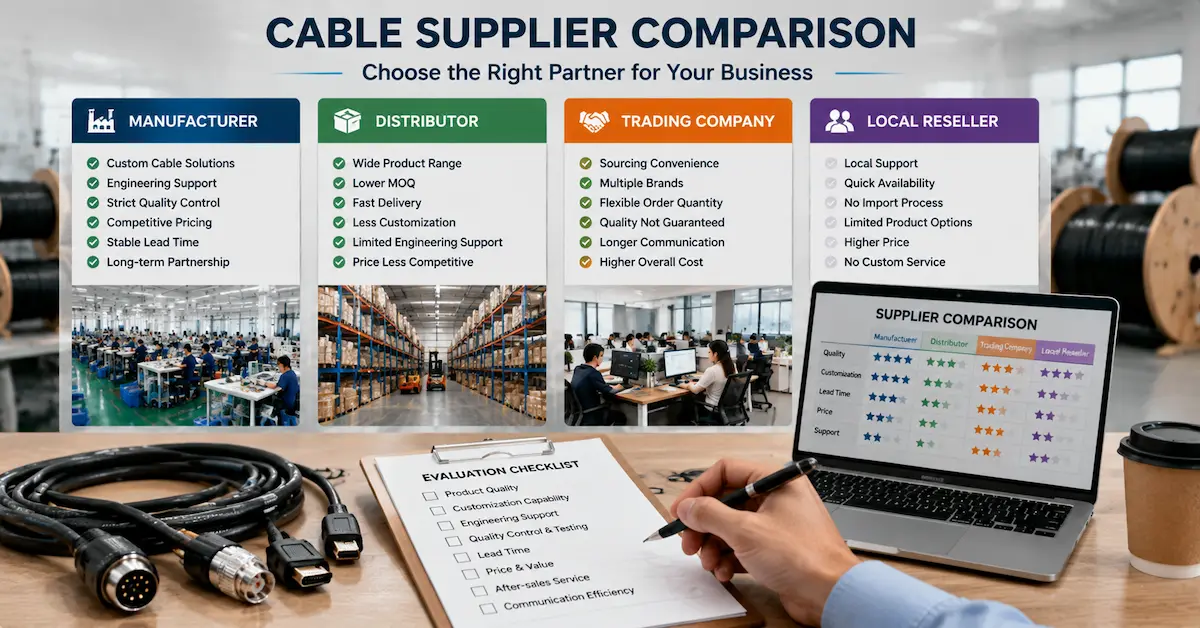
Cable Manufacturer vs Cable Trading Company
| Supplier Type | Advantages | Limitations | Best For |
| Trading company | Easy sourcing | Limited production control | Standard products |
| Distributor | Wide product range | Less customization | Common cables |
| Cable factory | Direct production | Requires technical communication | OEM projects |
| Custom cable manufacturer | Engineering and manufacturing support | More development involvement | Complex applications |
For customized projects, working directly with a manufacturer usually provides better control over quality and specifications.
Questions to Ask Before Choosing a Cable Manufacturer
Before cooperation, buyers should ask:
Technical Questions
- Can you manufacture according to drawings?
- Can you support custom connectors?
- Can you provide samples?
- Can you manage pinout revisions?
- Can you recommend suitable cable structures?
Quality Questions
- What tests are performed?
- Are inspection records available?
- How are materials controlled?
- How are product changes managed?
Production Questions
- What is the MOQ?
- What is the production lead time?
- Can you support repeat orders?
- Can you provide OEM packaging?
Common Mistakes When Selecting Cable Manufacturers
Choosing Only Based on Price
Low price may result in:
- Lower-grade materials
- Poor connectors
- Limited testing
- Inconsistent production
Ignoring Engineering Support
Without technical support, problems may appear during installation or mass production.
Skipping Sample Validation
Samples help confirm:
- Connector fit
- Cable length
- Wiring accuracy
- Equipment compatibility
Not Considering Future Supply
A manufacturer should support long-term production, not only the first order.
What Information Should Buyers Provide?
For selecting a cable manufacturer, prepare:
- Application details
- Cable type
- Connector requirements
- Wiring diagram
- Cable length
- Signal or power requirements
- Operating environment
- Quantity
- Annual demand forecast
- Drawings or samples
Why Choose Alvin’s Cables as Your Cable Manufacturer?
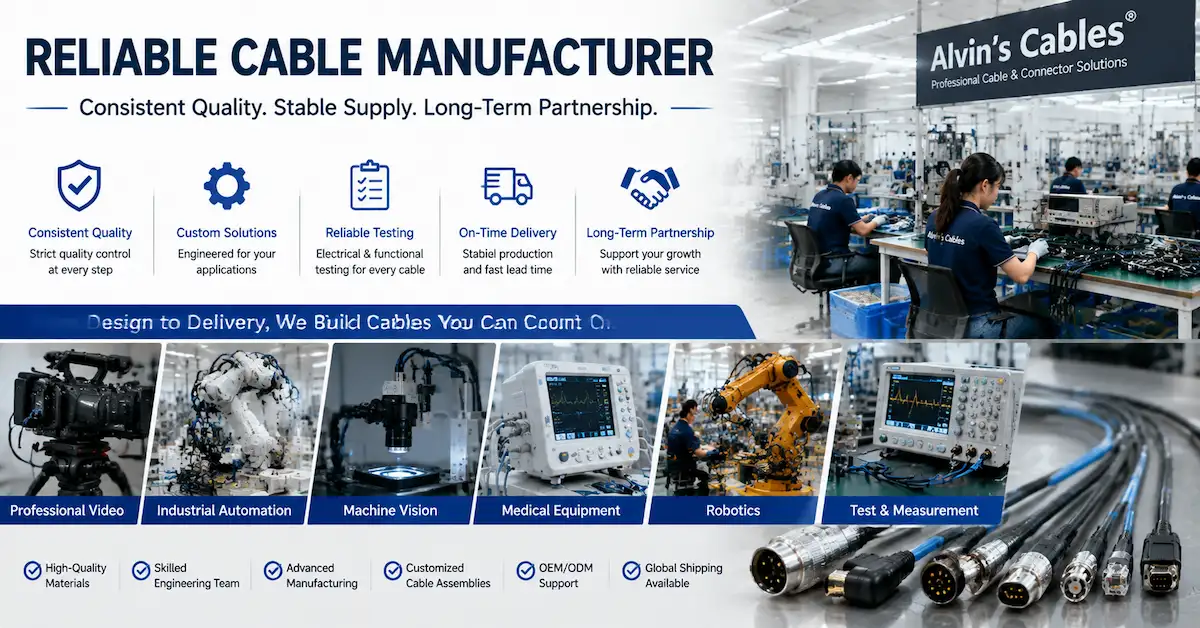
Alvin’s Cables provides custom cable assemblies and connector solutions for industrial automation, professional video systems, machine vision, robotics, medical equipment, test instruments, and OEM electronics.
Manufacturing capabilities include:
- Custom cable assembly development
- Industrial cable solutions
- Video and signal cables
- Power cable assemblies
- Cable harness solutions
- M8, M12, Hirose, RJ45, BNC, SDI, HDMI, D-TAP, XLR, and custom connectors
- Shielded and flexible cable designs
- Prototype production
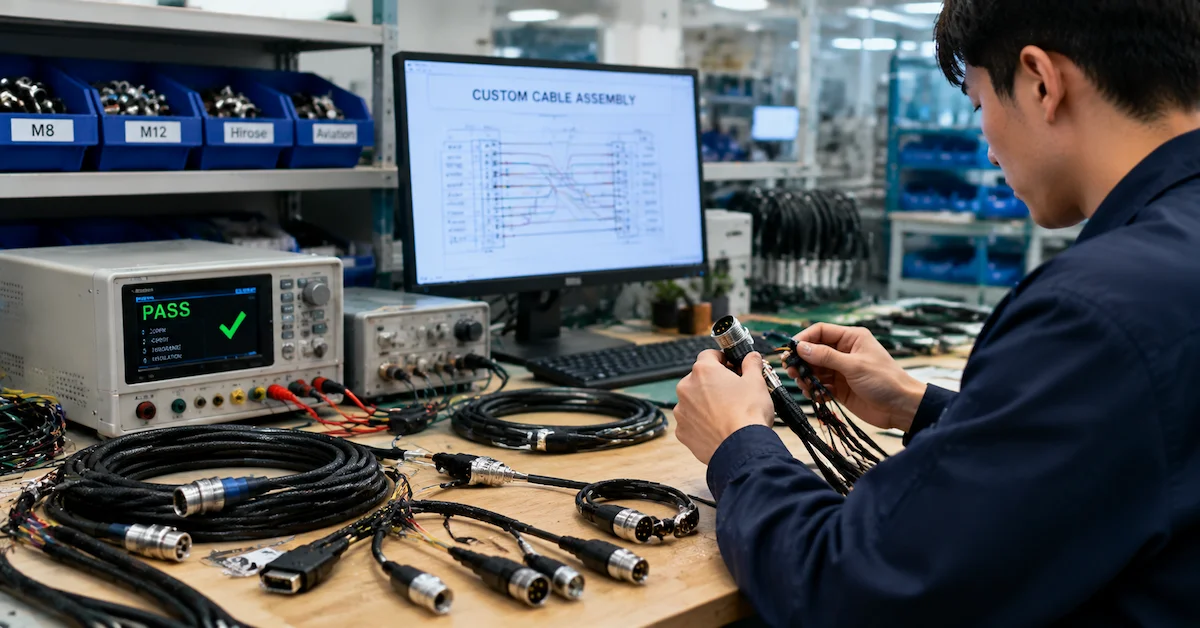
- Electrical and functional testing
- OEM labeling and packaging
Buyers can explore available products through Alvin’s Cables Products, learn more about manufacturing capability through About Alvin’s Cables, and review service advantages through Why Choose Alvin’s Cables.
FAQ
1. What makes a cable manufacturer a top supplier?
A top cable manufacturer combines engineering capability, quality control, customization support, reliable production, and long-term supply capability.
2. Are large cable factories always better?
Not always. The best supplier depends on the project requirements, technical complexity, and required support.
3. Can top cable manufacturers produce custom cables?
Yes. Professional manufacturers can customize connectors, wiring, lengths, shielding, structures, and packaging.
4. What industries need custom cable manufacturers?
Industries include automation, robotics, machine vision, medical equipment, professional video, and OEM electronics.
5. How do I compare cable manufacturers?
Compare engineering support, materials, testing, customization ability, production consistency, and delivery capability.
6. Why are samples important?
Samples verify cable performance, equipment compatibility, wiring accuracy, and installation requirements.
7. Can cable manufacturers support OEM production?
Yes. Many custom manufacturers support prototypes, repeat production, labeling, and packaging.
8. What information is needed for a quotation?
Provide application details, drawings, connector information, specifications, quantity, and testing requirements.
Conclusion
Selecting from the top cable manufacturers requires evaluating more than factory size or price. The right partner should provide engineering support, reliable production, quality testing, customization capability, and long-term supply stability.
For OEM and industrial applications, a professional cable manufacturer helps reduce development risks and improve equipment reliability.
Contact Alvin’s Cables with your cable requirements, drawings, samples, and project details to develop a reliable custom cable solution.